
VT-10 Primary INAV Ground School Instrument 3 Practice Test
$69.00
- Buy to unlock unlimited access to all Quiz questions and Answers in this Quiz.
- After purchase you can print a PDF of the whole quiz at any point. The PDF will contain the questions and the correct answers.
About this Exam
The VT-10 Primary INAV Ground School Instrument 3 exam is a critical theoretical milestone for student aviators and Naval Flight Officers (NFOs) within the United States military training pipeline, specifically at Training Squadron Ten (VT-10).
This phase of ground school focuses on advanced instrument navigation (INAV) principles required to transition from flying by visual references to operating solely by reference to cockpit instruments.
This exam is designed for military flight students who have mastered basic flight dynamics and are now mastering the procedures for complex, all-weather terminal environments and en route navigation.
Ready to test your knowledge?
Buy Now to Access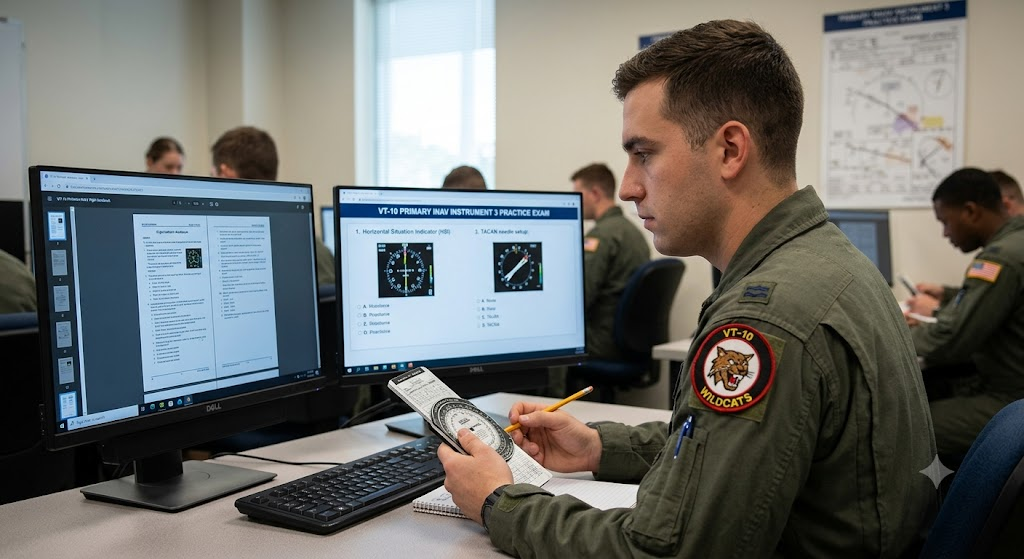
Additional Information
What the Course Entails and Exam Details
The Instrument 3 syllabus builds upon basic instrument familiarity to teach complex situational awareness and procedural adherence.
The primary focus is on utilizing standard navigation aids (NAVAIDs) such as VOR, TACAN, NDB, and GPS to perform precise maneuvers without external visual cues.
Core topics covered in the course include interpreting Horizontal Situation Indicators (HSI) and Radio Magnetic Indicators (RMI), mastering holding patterns (entries, timing, and wind correction), and executing standard arrival and departure procedures.
Furthermore, students learn how to apply regulations regarding weather minimums, alternate airport requirements, and instrument flight rules (IFR) en route charting.
What to Expect in the Final Exam
While this particular practice test prepares you for the challenge, the official VT-10 Instrument 3 final exam is a rigorous assessment of theoretical knowledge.
You should expect a computer-based, multiple-choice format containing numerous scenario-based questions that require you to "fly the desk."
You will be presented with cockpit instrument readouts and must deduce the aircraft’s position relative to a NAVAID, determine the correct holding entry, or calculate an intercept heading.
The passing score for military aviation ground school exams is high, typically 80% or greater, reflecting the precision required in actual flight operations.
The exam is time-limited, requiring students to synthesize information quickly and accurately, mirroring the cognitive load of a real instrument approach.
How to Study and Exam Centers
The key to success in Instrument 3 is the ability to visualize the aircraft's position from 2D data; rote memorization will not suffice for the scenario questions.
Start your preparation by thoroughly reviewing the official NATOPS manuals, specific VT-10 workbooks, and Air Information Manual (AIM) sections regarding IFR operations.
Utilize flashcards for defining IFR terminology, weather minimums, and holding pattern rules.
The most effective strategy is the repeated use of practice tests, such as this one, to familiarize yourself with the question logic and improve your interpretation speed.
Mental modeling of HSI/RMI needles and using simulator software to fly procedures can significantly bolster your situational awareness.
Regarding logistics, official VT-10 academics exams are administered in authorized military academic centers, usually located within the training squadron’s academics building or the Naval Aviation Schools Command (NASC) facility at NAS Pensacola.
Job Opportunities from the Course
Mastering INAV Instrument theory at the Primary level is a prerequisite to advanced flight training and eventually earning your wings. Success in this course unlocks the following specialized career paths within military and eventually civilian aviation:
United States Navy Pilot
United States Marine Corps Pilot
United States Coast Guard Pilot
Naval Flight Officer (NFO)
Weapons Systems Officer (WSO)
Electronic Warfare Officer (EWO)
Military Flight Instructor
Commercial Airline Pilot (upon separation from military service)
Test Pilot (with further qualification)
Frequently Asked Questions
Reviews
5.0
Based on 0 reviews
Leave a Review
No reviews yet. Be the first to review!