
Wake County Certified Pool Operator (CPO) Practice Test
$69.00
- Buy to unlock unlimited access to all Quiz questions and Answers in this Quiz.
- After purchase you can print a PDF of the whole quiz at any point. The PDF will contain the questions and the correct answers.
About this Exam
The Wake County Certified Pool Operator (CPO) designation is a vital credential for individuals responsible for the management and operation of public and commercial swimming pools and spas within Wake County, North Carolina.
This certification is designed to ensure that pool operators possess the essential knowledge, techniques, and skills required to maintain safe and healthy aquatic environments.
It is specifically tailored for aquatic facility managers, pool service technicians, environmental health officials, property managers (such as those overseeing HOAs or apartment complexes), and hotel engineering staff.
Preparing with a dedicated practice exam is an excellent way to gauge your readiness and identify areas where further study is needed before sitting for the official certification.
Ready to test your knowledge?
Buy Now to Access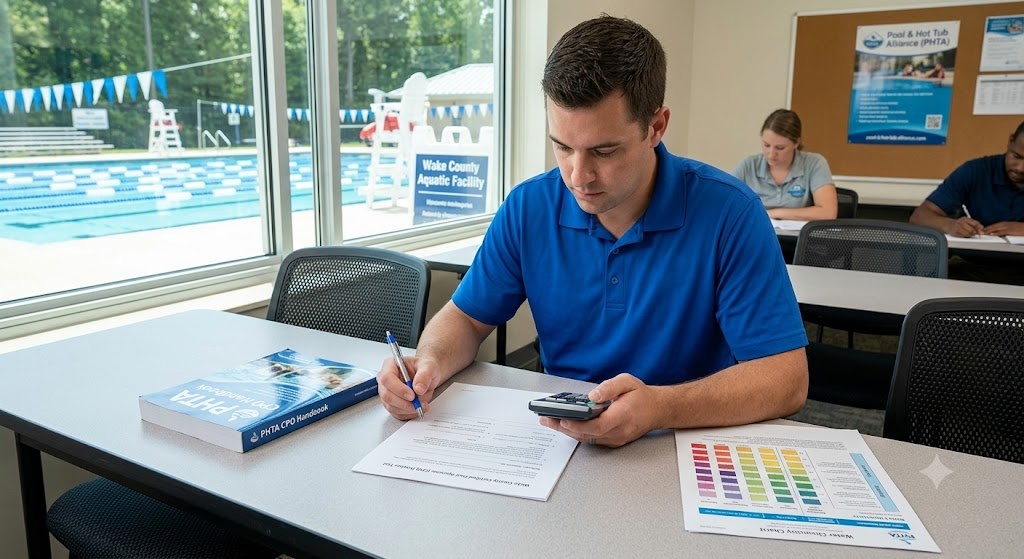
Additional Information
What the Course Entails and Exam Details
The comprehensive CPO course provides a deep dive into the technical aspects of pool and spa management, ensuring operators comply with stringent health regulations.
The core curriculum typically covers essential topics such as water chemistry and testing procedures, disinfection methods using chemicals like chlorine and bromine, and the physics of circulation, filtration, and recirculation systems.
Participants also study water problems, basic facility safety protocols, risk management, and seasonal pool maintenance routines.
Crucially, the course includes specific modules on local Wake County environmental health regulations and relevant North Carolina state codes.
Mastering mathematical calculations relevant to pool volume, flow rates, and chemical dosing is a critical component of the curriculum.
The associated exam strictly assesses knowledge based on the official Pool & Hot Tub Alliance (PHTA) training materials and local health ordinances.
What to Expect in the Final Exam
The final Certified Pool Operator examination is designed to be a comprehensive assessment of your understanding of aquatic facility management.
Candidates should expect a multiple-choice format covering all aspects of the CPO course syllabus.
The exam generally consists of approximately 50 standard questions.
The exam is traditionally an open-book test, allowing students to utilize their official PHTA Pool/Spa Operator Handbook for reference during the testing period.
Candidates are typically allocated between two to three hours to complete the examination.
To achieve certification, a passing score of at least 75% is usually required.
While the use of the handbook is permitted, the time constraints make a thorough understanding of the material and quick navigation of the manual essential for success.
How to Study and Exam Centers
Effective preparation for the Wake County CPO exam requires a strategic blend of studying theoretical knowledge and practical application.
The first step is to thoroughly read the official PHTA Handbook, focusing heavily on understanding water chemistry calculations and filtration operations.
Utilizing the Wake County CPO Practice Exam is vital for familiarizing yourself with the types of questions asked and practicing your mathematical application under simulated exam conditions.
Create flashcards for critical chemical formulas and local regulatory standards.
The standard CPO course and subsequent exam are administered by authorized instructors certified by the Pool & Hot Tub Alliance.
In the Wake County area, these courses are frequently offered by local swimming pool service companies, community colleges, or professional training organizations.
Many providers offer a blended learning format, allowing you to complete online coursework followed by a mandatory in-person classroom session and review prior to the exam.
Ensure you register with an approved provider that specifically covers the regulatory requirements relevant to North Carolina and Wake County.
Job Opportunities from the Course
Earning your Certified Pool Operator certification opens a variety of career paths within the aquatics, hospitality, and recreation industries throughout Wake County and beyond.
Potential job opportunities and career paths unlocked by this certification include:
Aquatic Facility Manager
Public Swimming Pool Operator (City or County Recreation Departments)
Commercial Pool Service Technician
Hotel Chief Engineer or Maintenance Supervisor (overseeing pools and spas)
Waterpark Operations Manager
Property Management Maintenance Supervisor (HOAs and Apartment Complexes)
Country Club or Health Club Aquatics Director
Environmental Health Specialist (Pool Inspector)
Frequently Asked Questions
Reviews
5.0
Based on 0 reviews
Leave a Review
No reviews yet. Be the first to review!