
Wall Street Redbook Practice Test
$69.00
- Buy to unlock unlimited access to all Quiz questions and Answers in this Quiz.
- After purchase you can print a PDF of the whole quiz at any point. The PDF will contain the questions and the correct answers.
About this Exam
The Wall Street Redbook Practice Test is a comprehensive mastery assessment designed to simulate the rigorous technical evaluation often encountered during recruiting for elite finance roles. Based on the industry’s gold-standard technical interview guide, known informally as "The Red Book," this exam evaluates a candidate’s depth of knowledge in core financial concepts essential for success in investment banking, private equity, and corporate finance.
This practice test is designed for undergraduate and graduate students, career changers, and early-career professionals seeking to validate their technical competency. It provides a crucial benchmark for identifying knowledge gaps before facing high-stakes interviews at major financial institutions.
Ready to test your knowledge?
Buy Now to Access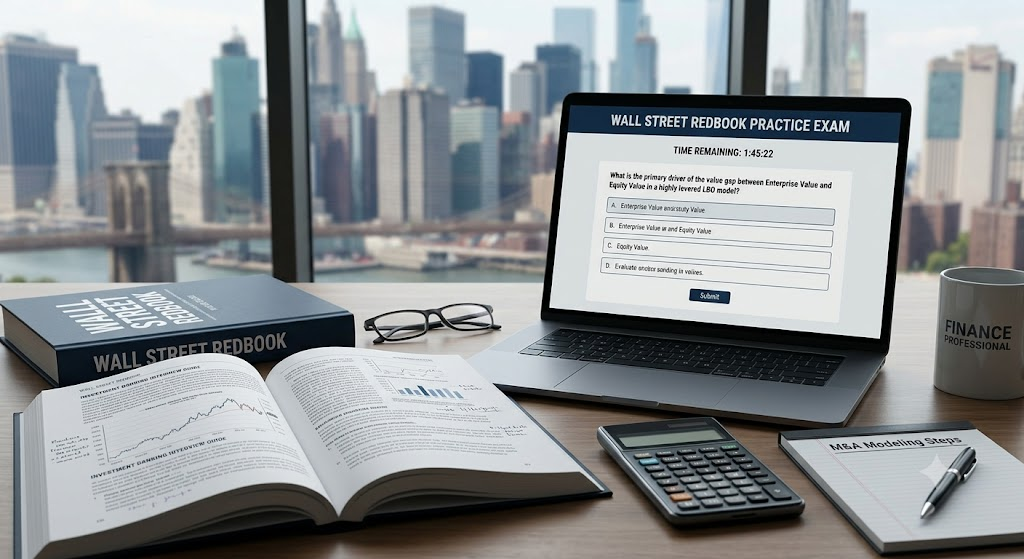
Additional Information
What the Course Entails and Exam Details
To prepare for this practice exam, candidates must master a detailed syllabus covering foundational and advanced financial theory and application. The underlying material is centered on the practical, "on-the-job" technical skills used by working professionals on Wall Street.
Key core topics covered include:
Accounting and Financial Statement Analysis: Mastering the mechanics of the Income Statement, Balance Sheet, and Cash Flow Statement, with an emphasis on how they link together.
Valuation Methodologies: In-depth application of Discounted Cash Flow (DCF) analysis, Trading Comparables (Comps), and Precedent Transactions.
M&A and LBO Modeling Concepts: Understanding the drivers of accretion and dilution, synergy calculation, and the mechanics of Leveraged Buyouts and Internal Rate of Return (IRR).
Capital Markets and Financial Instruments: Knowledge of different debt and equity structures and their cost of capital implications.
Regulatory Frameworks and Ethics: Core understanding of financial laws and ethical standards in professional finance.
What to Expect in the Final Exam
While the exact structure can vary depending on the provider of the final assessment, a comprehensive Wall Street Redbook practice test is typically designed to be a high-intensity, time-constrained environment.
Candidates can generally expect a computer-based final exam with the following parameters:
Format: Primarily multiple-choice questions designed to test both theoretical knowledge and practical application of complex concepts. Some advanced versions may include short-form case study scenarios or modeling components.
Number of Questions: A standard comprehensive exam often consists of 100 questions.
Time Limit: Approximately 120 minutes (2 hours). This demands swift decision-making and strong time management.
Passing Score: While practice tests define their own benchmarks, demonstrating technical mastery equivalent to "Red Book" readiness typically requires a score of 70% to 80% or higher.
Rules: The exam is closed-book. Use of advanced calculators or external resources is generally prohibited to mimic true assessment conditions.
How to Study and Exam Centers
Effective preparation for the Wall Street Redbook Practice Test requires a structured, multi-phase study strategy that emphasizes deep conceptual understanding over simple memorization.
Actionable Study Strategies:
Master the Concepts First: Do not rely on rote memory. Ensure you thoroughly understand why the three financial statements link the way they do or how changing a driver affects an LBO model’s output.
Use Active Learning: When working through "The Red Book" questions, attempt to answer them without looking at the solutions first. Create detailed flashcards for key definitions and formulas.
Take Multiple Mock Exams: Simulate test-day conditions by taking timed practice tests. Analyze your results meticulously to identify and strengthen your weak areas.
Target Your Weaknesses: If you consistently struggle with the mechanics of a DCF or accounting for leases, dedicate focused study time to those specific domains.
Form a Study Group: Discussing complex concepts with peers can deepen your understanding and expose you to different problem-solving methods.
Exam Centers and Access: As a practice and mastery tool, the Wall Street Redbook Practice Test is typically accessed online through specialized financial training platforms, self-study portals, or as an internal benchmark within career centers of universities and financial institutions. It is not generally taken at physical test centers like Pearson VUE or Prometric. Candidates can take the exam remotely from any computer with an internet connection, subject to the integrity and proctoring rules of the specific provider.
Job Opportunities from the Course
A strong performance on this practice test provides tangible evidence of technical competency that is highly sought after by recruiters and hiring managers at major investment banks, private equity funds, and other financial institutions. Validating this level of expertise is a critical step towards securing highly competitive roles.
Career paths unlocked and strengthened by mastering this material include:
Investment Banking Analyst / Associate
Private Equity Analyst / Associate
Equity Research Analyst
Corporate Development Associate
Financial Analyst (Corporate Finance)
Hedge Fund Analyst
Commercial Banking Analyst
Venture Capital Associate
By prioritizing this study guide and committing to a rigorous preparation plan, students can approach the Wall Street Redbook Practice Test with confidence, demonstrating the technical acumen required to launch a successful career in high finance.
Frequently Asked Questions
Reviews
5.0
Based on 0 reviews
Leave a Review
No reviews yet. Be the first to review!