
Warrant Officer Basic Course (WOBC) Communications Equipment I Practice Test
$69.00
- Buy to unlock unlimited access to all Quiz questions and Answers in this Quiz.
- After purchase you can print a PDF of the whole quiz at any point. The PDF will contain the questions and the correct answers.
About this Exam
The Warrant Officer Basic Course (WOBC) Communications Equipment I phase is the foundational technical hurdle for newly appointed Army Signal Warrant Officers. This rigorous course certifies your baseline proficiency in the essential tactical communication systems that define the modern battlefield.
It is designed exclusively for newly commissioned Warrant Officers (WO1) entering the Signal Corps, typically coming from enlisted backgrounds in information systems or signal operations. Mastering this content is crucial, as it validates your transition from a technician to a technical leader and advisor. This practice exam is your essential tool to self-assess your readiness before facing the high-stakes official evaluation.
Ready to test your knowledge?
Buy Now to Access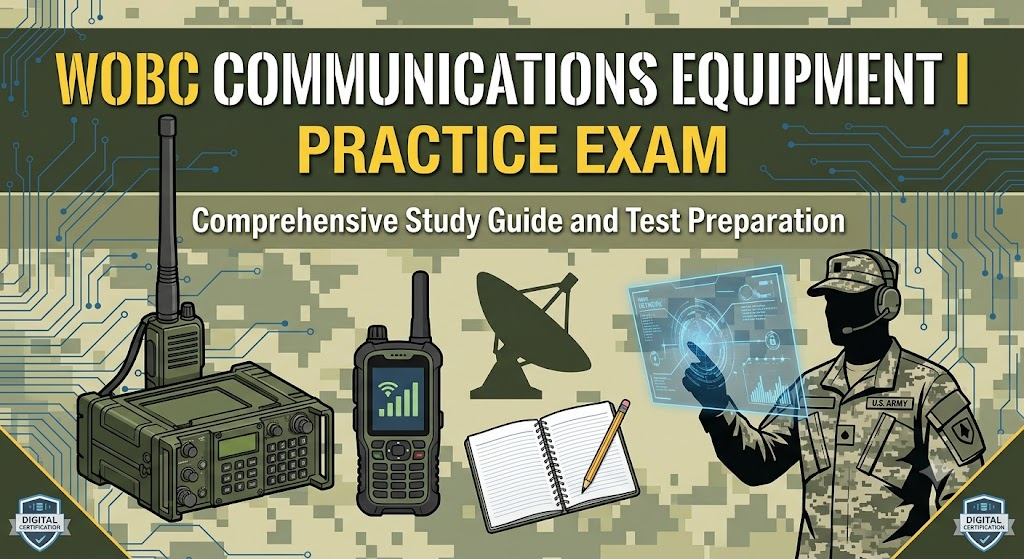
Additional Information
What the Course Entails and Exam Details
This segment of WOBC focuses on the theoretical knowledge and practical operation of foundational tactical hardware. It moves beyond basic user knowledge to deep technical understanding. The core topics covered in this course, and therefore tested on the practice exam, include:
Tactical Radio Systems: Deep diving into the operation, configuration, and advanced troubleshooting of core Army systems, including SINCGARS (Single Channel Ground and Airborne Radio System), ASIP (Advanced SINCGARS SIP), and various HF, VHF, and UHF tactical radios.
Communications Security (COMSEC): Mastering the principles of secure communication, including key management, loading devices (like the SKL), handling procedures, and the regulatory environment governing classified equipment.
Signal Operation Instructions (SOI): Interpreting, creating, and implementing complex SOI data, which includes managing call signs, frequencies, and communication protocols within a larger operational network.
Antenna Theory and Propagation: Understanding wave propagation across different frequency bands and mastering the deployment of standard and field-expedient antennas to optimize communication range and reliability.
What to Expect in the Final Exam
The actual WOBC Communications Equipment I final evaluation is a comprehensive test of your technical competence. It is designed to simulate the time constraints and high-pressure environment of operational planning and troubleshooting. You must be prepared for two distinct components:
Written Knowledge Evaluation: This is a rigorous, timed examination typically consisting of complex multiple-choice, matching, and short-answer questions. It will test your recall of technical specifications, regulatory procedures (specifically COMSEC), and theoretical principles of radio operation.
Hands-On Practical Evaluation: This is the most critical phase. You will be given a series of tasks where you must demonstrate your ability to configure, operate, and troubleshoot specific communication equipment. This may include loading COMSEC, establishing a radio link under adverse conditions, or correctly constructing a field-expedient antenna within strict time limits.
Passing Score Requirements: To pass this course phase, you must typically achieve a minimum score of 80% (or higher depending on the current proponent guidance) on both the written and practical components. The standards are high; proficiency is non-negotiable.
How to Study and Exam Centers
Preparation for this exam demands a combination of academic study and physical practice. Because this is a specialty military course, your study methods must be tailored.
Effective Study Strategies:
Master the Technical Manuals (TMs): The TMs are your primary source of truth. Your strategy should move beyond skimming to memorizing key specs, programming sequences, and basic troubleshooting trees.
Get Hands-On Time: There is no substitute for muscle memory. Use every available minute in the schoolhouse labs to physically practice configuring the gear, especially loading COMSEC and establishing links.
Simulate Exam Conditions: Take practice exams like this one under strict time limits and without your notes. This is the only way to honestly assess your speed and recall ability.
Focus on the ‘Why’: Don't just memorize the sequence to turn on a radio. Understand the underlying theory, such as frequency hopping logic or antenna polarity, so you can adapt when equipment fails.
Exam Centers:
The Warrant Officer Basic Course, including the official Communications Equipment I final exam, is administered exclusively at the U.S. Army Signal School, Fort Eisenhower (formerly Fort Gordon), Georgia.
There are no online testing options or third-party testing centers (like Pearson VUE) for this initial military certification. You must successfully complete this exam as a resident student in the WOBC course to remain in the Signal Corps.
Job Opportunities from the Course
Successfully completing WOBC and mastering this technical foundation is the gateway to a rewarding career as a technical expert and leader in the Army Signal Corps. This certification validates your skill set and unlocks specific, high-responsibility Warrant Officer Military Occupational Specialty (WOMOS) paths, including:
Network Operations Technician (MOS 255N)
Information Systems Technician (MOS 255A)
Cybersecurity Technician (MOS 255S)
Tactical Communications Planner
Signal Company Technical Advisor
Battalion S-6 Technical Officer
Frequently Asked Questions
Reviews
5.0
Based on 0 reviews
Leave a Review
No reviews yet. Be the first to review!