
Washington Comprehensive Assessment of Science (WCAS) Practice Test
$69.00
- Buy to unlock unlimited access to all Quiz questions and Answers in this Quiz.
- After purchase you can print a PDF of the whole quiz at any point. The PDF will contain the questions and the correct answers.
About this Exam
The Washington Comprehensive Assessment of Science, commonly known as the WCAS, is a crucial state-mandated examination designed to measure student proficiency in science.
It is not designed for professionals seeking certification; rather, it is taken by all students in Washington public schools at three key educational milestones: grade 5, grade 8, and grade 11.
This assessment ensures that students are developing the essential scientific literacy, critical thinking, and problem-solving skills needed to succeed in their academic journey and beyond.
It provides valuable feedback to students, parents, and educators about progress toward meeting the state's rigorous learning standards.
Ready to test your knowledge?
Buy Now to Access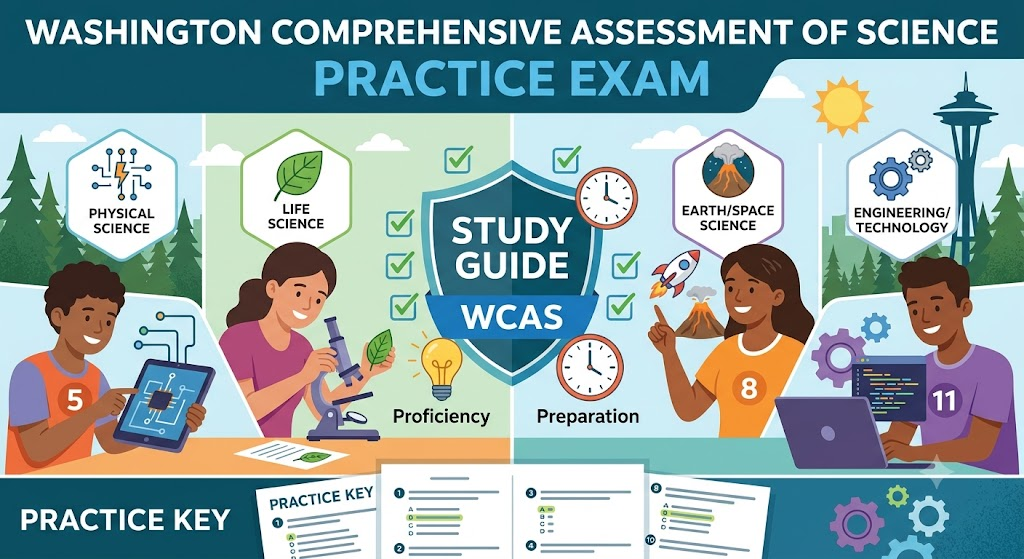
Additional Information
What the Course Entails and Exam Details
The WCAS is strictly aligned with the Washington State Science and Learning Standards (WSSLS), which are based on the Next Generation Science Standards (NGSS).
This means the assessment does not just test your ability to memorize facts; it tests how you apply scientific principles to real-world scenarios.
You will be tested on four major domains of science: Physical Science, Life Science, Earth and Space Science, and Engineering, Technology and Science Application.
A key aspect of the WCAS is its focus on "three-dimensional learning," meaning questions require you to simultaneously use Science and Engineering Practices (like analyzing data or developing models), Crosscutting Concepts (like patterns or cause and effect), and Disciplinary Core Ideas (the actual science content).
There is no "course" you take specifically for the WCAS; rather, your regular K-12 science curriculum prepares you for it.
What to Expect in the Final Exam
The WCAS is a modern, computer-based test that features various question formats beyond standard multiple-choice.
Expect to encounter multiple-select (choosing more than one correct answer), drag-and-drop interactions, graphing, table completion, and short constructed-response items where you must write out your reasoning.
Many questions are bundled together into "item clusters," where you must read a stimulus (a scenario, data set, or experiment description) and then answer several related questions based on that single phenomenon.
The exam is typically administered in two sessions.
In terms of timing, the WCAS is not strictly timed; students are generally allowed as much time as they need on the day of the test to complete it, though most finish within one to two hours per session.
The exam does not have a single "passing score" that determines graduation; instead, student performance is reported across four proficiency levels, with Level 3 indicating "Proficient" grade-level knowledge and skills.
How to Study and Exam Centers
The best way to prepare for the WCAS is through active engagement with your science coursework throughout the school year.
However, as test day approaches, utilizing the Washington Comprehensive Assessment of Science Practice Test is an invaluable strategy to become familiar with the online testing platform, the unique item formats, and the style of the questions.
To study effectively, focus on practicing how to interpret graphs, analyze experimental data, and construct written arguments using scientific evidence.
Review your past science units, paying close attention to key vocabulary and how different scientific concepts connect to one another through Crosscutting Concepts.
When utilizing the WCAS Practice Test, replicate exam conditions: sit in a quiet room, avoid distractions, and complete the full practice session to build stamina.
You do not need to register for the exam at an independent testing center like Pearson VUE; the WCAS is administered directly at your public school by your teachers during a designated state testing window in the spring.
Job Opportunities from the Course
While the WCAS itself does not grant a professional certification that unlocks immediate job opportunities, achieving proficiency on this assessment is a strong indicator of readiness for the future.
The science engineering practices and critical thinking skills measured by the WCAS are fundamental prerequisites for entering higher education and pursuing a wide variety of lucrative and impactful career paths in the STEM fields.
Demonstrating strong scientific understanding in high school can build your confidence to pursue further education that eventually leads to careers as a Mechanical Engineer, Laboratory Technician, Environmental Scientist, or Nurse.
Other potential paths requiring this solid scientific foundation include roles such as Wildlife Biologist, Software Developer (applying logic and modeling), Physician, and Science Educator.
Frequently Asked Questions
Reviews
5.0
Based on 0 reviews
Leave a Review
No reviews yet. Be the first to review!