
Washington Concealed Pistol License (CPL) Practice Exam
$69.00
- Buy to unlock unlimited access to all Quiz questions and Answers in this Quiz.
- After purchase you can print a PDF of the whole quiz at any point. The PDF will contain the questions and the correct answers.
About this Exam
The Washington Concealed Pistol License (CPL) is the mandatory permit required for any citizen who wishes to carry a pistol concealed on their person, or loaded within a vehicle, within the State of Washington.
This license is designed for law-abiding residents and non-residents who are 21 years of age or older and seek to legally exercise their right to self-defense outside the home.
While Washington State is technically a "shall-issue" jurisdiction and does not currently mandate a training course to apply for the CPL, responsible gun ownership dictates thorough preparation.
This Washington Concealed Pistol License Practice Exam is specifically designed to support individuals taking introductory firearm safety and concealed carry courses offered by private instructors throughout the state. It helps prospective applicants master the crucial legal and safety concepts required to carry confidently and responsibly in the Pacific Northwest.
Ready to test your knowledge?
Buy Now to Access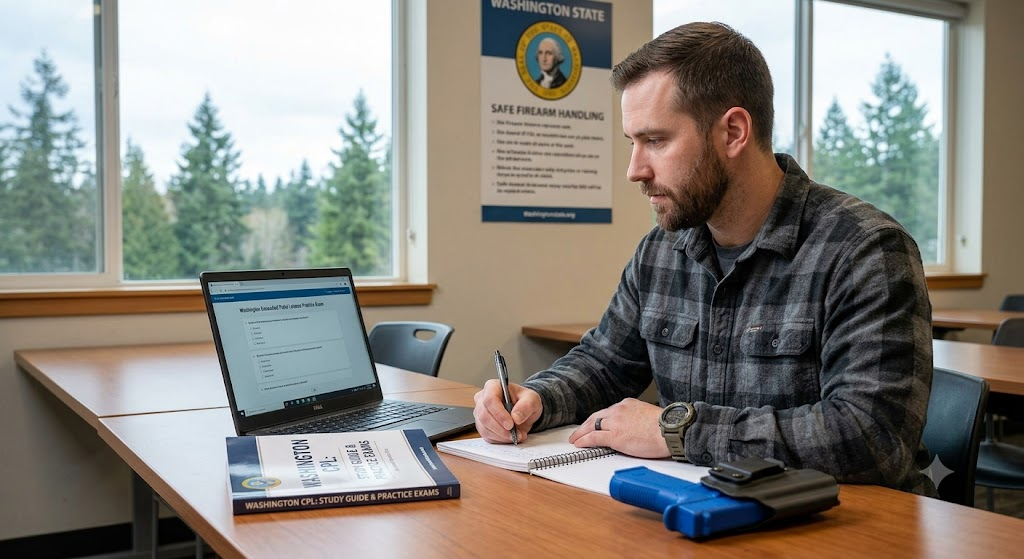
Additional Information
What the Course Entails and Exam Details
A comprehensive preparation course for a Washington CPL focuses on two primary domains: safe handling and legal knowledge. The practice exam validates your understanding of these core competencies.
The primary topics covered include:
Washington State Firearm Laws: In-depth review of Revised Code of Washington (RCW) Title 9.41. This is the most critical component.
Use of Force Statutes: Understanding the legal definitions of "reasonable force," "deadly force," and the severe legal ramifications of self-defense encounters.
Prohibited Locations: Identifying exactly where carrying a concealed pistol is forbidden by state and federal law in Washington.
The Four Universal Rules of Firearms Safety: Absolute mastery of fundamental safety protocols.
Pistol Mechanics and Operation: Knowledge of handgun types, ammunition, and basic maintenance.
Safe Storage and Transport: Requirements for securing firearms at home and legally transporting them in vehicles.
Interaction with Law Enforcement: Proper protocols when stopped by police while carrying.
What to Expect in the Final Exam
It is vital to understand that the State of Washington does not administer a mandatory written or practical exam for the CPL application itself.
The "final exam" context arises in private, recommended certification courses. Because these courses are offered by independent instructors (such as NRA Certified Instructors or USCCA Instructors), the exact format may vary. However, a typical end-of-course assessment will feature:
Written Format: Usually consists of multiple-choice and true/false questions.
Emphasis on Law: The vast majority of questions will focus on legal scenarios based on RCW 9.41, testing your ability to apply the law to real-world situations.
Passing Score: Most instructors require a score of 80% or higher to receive a course completion certificate.
No Time Limit (Usually): Instructors prioritize comprehension over speed.
Practical Assessment (Optional): While not required for the state CPL, some comprehensive "Handgun 101" or "Concealed Carry" courses may include a live-fire range component to verify safe handling, loading, and fundamental marksmanship.
How to Study and Exam Centers
How to Study
Actionable strategies are key to succeeding on your course practice exam and being a prepared CPL holder:
Read the RCW Directly: Do not rely solely on course summaries. Meticulously read RCW 9.41 (Firearms and Dangerous Weapons). Focus especially on sections detailing prohibited places (9.41.300) and the unlawful aiming/discharge of weapons.
Use Flashcards for Statutes: Create flashcards for critical legal definitions (e.g., "deadly force") and the list of prohibited carrying locations in Washington.
Take Reputable Practice Quizzes: Utilize practice tests from established training entities or your specific instructor to internalize question formats.
Emphasize "Safety-First" Thinking: When answering practical or ethical questions, the safest possible action is almost always the correct answer.
Exam Centers and Application Centers
It is critical for students to differentiate between training and licensing.
Where to Take the "Exam" (Training Courses): There are no standardized government testing centers (like Pearson VUE) for a WA CPL. Training courses are held at private firearms academies, authorized gun ranges, tactical schools, or private classroom spaces dedicated to firearms education throughout Washington.
Where to Apply for the License: Once you feel prepared (and have completed any optional training), you do not visit a test center. You must submit your CPL application, fingerprints, and fees to your local law enforcement agency.
If you live within city limits, apply at your local Police Department.
If you live in an unincorporated area of a county, apply at the County Sheriff’s Office.
Non-residents of Washington must apply at a Sheriff's Office anywhere in the state.
Job Opportunities from the Course
A Washington Concealed Pistol License is a personal safety permit, not a vocational certification.
However, the knowledge, responsibility, and validated safety skills achieved by mastering the concepts in a CPL training course serve as a fundamental foundation for several career paths. Possessing a CPL is often a minimum requirement, or a significant competitive advantage, for professions involving security, protection, and high-responsibility roles.
Career paths this preparation unlocks include:
Armed Security Officer
Private Investigator / Private Detective
Armored Car Guard / Cash Transportation Specialist
Executive Protection Specialist (Bodyguard)
Bail Enforcement Agent (Bounty Hunter)
Firearms Retail Sales Associate (Requires specific federal licensing, but CPL knowledge is vital)
Range Safety Officer (Though additional certification is required)
Future pathway to becoming a Certified Firearms Instructor (Requires advanced training and certification)
Frequently Asked Questions
Reviews
5.0
Based on 0 reviews
Leave a Review
No reviews yet. Be the first to review!