
Washington Cosmetology License Practice Exam
$69.00
- Buy to unlock unlimited access to all Quiz questions and Answers in this Quiz.
- After purchase you can print a PDF of the whole quiz at any point. The PDF will contain the questions and the correct answers.
About this Exam
The Washington Cosmetology License is the essential certification for individuals aspiring to practice professional cosmetology within the state of Washington. This comprehensive license allows individuals to provide a wide array of services, including hair cutting, styling, coloring, chemical treatments, skin care basics, and nail technology. The certification is designed for graduates of state-approved cosmetology programs or recognized apprenticeship programs, acting as the final, critical step before entering the professional beauty industry.
Passing both the theory and practical examinations demonstrates a candidate's competency in foundational skills, crucial safety protocols, state laws, and regulations, ensuring they can safely and professionally serve the public in a salon environment. This guide provides an overview and practice insights for this pivotal exam.
Ready to test your knowledge?
Buy Now to Access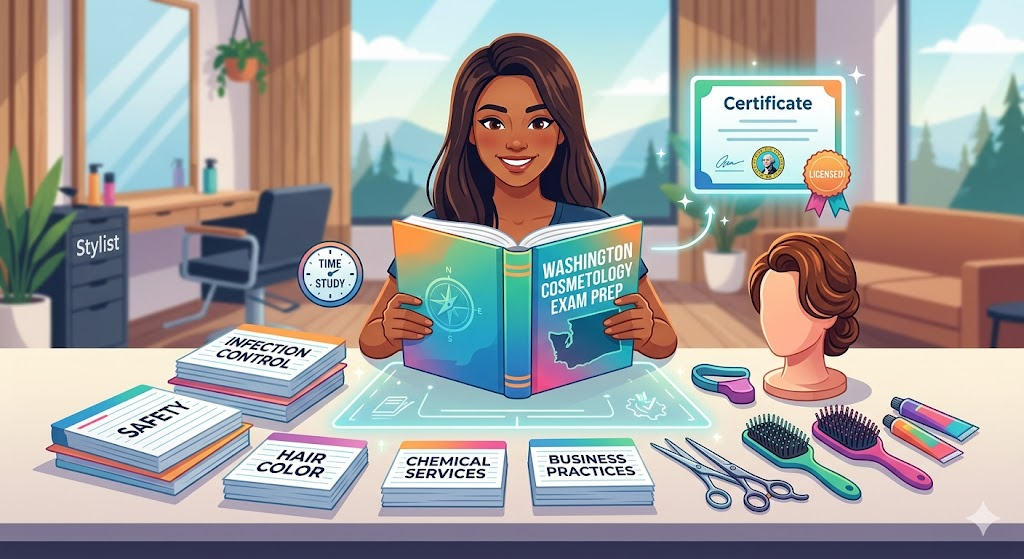
Additional Information
What the Course Entails and Exam Details
Successfully obtaining a Washington Cosmetology License requires first completing the state-mandated training hours. For a standard cosmetology license, this typically involves 1,600 hours of training at an accredited beauty school or 2,000 hours through an approved apprenticeship program, though hours vary slightly for specialized licenses like Barber, Esthetician, or Nail Technician.
The Washington Cosmetology Exam consists of two main, distinct components:
The Theory (Written) Examination: This is a computer-based, multiple-choice test that assesses a candidate's knowledge across a broad range of subjects. Key topics covered include scientific concepts relevant to cosmetology (such as biology, chemistry, and electricity), client safety and professional ethics, hair care and services (styling, cutting, coloring, waving), skin care fundamentals, nail technology basics, and crucially, Washington State laws, rules, and sanitation procedures.
The Practical Examination: This hands-on component requires candidates to demonstrate specific cosmetology skills and services in a timed, controlled, and evaluated environment. The practical exam tests execution of various procedures such as set-up, client preparation, thermal curling, hair cutting, chemical waving, and relevant treatments (e.g., skin care and basic manicure steps, though specific components can vary by exam session). Continuous evaluation is conducted on the applicant's skill proficiency, proper tool handling, and unwavering adherence to strict sanitation and infection control protocols throughout every step of the demonstration.
What to Expect in the Final Exam
Theory (Written) Exam
The computer-based theory exam generally consists of approximately 100 scored multiple-choice questions, along with some non-scored pre-test questions. Candidates typically have a 90-minute time limit to complete this section. Questions are weighted across different content areas, with significant emphasis placed on sanitation, safety, scientific concepts, and the unique regulations of Washington State. To pass, applicants must achieve a minimum scaled score, often 75 or higher.
Practical Exam
The hands-on practical exam is a rigorous, often 4 to 5-hour evaluation. Candidates must bring their own carefully prepared kit with all necessary tools, supplies, and a mannequin head, all clearly labeled and sanitized. The exam is structured into distinct, timed segments for each required service. Applicants are closely observed and graded by trained evaluators on their technique, client safety, infection control practices, final results, and proper cleanup. Failure to follow the strict time constraints or to maintain proper sanitation protocols can lead to deduction of points or immediate failure of a specific segment, or potentially the entire practical portion. Passing requirements for the practical exam also typically demand a minimum scaled score, like 75 or higher.
How to Study and Exam Centers
Study Strategies
Preparation is key to success on both portions of the Washington Cosmetology Exam. For the theory exam, candidates should thoroughly review their school curriculum, textbooks, and the specific information covered in the National Interstate Council (NIC) or Washington State Department of Licensing (DOL) guidelines. Utilizing comprehensive practice exams and flashcards can help to simulate test conditions and reinforce key concepts, particularly Washington State laws and sanitation procedures. For the practical exam, candidates must dedicate substantial time to physically practicing the required services under timed conditions, following the official skill rubrics and sanitation checklists precisely. Practicing set-up and cleanup procedures is equally important, as any lapse in these areas can be just as detrimental as a technical error. Creating and practicing with a well-organized exam kit is essential for efficiency during the practical. Mock practical exams with a school instructor can provide invaluable feedback.
Exam Registration and Centers
Before scheduling the examinations, candidates must have completed all training hour requirements and submit their initial license application and applicable fees to the Washington State Department of Licensing (DOL). Once the DOL has confirmed eligibility, applicants will typically receive instructions for online registration and scheduling for both the theory and practical examinations through an authorized testing provider, currently the National Interstate Council (NIC) exams for Washington. Practical and sometimes theory examinations are offered at multiple designated locations across the state, such as in or near major regions like Fife, Yakima, and Spokane, with dates and times varying throughout the year. Information on exact testing centers, dates, scheduling procedures, and allowed materials (such as for the practical kit) will be provided upon registration and are always subject to change by the state and testing provider. Candidates are responsible for selecting their testing location and dates in accordance with the official guidelines.
Job Opportunities from the Course
A Washington State Cosmetology License opens the door to numerous professional paths in the dynamic beauty and wellness industry. Opportunities are diverse and can range from traditional salon roles to creative and management positions. Potential career paths and specific job titles that this license can unlock in Washington include, but are not limited to, the following:
Hairstylist
Hair Color Specialist
Salon Manager
Salon Owner/Entrepreneur
Nail Technician (depending on scope in combination or separate specialty licenses)
Esthetician/Skin Care Specialist (similar scope caveats apply)
Makeup Artist (in salon or freelance settings)
Beauty Educator/Cosmetology Instructor (with additional training)
Cosmetic Product Representative
Cosmetology and Barbering School Director
Texture Specialist
Trichologist
Salon/Spa Consultant
By pursuing a Washington Cosmetology License and preparing thoroughly with practice resources and dedicated study, candidates are not just aiming to pass an exam; they are taking a crucial step toward an exciting and potentially rewarding career in the beauty arts. Good luck with your study and practice!
Frequently Asked Questions
Reviews
5.0
Based on 0 reviews
Leave a Review
No reviews yet. Be the first to review!