
Washington DECA State President/Area President Practice Exam
$69.00
- Buy to unlock unlimited access to all Quiz questions and Answers in this Quiz.
- After purchase you can print a PDF of the whole quiz at any point. The PDF will contain the questions and the correct answers.
About this Exam
The Washington DECA State President and Area President exams are critical, foundational components of the officer candidate selection process. These rigorous assessments are designed specifically for highly motivated high school DECA members seeking to ascend to the highest levels of student leadership within the state organization. Passing these exams demonstrates that a candidate possesses the requisite institutional knowledge, grasp of parliamentary procedure, and deep understanding of DECA’s mission necessary to effectively lead thousands of members. This practice exam is an essential diagnostic tool to help candidates identify knowledge gaps and build the confidence required to succeed in the official testing environment.
Ready to test your knowledge?
Buy Now to Access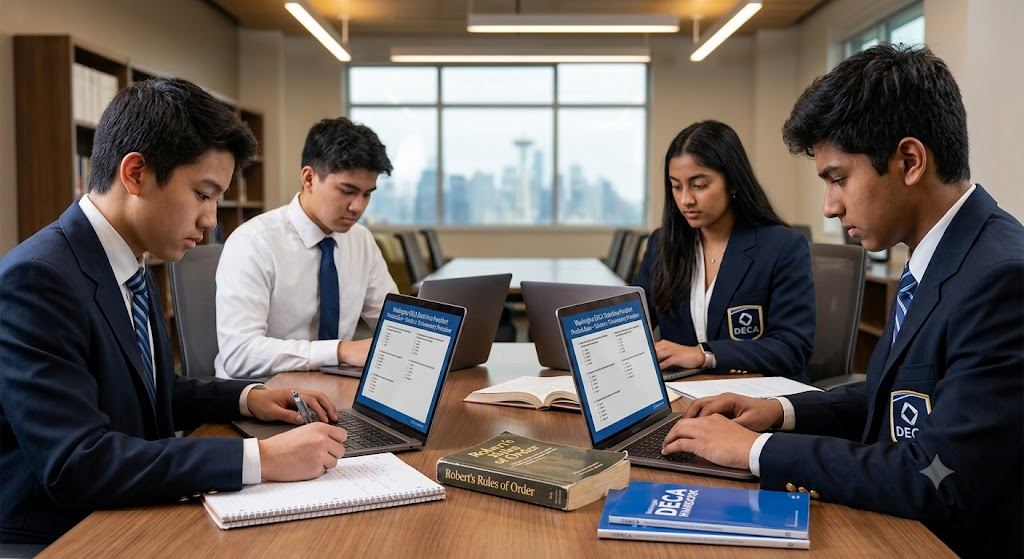
Additional Information
What the Course Entails and Exam Details
Preparing for this exam is not just about memorization; it is about understanding the core mechanics of leadership within a large student organization. The exam syllabus rigorously covers several distinct thematic areas essential for any prospective presiding officer.
Firstly, candidates must master DECA Institutional Knowledge. This includes the comprehensive history of both International DECA and Washington DECA, the current organizational structure, the specific missions and values, and the names and roles of current key state and international leadership figures.
Secondly, a significant portion of the exam focuses on Parliamentary Procedure, specifically Robert's Rules of Order, Newly Revised. Candidates are expected to know how to properly handle motions, manage debate, understand voting thresholds, and maintain order during complex business meetings.
Finally, the exam tests DECA Programming and Logistics. This includes detailed knowledge regarding Washington DECA’s specific conferences (such as SCDC and WRLC), competitive event categories, the programmatic calendar, and the overall strategic goals for the academic year.
What to Expect in the Final Exam
While specific formatting may vary slightly by year based on the discretion of the Washington DECA Chartered Association Advisor, candidates should prepare for a demanding, objective assessment. The exam typically consists entirely of multiple-choice questions designed to test both recall and the application of knowledge (especially regarding parliamentary scenarios).
The official exam is highly competitive and acts as a qualifying hurdle. Candidates are often required to achieve a minimum passing score (frequently 70% or higher) simply to remain eligible to continue in the election process, which includes interviews and speeches.
There is a strict time limit enforced, usually giving candidates approximately 60 minutes to complete the assessment. Proctors ensure a standard testing environment. For the State President exam, specifically, candidates with the highest scores often receive a competitive advantage in the overall selection matrix.
How to Study and Exam Centers
Success on this exam requires a structured and disciplined study approach. Candidates should treat this process with the same seriousness as an AP or IB exam.
Effective study strategies include creating comprehensive flashcards for DECA history, facts, and key parliamentary terms. Utilizing Robert's Rules of Order "cheat sheets" to quickly reference motion precedence is highly recommended. Form study groups with other chapter officers to role-play parliamentary scenarios, as active application solidifies knowledge best. We recommend taking this practice exam multiple times under timed conditions to acclimate to the pressure.
Regarding exam logistics, the Washington DECA State and Area President exams are not administered at public commercial testing centers like Pearson VUE. Instead, they are held at specific, authorized Washington DECA events. Area President exams are often administered locally at Area Leadership Conferences. The State President exam is traditionally proctored in person during the State Career Development Conference (SCDC) or a dedicated Officer Candidate Training weekend. Candidates must register through their local chapter advisor.
Job Opportunities from the Course
While this exam is for a volunteer student leadership position, the skills validated and the network gained are exceptional catalysts for future professional success. Students who serve as State or Area Presidents build resumes that stand out to university admissions officers and elite corporate recruiters. This certification of leadership capability directly unlocks high-tier opportunities in various business-related fields.
Potential career paths and professional job titles favored by former DECA Executive Officers include:
Corporate Marketing Manager
Public Relations Specialist
Management Consultant
Non-Profit Executive Director
Project Manager
Business Development Director
Event Operations Manager
Politician or Public Administrator
Human Resources Director
Frequently Asked Questions
Reviews
5.0
Based on 0 reviews
Leave a Review
No reviews yet. Be the first to review!