
Washington State Security Guard License Practice Exam
$69.00
- Buy to unlock unlimited access to all Quiz questions and Answers in this Quiz.
- After purchase you can print a PDF of the whole quiz at any point. The PDF will contain the questions and the correct answers.
About this Exam
Becoming a licensed private security guard in Washington State is an essential step toward a stable and rewarding career in public safety and asset protection. This credential, mandated by the Washington State Department of Licensing (DOL), ensures that individuals patrolling properties, managing events, or protecting personnel possess the fundamental knowledge and legal understanding required for the role. This article focuses specifically on the preparation required for the exam associated with the mandatory pre-assignment training for unarmed guards. If you are looking to obtain your unarmed security license in Washington, a comprehensive Washington State Security Guard License Practice Exam is an invaluable tool to familiarize yourself with the material, build confidence, and ensure you are ready for the official assessment administered by your certified trainer.
Ready to test your knowledge?
Buy Now to Access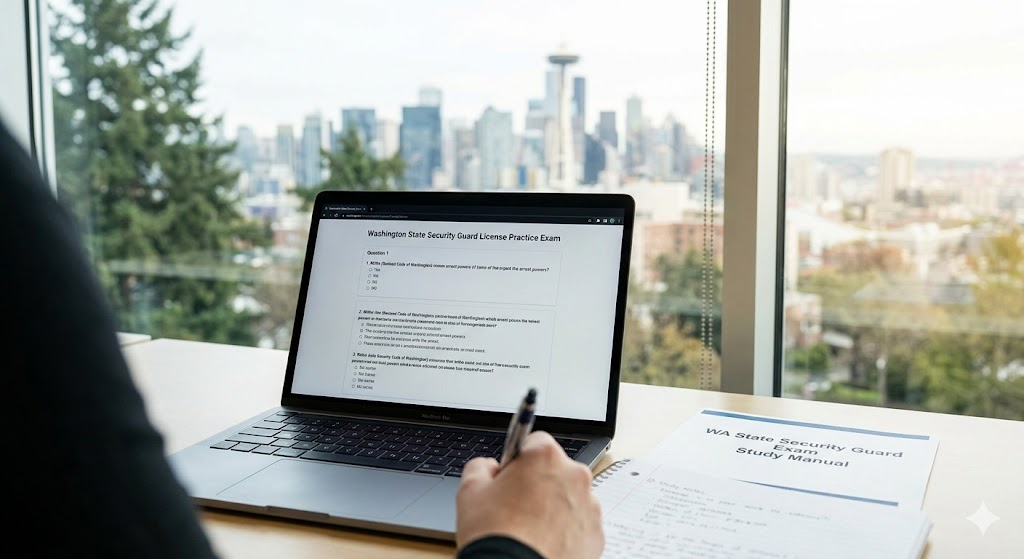
Additional Information
What the Course Entails and Exam Details
The path to licensure begins with completion of the state-mandated 8 hours of pre-assignment training, typically administered by a certified security guard company or a DOL-approved training school. The core curriculum focuses on foundational skills and the unique legal framework of the state.
The topics covered in the training and subsequent examination include:
• Role of the Private Security Guard: Understanding the fundamental duties, expectations, and the difference between public law enforcement and private security. • Washington State Laws (RCWs and WACs): Crucial sections of the Revised Code of Washington (RCW) and Washington Administrative Code (WAC) relevant to security work, including laws surrounding private citizen arrest powers. • Legal Powers and Limitations: A thorough understanding of what a security guard can and cannot legally do, especially regarding the use of force (even for unarmed personnel) and the detention of individuals. • Observation and Report Writing: Techniques for observing incidents accurately and mastering the art of writing clear, factual, and concise incident reports for legal and client use. • Emergency Procedures: Understanding protocols for responding to medical emergencies, fire hazards, and potential natural disasters. • Patrol Procedures: Techniques for effective foot and vehicle patrols, identifying safety hazards, and recognizing security vulnerabilities.
What to Expect in the Final Exam
It is important to understand that there is no single, centralized "State Exam" at a government facility for the unarmed license; rather, the "final exam" is administered by the certified trainer upon completion of the mandatory training hours. However, the structure and content are standardized based on DOL requirements.
• Exam Format: The test is almost universally multiple-choice or true/false, designed to efficiently gauge your comprehension of the core modules. • Specific Rules: This is typically an "open book" exam, meaning you may reference your training manual or notes during the test. The state’s focus is on your ability to find and understand the material, not just rote memorization. • Passing Score: A strong comprehension is required. Most trainers set the passing bar at 80%, although some require 100% mastery, allowing remediation until you achieve that score, as this material is critical for safety and legal compliance. • Time Limits: While usually timed to keep the process moving (often about an hour), the primary constraint is the conclusion of the 8-hour training period itself.
How to Study and Exam Centers
Effective preparation for the exam starts with active participation during your training hours. Because it is often an open-book test, organized notes and a clear understanding of where information is located within your manual are your greatest assets.
Study Strategies:
• Use a Study Guide: Consistently reviewing a high-quality Washington State Security Guard License Study Guide is essential for reinforcing the key concepts. • Engage with Practice Exams: Taking a dedicated Washington State Security Guard License Practice Exam is the most effective way to identify knowledge gaps and get comfortable with the phrasing of questions before the actual test. • Focus on RCWs and WACs: Pay extra attention to the specific legal codes governing security guards in Washington; this is the most common area where applicants struggle. • Practice Report Writing: While the exam is multiple-choice, your ability to write clear reports is a major part of the training curriculum.
Exam Centers and Locations:
Unlike standardized tests that use Pearson VUE centers, the examination for the Washington State security license occurs directly at the authorized training facility or company where you complete your required coursework. These authorized schools include major security firms licensed by the state or independent private security training academies. Your employer or potential employer is typically the best resource for directing you to an authorized training and testing location.
Job Opportunities from the Course
Successfully completing this training and passing the exam unlocks a variety of career opportunities in diverse environments across Washington.
The career paths and specific job titles opened by this license include:
• Unarmed Security Officer
• Event Security Staff (Concerts, Sports Venues)
• Corporate Security Guard
• Hospital Security Officer
• Retail Loss Prevention Specialist
• Mobile Patrol Officer (Unarmed)
• Construction Site Security Watchman
• Access Control Specialist (e.g., Data Centers, Gated Communities)
• Hotel Security and Concierge
Frequently Asked Questions
Reviews
5.0
Based on 0 reviews
Leave a Review
No reviews yet. Be the first to review!