
Washington Turf and Ornamental Weed Management Practice Test
$69.00
- Buy to unlock unlimited access to all Quiz questions and Answers in this Quiz.
- After purchase you can print a PDF of the whole quiz at any point. The PDF will contain the questions and the correct answers.
About this Exam
The Washington Turf and Ornamental Weed Management exam is a specialized certification required by the Washington State Department of Agriculture (WSDA) for individuals who apply pesticides—specifically herbicides—to control weeds in turf and ornamental settings.
This endorsement is essential for professional pesticide applicators working on commercial properties, golf courses, parks, schools, residential lawns, landscapes, greenhouses, and nurseries. It is designed to ensure that applicators possess the technical knowledge and practical skills necessary to manage weeds effectively while maximizing safety for people, property, and the environment.
Whether you are looking to start a new career in landscape management or are a seasoned professional seeking to formalize your expertise, passing this exam is a critical step in obtaining your commercial applicator license in Washington.
Ready to test your knowledge?
Buy Now to Access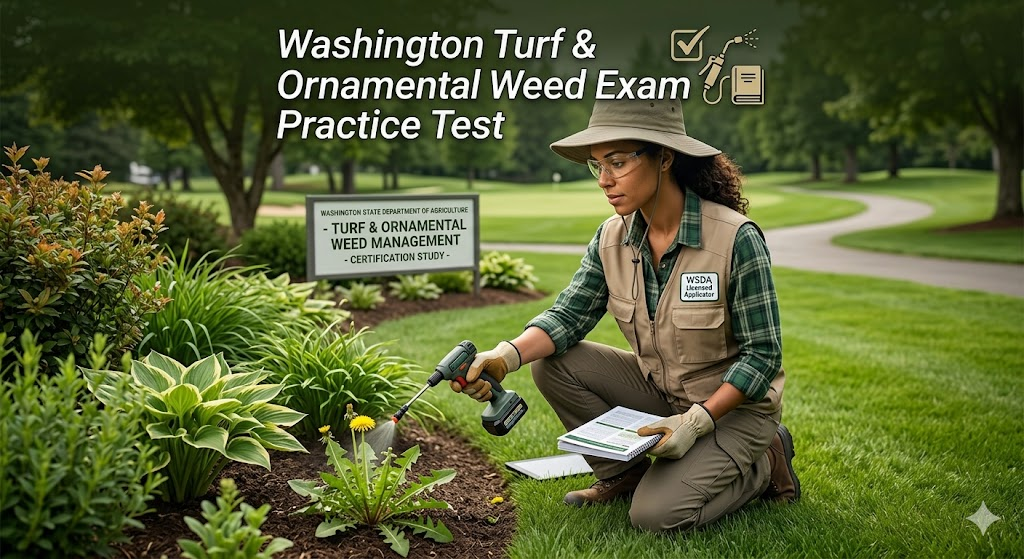
Additional Information
What the Course Entails and Exam Details
This certification program equips you with the foundational principles and advanced techniques of integrated weed management in a professional landscape context. The primary study material is the Washington State University (WSU) publication: Turf and Ornamental Weed Management Principles (EM035).
The exam content is designed to test your understanding of the following core topics:
Integrated Weed Management (IWM) Strategies: Understanding cultural, mechanical, biological, and chemical methods for controlling weeds in specific turf and ornamental environments.
Weed Identification: Recognizing common broadleaf, grass, and sedge weeds, understanding their life cycles, and how their growth characteristics impact management decisions.
Herbicide Modes of Action and Selection: Differentiating between selective and non-selective, contact and systemic, and pre-emergent and post-emergent herbicides, and selecting the correct product for the target site and pest.
Herbicide Application Principles: Mastering best practices for the safe and effective application of herbicides, with a specific focus on equipment like hand sprayers and backpack sprayers.
Equipment Calibration: Acquiring the mathematical skills to calibrate application equipment precisely, focusing on variables such as sprayer nozzles and sprayer delivery rates.
Label Comprehension: Interpreting and following pesticide labels correctly, understanding safety data sheets (SDS), and adhering to regulatory requirements.
Environmental Protection and Drift Management: Identifying potential environmental risks and implementing strategies to prevent pesticide drift, runoff, and groundwater contamination.
What to Expect in the Final Exam
The final Washington Turf and Ornamental Weed Management endorsement exam is administered by the WSDA. It is a closed-book, multiple-choice test that rigorously evaluates your knowledge across the domains listed above.
The exact number of questions can vary, but generally, WSDA category exams range from 50 to 100 questions. You will have a defined time limit to complete the exam, which is typically around two hours, though this should be confirmed with the testing center when you make your reservation.
A passing score is 70% or higher. Upon successfully passing this exam, along with the foundational Washington Pesticide Laws and Safety exam, you will be eligible to apply for your commercial pesticide applicator license with this specialized endorsement. It is a challenging but fair assessment of your professional competence.
How to Study and Exam Centers
Effective preparation is key to success. Your study plan should revolve around a thorough review of the core study materials and active practice of key concepts.
Primary Study Material: You must obtain and study the WSU publication EM035: Turf and Ornamental Weed Management Principles. This is the standard textbook upon which the exam is based. Pay special attention to the sections on calibration, calculations, and equipment.
Utilize Practice Exams: The practice test you are preparing to take is one of the most powerful tools in your arsenal. Use it to:
Identify your knowledge gaps.
Get comfortable with the multiple-choice format.
Gauge your readiness and time management skills.
Simulate the high-pressure environment of the final exam.
Focus on Math: Many candidates find the calibration calculations to be the most demanding part of the exam. Take time to work through all sample problems in the study manual. Create your own scenarios to practice determining active ingredient per acre, sprayer delivery rates, and tank mixing ratios.
Practice Active Learning: Instead of just passively reading, take notes, create flashcards for key terms and weed ID, and teach concepts to a peer.
Where to Take the Exam: The WSDA offers both paper-based and computer-based testing options. In all cases, a reservation is required by calling 1-877-301-4555.
Computer-Based Testing: WSDA partners with professional testing centers, such as Pearson VUE, to provide secure, on-demand testing at locations across the state. This is often the most convenient option for many candidates.
Paper-Based Testing: WSDA schedules periodic paper-based testing sessions at select locations. These sessions have fixed times and may require more advanced planning.
Job Opportunities from the Course
Passing the Washington Turf and Ornamental Weed Management exam, in conjunction with your base applicator license, unlocks numerous fulfilling and essential career paths in the state's vibrant green industry. This endorsement validates your technical proficiency, making you a highly desirable candidate for roles with a strong focus on landscape health and preservation.
Specific job opportunities that this certification unlocks include:
Spray Technician: Specialized in the precise application of herbicides and plant health products for landscapes.
Landscape Spray Technician: Manages weed control programs across a variety of client sites.
Turfgrass Management Specialist: Focuses on the care of professional golf courses, sports fields, and public parks.
Arborist / Plant Health Care Specialist: Integrates weed management with tree and shrub care on commercial and residential properties.
Highway Maintenance Worker 2 / Vegetation Management: Controls weeds and manages vegetation on roadsides for state or municipal agencies.
Nursery or Greenhouse Manager: Oversees complex weed and pest control programs in production environments.
Restoration Foreman: Leads teams in environmental restoration and invasive plant management projects.
For those with an entrepreneurial spirit, this endorsement provides the critical legal requirement to start your own professional landscape maintenance business. It is a highly valued credential that signals safety and professionalism to potential employers and clients. You’ve got this!
Frequently Asked Questions
Reviews
5.0
Based on 0 reviews
Leave a Review
No reviews yet. Be the first to review!