
Watchstation 301-306 Basic Damage Control (DC) Practice Test
$69.00
- Buy to unlock unlimited access to all Quiz questions and Answers in this Quiz.
- After purchase you can print a PDF of the whole quiz at any point. The PDF will contain the questions and the correct answers.
About this Exam
The Watchstation 301-306 Basic Damage Control (DC) qualification is a foundational milestone for every U.S. Navy and Coast Guard Sailor. Unlike a civilian certification, this qualification is an internal military standard that verifies a service member's ability to act as a vital first responder in shipboard emergencies. This qualification is designed for all hands, from new recruits to senior officers, ensuring that everyone onboard possesses the essential knowledge and skill to fight fires, control flooding, and maintain the ship’s structural integrity and combat readiness, ultimately ensuring the vessel's survival and the crew's safety.
Ready to test your knowledge?
Buy Now to Access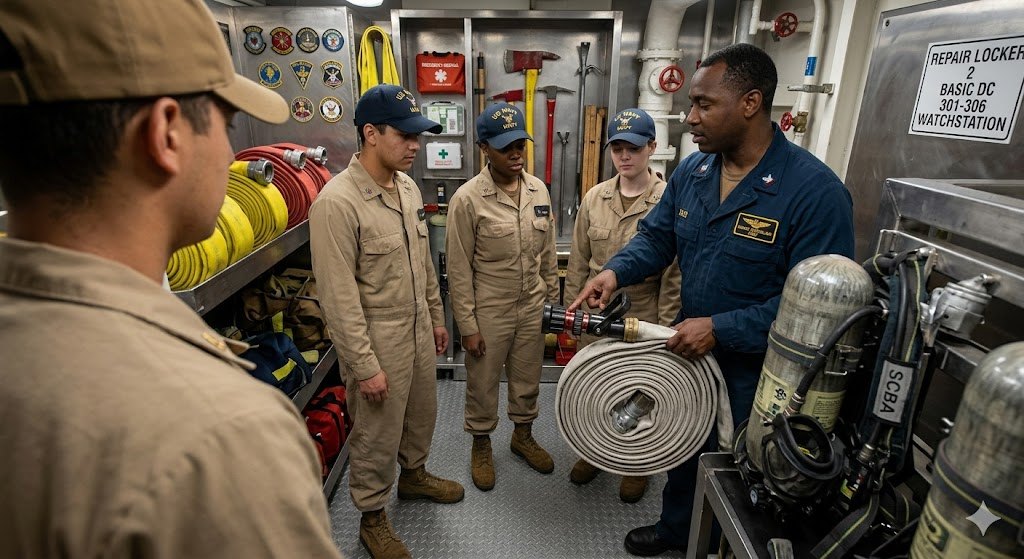
Additional Information
What the Course Entails and Exam Details
The Watchstation 301-306 curriculum covers the critical knowledge required to be an effective member of a ship's damage control organization. The comprehensive study guide includes:
Firefighting Fundamentals: Classification of fires (Alpha, Bravo, Charlie, Delta); primary and secondary extinguishing agents (water, AFFF, PKP, CO2, HFP, APC); firefighting equipment (fire main systems, hoses, nozzles, and various extinguishers); proper use of the Self-Contained Breathing Apparatus (SCBA) and emergency breathing devices (EEBD).
Flooding Control: Principles of ship stability and watertight integrity; methods for plugging, patching, and shoring to control hull damage and contain water; operation of dewatering equipment (pumps, eductors).
Equipment Operation: Hands-on operation and maintenance of vital DC gear, including thermal imagers, gas detectors, and communicaitons equipment.
Chemical, Biological, and Radiological Defense (CBR-D): Principles of CBR-D; proper wear, don, and doff of the MCU-2/P mask and protective suits; decontamination procedures; and material conditions of readiness related to CBR-D.
First Aid and Triage: Basic life-saving techniques; treating burns, fractures, and shock; and understanding the triage system for managing multiple casualties.
Administration and Communications: Understanding the Damage Control organization (including the role of the DCO, DCA, and repair lockers); standard shipboard communication methods (1MC, sound-powered telephones); and reading shipboard diagrams ("bullseyes").
Material Conditions of Readiness: Detailed knowledge of setting and maintaining the ship's closure classifications (X-Ray, Yoke, Zebra, William, Circle William) to ensure the maximum survivability.
What to Expect in the Final Exam
The Watchstation 301-306 Basic Damage Control evaluation is a multi-part process, combining both written and practical assessments.
Written Examination: You must first pass a comprehensive written examination. This multiple-choice test will challenge your understanding of all topics covered in the curriculum, from the range of a 27lb PKP extinguisher to the correct procedures for setting Material Condition Zebra. A passing score, often 80% or higher, is required to move on to the practical evaluation.
Practical Evaluation ("Walkthrough"): The hallmark of a military qualification is the practical demonstration. A qualified Damage Controlman (DC) or specialized instructor will evaluate your ability to put knowledge into action. This will likely involve:
Demonstrating proper SCBA don and doff procedures within a specified time limit.
Correctly identifying and operating various pieces of DC equipment.
"Walking through" a simulated repair locker response, including proper communication and team integration.
Correctly setting a specified material condition on a representative space.
Failure on any portion of the practical evaluation will require retraining and a complete re-evaluation.
How to Study and Exam Centers
Preparation for the Watchstation 301-306 exam must be diligent and multifaceted, utilizing the unique resources available in the military environment. Actionable strategies include:
PQS/Watchstation Qualification Book: This is your primary roadmap. Complete all line items, seeking signatures only when you have truly mastered the required knowledge or task.
Technical Manuals: Refer directly to the "bible" of damage control: Navy Stock Fund (NSF) publications, specifically the Naval Ships’ Technical Manual (NSTM) Chapter 555 (Volume 1) for Firefighting, Chapter 079 (Volume 1) for Damage Control, and Chapter 470 for CBR-D.
Practice Tests and Flashcards: Utilize military-specific practice question banks and create detailed flashcards from the PQS.
Drills and Practical Experience: Actively participate in all shipboard damage control drills (e.g., General Quarters, In-Port Emergency Team drills). Seek out Damage Controlmen (DCs) to get "hands-on" time with the gear.
Exam Centers: There are no civilian Pearson VUE centers for this qualification. The exams are administered:
Onboard U.S. Navy and Coast Guard Vessels: For sailors assigned to a ship, evaluations are conducted by qualified crew members.
Military Training Facilities: Training Commands (e.g., Surface Warfare Schools Command in Great Lakes, IL, or San Diego, CA) and specific "DC Trainers" ("buttercups") conduct formal training and initial evaluations for new accession sailors and those in specialized schools.
Job Opportunities from the Course
While the Watchstation 301-306 Basic DC is a prerequisite for military service rather than a civilian job, this qualification unlocks essential career paths and internal opportunities within the sea services. It is the necessary first step toward:
Required for Advancement: Completion of the Basic DC qualification is mandatory for advancement to Petty Officer Third Class (E-4) and beyond for all ratings (MOS).
Specialized Team Assignments: Qualifies sailors for critical roles on shipboard emergency teams, including:
Repair Locker Personnel: The standard first responders to any shipboard casualty.
At-Sea and In-Port Emergency Teams (IET).
Damage Control Training Team (DCTT): Qualified members who train and evaluate the rest of the crew.
Rescue and Assistance (R&A) Teams: Assigned to assist other vessels in distress.
Path to Advanced Qualifications: Basic DC 301-306 is the prerequisite for all advanced damage control watchstations, including Damage Control Petty Officer (DCPO), Investigator, and eventually, the Damage Control Assistant (DCA) and Fire Marshal.
Frequently Asked Questions
Reviews
5.0
Based on 0 reviews
Leave a Review
No reviews yet. Be the first to review!