
Water and Fuel Systems Maintenance (WFSM) Set B Volume 1 Practice Test
$69.00
- Buy to unlock unlimited access to all Quiz questions and Answers in this Quiz.
- After purchase you can print a PDF of the whole quiz at any point. The PDF will contain the questions and the correct answers.
About this Exam
The Water and Fuel Systems Maintenance (WFSM) Set B Volume 1 exam is a critical component of the United States Air Force's Career Development Course (CDC) for personnel in the 3E4X1 Air Force Specialty Code (AFSC). This comprehensive certification path is specifically designed for Airmen, as well as joint-service partners from the Army and Navy, who are responsible for the installation, inspection, maintenance, and repair of essential infrastructure. It validates the foundational technical knowledge required to manage complex water distribution, wastewater collection, plumbing, natural gas, fire suppression, and liquid fuel systems in both garrison and contingency (deployed) environments.
Ready to test your knowledge?
Buy Now to Access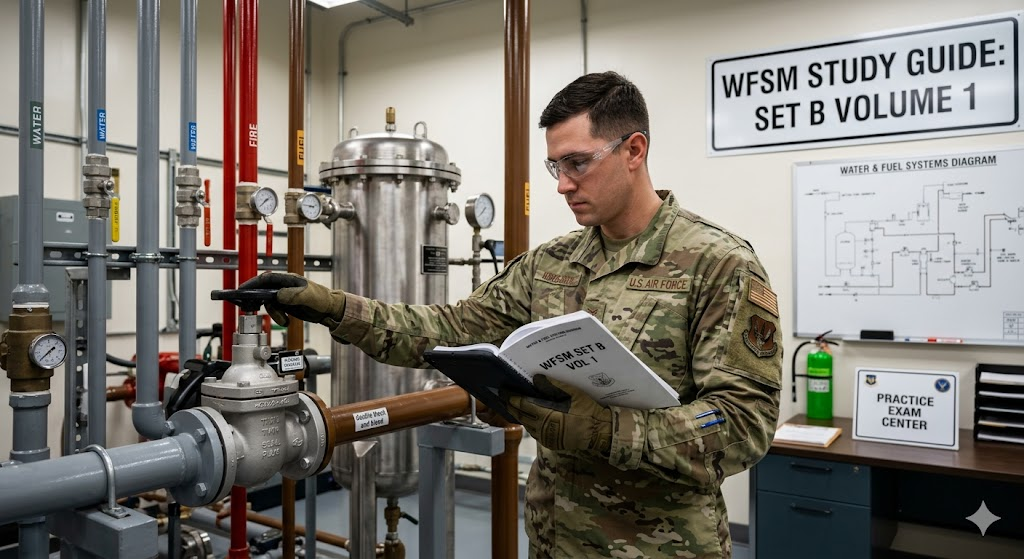
Additional Information
What the Course Entails and Exam Details
The course focuses on the core competencies needed to ensure the safe and efficient operation of vital base utilities and aircraft fueling infrastructure. The exam covers a broad spectrum of topics derived from Technical Orders (TOs), Air Force Instructions (AFIs), and safety standards. Key areas include:
Air Force Publications and Safety: Mastery of AFOSH standards, Hazard Communication (HAZCOM), confined space procedures, personal protective equipment (PPE), and excavation safety.
Technical Orders (TOs): Understanding the purpose, use, and management of TOs, including commercial-off-the-shelf (COTS) and Time Compliance Technical Orders (TCTO).
Tools and Equipment: Proper identification, selection, and maintenance of specialized tools for piping, pipe cutting, threading, and valve maintenance.
Piping Systems: Principles of interior and exterior piping, including grading, soldering, threading, and material handling (e.g., as-built drawings).
Valves and Components: A detailed study of various valve types (gate, globe, plug, ball, butterfly, check, general twin seal), their operation, applications, and specific maintenance requirements within water and fuel systems.
Liquid Fuels Maintenance: Basic knowledge of fuel system components like filters/separators, hydrant refueling systems, and the application of static dissipating additives (SDA).
Environmental and Contingency Operations: Compliance with environmental regulations for waste management and knowledge of contingency skills, such as building a base from scratch and establishing potable water points in deployed locations.
The final exam is a supervised, closed-book, multiple-choice test. While specific question counts and time limits can vary, a passing score of at least 65% is generally required to progress to the next CDC volume or upgrade training.
What to Expect in the Final Exam
You should expect a rigorous assessment of your ability to apply technical information and safety principles to practical scenarios. The question format is exclusively multiple-choice, focusing on recall, application of formulae (e.g., volume calculations), and procedural steps found in Technical Orders. The exam is administered under strict military conditions to ensure integrity. The emphasis is on accuracy and safety, reflecting the critical nature of maintaining high-risk systems like aviation fuel lines and high-pressure water mains. You must follow all directions provided by the testing official, and unauthorized materials are not allowed.
How to Study and Exam Centers
Preparation for this exam requires a structured and dedicated approach. Since it is a self-study course, your primary resource is the CDC itself. Combine it with these strategies:
Master the CDCs: Read and re-read every section of the Volume 1 material. Take detailed notes, highlighting key definitions, safety procedures, and step-by-step Technical Order instructions.
Use Unit Review Questions (URQs): Every volume has URQs. Answer them all without referring to the text, and then grade your work. Focus on understanding why the correct answer is right and why the other options are wrong.
Leverage Practice Tests: Utilize authorized online practice platforms and study groups to simulate the exam experience. This helps with time management and identifying knowledge gaps.
Group Study: Collaborate with fellow Airmen from your unit to discuss complex topics and quiz each other on technical specifications and valve functions.
Hands-on Application: Connect what you learn in the CDC to your daily job tasks. Ask your supervisor to explain how the theoretical information in the book applies to the physical systems you maintain.
The final exam must be scheduled through your Base Civil Engineering squadron's training section and is taken at an authorized physical testing center on a military installation. Students can view and manage their CDC progress through their online portal.
Job Opportunities from the Course
Successfully passing this exam is a major step in your career progression within the military and opens diverse pathways in the civilian sector, both in federal service and contracting. Potential job titles and career paths include:
Water and Fuels Systems Maintenance Technician
Liquid Fuels Maintenance Technician
Civil Engineering Utilities Supervisor
Water Plant Operator (Military/Civilian)
Wastewater Treatment Plant Operator (Military/Civilian)
Plumber (Residential/Industrial)
Base Civil Engineering Facility Manager
Environmental Compliance Inspector
Fuel System Field Service Engineer (Contractor)
Contingency Engineering Specialist
These roles are vital for infrastructure sustainability, environmental protection, and ensuring military mission readiness around the globe.
Frequently Asked Questions
Reviews
5.0
Based on 0 reviews
Leave a Review
No reviews yet. Be the first to review!