
Water and Fuel Systems Maintenance (WFSM) Set B Volume 3 Practice Test
$69.00
- Buy to unlock unlimited access to all Quiz questions and Answers in this Quiz.
- After purchase you can print a PDF of the whole quiz at any point. The PDF will contain the questions and the correct answers.
About this Exam
The Water and Fuel Systems Maintenance (WFSM) Set B Volume 3 exam is a critical milestone for professionals specializing in the management of vital liquid utilities. This specific volume focuses on advanced concepts and advanced systems required for operational success in specialized maintenance environments. It is designed specifically for facility engineers, utility technicians, and military civil engineer personnel who have completed foundational training and are now seeking to validate their expertise in complex water distribution and fuel storage operations. Successfully mastering this volume demonstrates a technician’s ability to handle high-stakes maintenance and ensure system reliability under varying conditions.
Ready to test your knowledge?
Buy Now to Access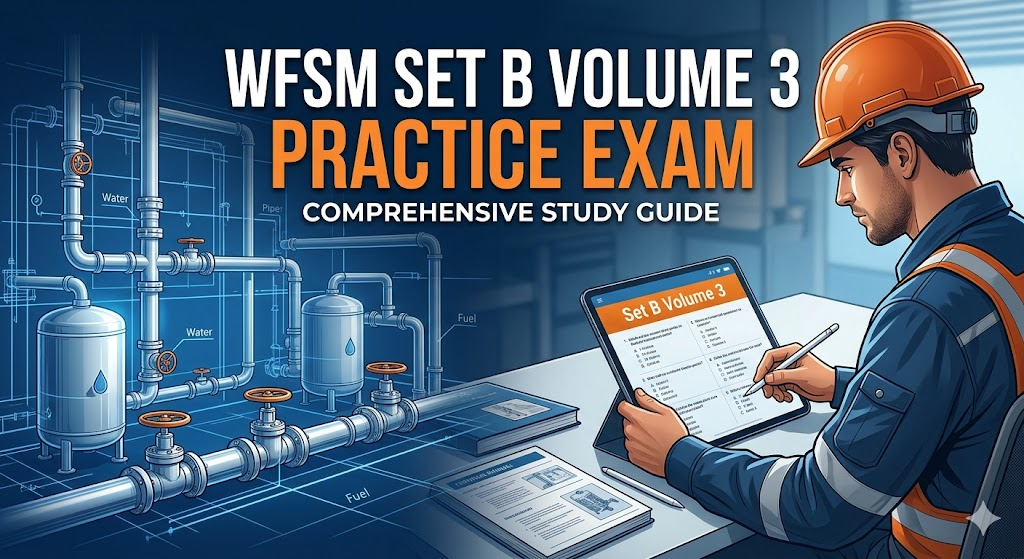
Additional Information
What the Course Entails and Exam Details
This practice test serves as the final preparation step for the formal evaluation covering Volume 3 material. The curriculum focused within this volume delves into intricate mechanical components and safety systems. Specifically, it entails in-depth knowledge of hydrocarbon fuel systems, including the maintenance of storage tanks, filtration separators, and intricate fueling manifolds. Furthermore, it covers advanced potable water treatment processes, distribution networking, and crucial wastewater management procedures. Technicians are expected to understand the synchronization of pumps, valves, and control systems relevant to both water and fuel infrastructure. Environmental regulation compliance and emergency shutdown protocols for these specific systems are also heavily emphasized.
What to Expect in the Final Exam
Students preparing for the WFSM Set B Volume 3 final exam should anticipate a rigorous evaluation of both theoretical knowledge and practical troubleshooting abilities. The exam is typically administered via a computer-based testing format, consisting of a fixed number of multiple-choice questions that require sharp attention to detail. Candidates must demonstrate not just memorization, but the application of maintenance principles to real-world scenarios. While specific passing scores can vary by administering organization, a high threshold is generally required to ensure safety and competency. A specific time limit will be enforced, challenging technicians to diagnose problems and recall procedures efficiently. There may also be interactive scenario-based questions within the digital interface.
How to Study and Exam Centers
Effective preparation for this exam requires a structured study approach. Utilize this practice test repeatedly to identify knowledge gaps and get accustomed to the questioning style. It is essential to go back to the source Volume 3 training manuals and review the specific technical diagrams for both fuel and water systems. Creating flashcards for safety procedures, regulation codes, and component functions is highly recommended. Form study groups to discuss troubleshooting scenarios, as explaining a process aloud reinforces learning. Regarding exam centers, this test is often administered through internal organizational portals for authorized personnel or within specialized military testing facilities (such as Base Education Centers). If facilitated through a civilian contractor, you will likely register via an online portal like Pearson VUE to find authorized physical testing centers near your location.
Job Opportunities from the Course
Mastering the material in WFSM Set B Volume 3 unlocks specialized, high-demand career paths in both the public and private sectors. Key job opportunities include:
Water and Fuel Systems Maintenance Technician
Civil Engineer Hydrology Specialist
Fuel Distribution System Operator (Bulk Storage)
Water Treatment Plant Superintendent
Environmental Compliance Officer for Utilities
Industrial Facilities Maintenance Engineer
Petroleum, Oils, and Lubricants (POL) Specialist
Utility Infrastructure Project Manager
Frequently Asked Questions
Reviews
5.0
Based on 0 reviews
Leave a Review
No reviews yet. Be the first to review!