
Water Distribution Grade 1 Certification Practice Exam
$69.00
- Buy to unlock unlimited access to all Quiz questions and Answers in this Quiz.
- After purchase you can print a PDF of the whole quiz at any point. The PDF will contain the questions and the correct answers.
About this Exam
The Water Distribution Grade 1 Certification is a foundational step for professionals dedicated to ensuring safe and reliable drinking water delivery. This certification validates essential knowledge in the operation, maintenance, and regulation of water distribution systems. Designed for entry-level operators, maintenance workers, and anyone aspiring to a career in the water industry, this exam assesses understanding of basic hydraulics, water quality, system components, safety procedures, and relevant environmental regulations. Achieving Grade 1 certification demonstrates competence to employers and the public, opening doors to a vital and rewarding field.
Ready to test your knowledge?
Buy Now to Access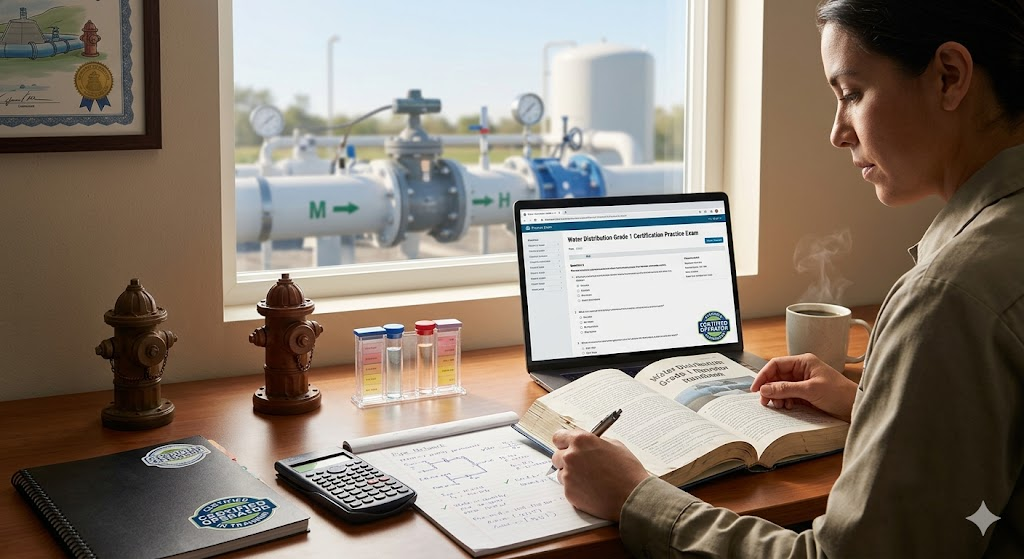
Additional Information
What the Course Entails and Exam Details
This comprehensive practice exam and underlying study guide cover a broad spectrum of critical topics ensuring you are well-prepared for the actual test. Expect to master the following core areas:
Water Quality & Sampling: Learn about common contaminants, sampling techniques, and basic testing procedures for parameters like chlorine and bacteria. Understand the importance of maintaining water quality throughout the distribution system.
System Components: Gain in-depth knowledge of pipes, valves, hydrants, meters, pumps, and storage facilities. Understand their functions, selection criteria, installation, and typical maintenance requirements.
Operations & Maintenance: Practice concepts related to flushing programs, leak detection, valve exercise, hydrant maintenance, and routine system troubleshooting. Develop a solid understanding of best practices for efficient and safe operations.
Basic Hydraulics & Math: Master the essential math needed for daily tasks, including calculating areas, volumes, flow rates, pressure, chemical dosages, and understanding basic hydraulic principles (e.g., pressure-flow relationships). Be prepared for significant math application on the exam!
Safety Protocols: Learn about confined space entry, electrical safety, chemical handling, excavation safety, and overall workplace safety procedures critical for water system workers.
Regulations: Familiarize yourself with the Safe Drinking Water Act (SDWA) and equivalent state regulations, understanding compliance requirements and operator responsibilities.
What to Expect in the Final Exam
The actual Water Distribution Grade 1 Certification exam is typically a challenging yet achievable multiple-choice test. Here is what you can generally expect:
Format: You will encounter a set number of multiple-choice questions (often around 100). The questions are designed to test both factual knowledge and its practical application.
Time Limit: Expect a time limit, often around 3 hours, requiring you to manage your time effectively and avoid getting stuck on single questions.
Passing Score: While specifics vary by state or certifying body, a passing score is typically in the range of 70% or higher. It is essential to check your specific region’s requirements.
Rules: The exam is typically closed-book, though you may be allowed a calculator (ensure it meets permitted criteria) and potentially specific reference sheets if provided by the testing entity. Electronic devices other than allowed calculators are strictly prohibited.
Scoring: You will receive immediate or timely notification of your score and, if successful, your certification details and potentially an breakdown of performance by topic area. Keep in mind that failing often allows for retakes after a waiting period.
How to Study and Exam Centers
Effective preparation is key to success on the Grade 1 exam. Use this practice exam as a core tool, but also diversify your study:
Actionable Strategies:
Review official manuals: Consult state-specific operator manuals, AWWA (American Water Works Association) publications, or equivalent study guides.
Practice regularly: Take this practice exam and others. Analyze your answers, understand why you got questions wrong, and review those topics. Re-take exams to gauge improvement.
Master the Math: Practice water-related math problems consistently. Know your formulas and unit conversions inside out. A significant portion of the exam often involves calculations.
Join study groups: Discussing concepts and working through problems with peers can solidify your understanding and provide different perspectives.
Focus on weaknesses: Identify the topics you struggle with most from practice exams and dedicate focused study time to them. Don’t ignore difficult sections!
Use multiple resources: Online forums, flashcards, and video tutorials can provide alternative explanations and reinforce learning.
Exam Centers & Portals:
Certification is usually managed on a state or regional level. Your first stop should be the website of your state’s environmental agency or specific water operator certification board.
State Agencies: Many states administer their own exams, often at designated government buildings, community colleges, or vocational training centers.
Online Portals: Some states offer online exam scheduling and administration, sometimes using third-party platforms. Check for options for remote proctoring if available and applicable.
Third-Party Testing: In some regions, third-party testing centers like Pearson VUE or PSI may be authorized to administer water operator certification exams. You will need to register with the relevant state board first to be authorized to schedule through these centers.
Approved Schools/Organizations: Certain educational institutions, rural water associations, or training providers might be authorized to host exam sessions.
Job Opportunities from the Course
A Grade 1 Water Distribution Certification is a valuable credential that significantly enhances your employability and earning potential in the stable and essential water industry. It unlocks various career paths:
Water Distribution Operator Grade 1: The most direct role, involving hands-on operation, maintenance, and monitoring of the water distribution system.
Water Utility Worker I: A foundational position with diverse responsibilities, from pipe repair and maintenance to meter reading and customer service related to water distribution.
Maintenance Technician (Water Distribution): Specializes in repairing, troubleshooting, and maintaining all mechanical and infrastructure components of the distribution system.
Meter Reader / Utility Services Representative: Grade 1 knowledge provides valuable context for reading meters and interacting with customers regarding water service.
Plant Operator Trainee: While focused on treatment, understanding distribution is often required or beneficial, and some states integrate certifications or provide a path between disciplines.
Municipal Worker: Many municipalities employ water staff, and a Grade 1 certification makes you a highly desirable candidate for these stable roles.
Customer Service Representative (Water Department): Technical knowledge helps in resolving customer issues and explaining system details effectively.
By succeeding in this foundational exam and gaining your Grade 1 certification, you are not just passing a test; you are launching a rewarding career dedicated to a critical public service, with clear pathways for advancement through subsequent certification grades and experience.
Frequently Asked Questions
Reviews
5.0
Based on 0 reviews
Leave a Review
No reviews yet. Be the first to review!