
Water Quality Analyst Practice Test
$69.00
- Buy to unlock unlimited access to all Quiz questions and Answers in this Quiz.
- After purchase you can print a PDF of the whole quiz at any point. The PDF will contain the questions and the correct answers.
About this Exam
The Water Quality Analyst certification is a vital credential for environmental professionals dedicated to ensuring public safety and ecological balance through accurate water testing and analysis. This examination is designed for individuals working in or aspiring to work within municipal water treatment facilities, private testing laboratories, and environmental regulatory agencies. It validates an individual's competency in analyzing drinking water, wastewater, or industrial process water for chemical, physical, and biological contaminants. This practice test serves as a critical tool for identifying knowledge gaps and building confidence prior to sitting for the official certification exam.
Ready to test your knowledge?
Buy Now to Access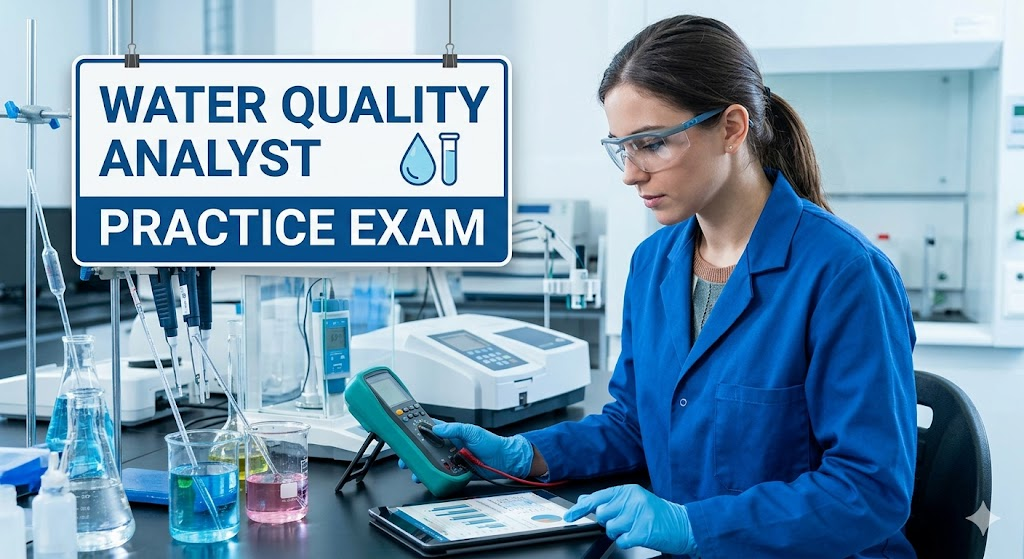
Additional Information
What the Course Entails and Exam Details
Preparation for the Water Quality Analyst examination requires a thorough understanding of multi-disciplinary scientific principles and regulatory frameworks. The course curriculum and subsequent exam cover several core areas crucial to effective water monitoring. Candidates are expected to demonstrate mastery in standard laboratory safety practices and advanced analytical chemistry techniques utilized for detecting metals, nutrients, and organic compounds.
The syllabus significantly emphasizes microbiological analysis, including protocols for detecting indicators like coliform bacteria. Furthermore, candidates must possess a deep understanding of quality assurance and quality control (QA/QC) methodologies to ensure data defensibility. Finally, a thorough knowledge of federal and local environmental regulations, such as the Safe Drinking Water Act (SDWA), is essential for success in this certification process.
What to Expect in the Final Exam
The final certification exam typically utilizes a comprehensive multiple-choice format designed to assess both theoretical knowledge and practical application scenarios. While specific question counts may vary slightly by jurisdiction or certifying body, candidates generally face between 70 and 100 questions. The allotted time limit is usually standardized around two to three hours, requiring efficient time management.
A minimum passing score of 70% is commonly required to earn the certification. The examination is administered under strict proctored conditions, and it is usually a "closed-book" test, meaning applicants are not permitted to use outside reference materials, textbooks, or personal notes during the session.
How to Study and Exam Centers
The most effective study strategy for the Water Quality Analyst exam involves a structured review of the core competencies combined with active recall practice. We strongly recommend dedicating significant time to working through the Water Quality Analyst Practice Test multiple times. This not only familiarizes you with the phrasing of the questions but also highlights specific technical areas where you require further review of the foundational textbooks or regulatory documents.
Augment your practice tests by reviewing official study guides provided by organizations such as the American Water Works Association (AWWA) or the Water Environment Federation (WEF). Regarding the examination location, the final test is generally administered either online through secure, proctored portals or at authorized physical testing centers designated by the state environmental agency. You must register in advance through your local certifying board to secure a testing slot.
Job Opportunities from the Course
Successfully achieving the Water Quality Analyst certification unlocks a variety of career paths within both the public and private sectors. Employers value this credential as proof of specialized technical competence. Common career paths and job titles include:
Water Quality Analyst
Environmental Laboratory Technician
Wastewater Plant Laboratory Supervisor
Environmental Compliance Specialist
Water Treatment Plant Operator (specifically those focused on laboratory analysis)
Field Sampling Technician
Industrial Pretreatment Specialist
Environmental Consultant
Frequently Asked Questions
Reviews
5.0
Based on 0 reviews
Leave a Review
No reviews yet. Be the first to review!