
Water Treatment Class E Practice Test
$69.00
- Buy to unlock unlimited access to all Quiz questions and Answers in this Quiz.
- After purchase you can print a PDF of the whole quiz at any point. The PDF will contain the questions and the correct answers.
About this Exam
The Water Treatment Class E certification is typically an entry-level or system-specific qualification designed for individuals starting their career in the drinking water industry or those responsible for operating smaller, often consecutive, water treatment and distribution systems. This certification, and by extension, a practice exam designed for it, is your key to understanding the fundamental principles of creating safe and healthy drinking water.
Designed for aspiring water operators, utility workers, maintenance technicians, and anyone involved in the essential task of ensuring clean water reaches public and private taps, this path focuses on foundational concepts and regulatory compliance relevant to this scale of operations. A practice test aims to assess your readiness by covering topics common to these crucial roles.
Ready to test your knowledge?
Buy Now to Access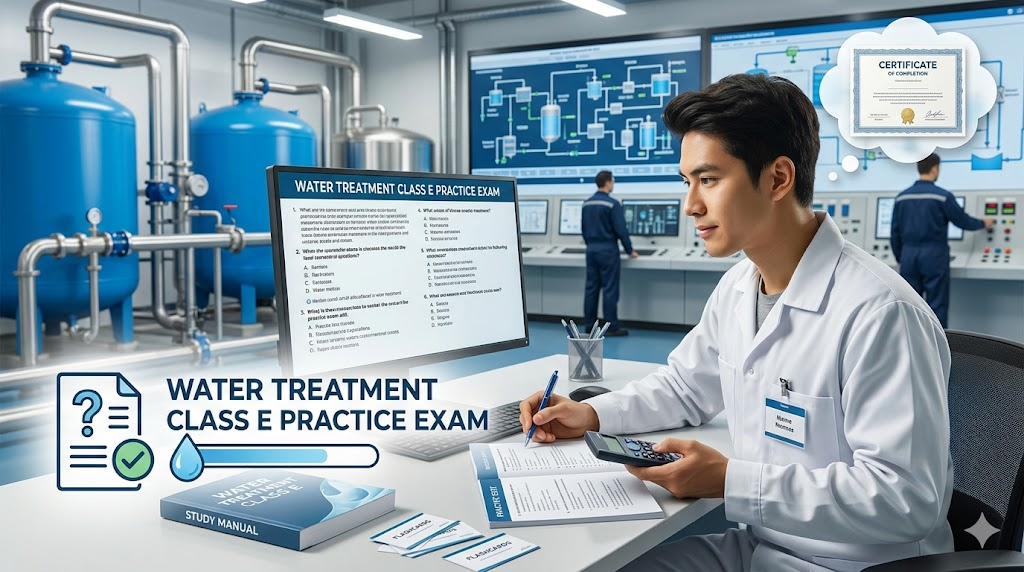
Additional Information
What the Course Entails and Exam Details
Preparing for the Water Treatment Class E requires a broad understanding of safe water principles and the specific operations appropriate for this level of certification. Key areas that a practice exam and your preparation will likely cover include:
Regulations and Safe Water Principles: A grounding in essential safety rules, public health implications of drinking water contaminants, and the history and impact of major regulations such as the Safe Drinking Water Act.
Basic Water Treatment Processes: An overview of common steps such as coagulation, flocculation, sedimentation, filtration, and significantly on a Class E level, disinfection principles, dosages, and residual testing.
Water Distribution Systems: Understanding the fundamentals of pipes, pumps, storage tanks, valves, and the general operation and maintenance of the systems that convey treated water.
Basic Water Math: Calculations vital to everyday operations, including dosages for chemical addition (like chlorine), detention times, filtration rates, flow measurements, and conversion between different units (e.g., Gallons, Cubic Feet, Pounds). Expect these to be fundamental to intermediate.
Sampling, Testing, and Laboratory Procedures: The importance of regular, accurate water sampling, basic tests for key parameters like pH, turbidity, chlorine residual, and understanding the significance of monitoring for bacteria, nitrates, and other potential contaminants.
Operation and Maintenance (O&M): Fundamental principles of pump operation, safety protocols (including handling chemicals), basic equipment maintenance, and understanding operational logs and records.
What to Expect in the Final Exam
While the specifics can vary significantly by state or provincial regulatory bodies, most water treatment certification exams, including those at a foundational or "Class E" level, follow a similar format. You can generally expect:
Format: Multiple-choice questions are the standard. You may encounter other types like matching, but multiple-choice is the most common and likely to be the focus of a practice exam.
Number of Questions: The final exam typically contains between 50 and 100 questions. Practice tests may vary, sometimes offering shorter or longer versions to help you manage your time and test a specific range of knowledge.
Time Limit: Expect to be given a specific time frame to complete the exam, often ranging from 1 to 3 hours, depending on the number of questions and exam structure. Practice with time limits is crucial.
Passing Score: A score of 70% is the most common passing mark. Check with your local certifying authority for their exact requirements.
Rules & Materials: Typically, calculators are permitted, sometimes along with formula sheets provided with the exam. Electronic devices other than a basic calculator are generally prohibited. Most exams are now taken on a computer, either in-person at a testing center or via secure online proctoring. Make sure to check your local rules regarding permissible calculators and the provision of formula sheets.
How to Study and Exam Centers
Preparation is paramount for success on any certification exam. Here is how to approach studying for the Water Treatment Class E test:
Actionable Study Strategies:
Leverage Practice Exams: Utilize high-quality Water Treatment Class E Practice Tests repeatedly. This helps you get comfortable with the multiple-choice format, identifies areas where you need further study, and helps with time management. Look for tests that explain correct answers.
Obtain Official Manuals/Courses: Consult with your state or province's regulatory agency and their official study guides and manuals. They may offer specific training courses, workshops, or list accredited educational institutions that cover the relevant material.
Focus on Foundational Concepts & Math: Dedicate significant time to mastering the foundational principles of water treatment, disinfection, regulations, and crucially, the basic math. Practice calculations for dosage, flow, and detention time frequently.
Create Flashcards & Study Guides: Distill key terms, definitions, regulatory limits, common formulas, and process steps into flashcards for efficient review. Build your own comprehensive study guides based on the syllabus.
Join Study Groups: Interacting with peers preparing for the same exam can provide different perspectives, explanations, and accountability.
Exam Centers: The final certification exam is administered through various official channels:
Online Proctoring: Increasingly, exams can be taken remotely via secure online proctoring services, often at your own office or home computer, subject to strict security guidelines.
State/Provincial Testing Centers: Many jurisdictions operate their own physical testing centers.
Authorized Schools & Colleges: Select educational institutions may be authorized to offer both the pre-exam coursework and the certification exam itself.
Testing Companies (e.g., Pearson VUE): Some regulatory bodies partner with large, professional testing organizations that have numerous physical centers across different locations.
Contact your local licensing or environmental agency directly to confirm their preferred study materials, accredited courses, and specific exam registration procedures and testing locations.
Job Opportunities from the Course
Successfully preparing for and passing a water treatment certification exam, even at an entry or foundational level like Class E, opens doors to meaningful and impactful careers in the public and private sectors. Your certification directly demonstrates your knowledge and commitment, making you a strong candidate for positions like:
Entry-Level Water Treatment Plant Operator: Assisting with the daily operations of a water treatment facility, monitoring processes, adjusting equipment, and ensuring compliance with regulations under supervision.
Utility Worker: Involved in the hands-on operation and maintenance of the water distribution and treatment systems, including repairing pipes, valves, and hydrants, and performing general utility tasks.
Maintenance Technician (Water Systems): Specializing in the upkeep, repair, and installation of machinery, pumps, and other essential components of the water infrastructure.
Water Quality Technician: Taking water samples, performing fundamental laboratory tests to ensure safety and regulatory compliance, and maintaining accurate records of water quality data.
Consecutive Water System Operator: Focusing specifically on the operation and maintenance of smaller systems that receive treated water from a larger system and distribute it to a distinct service area, a key responsibility for many Class E holders.
Distribution Operator (Entry-Level): For those focusing on the vast network of pipes and storage that delivers finished water, overseeing system performance and water quality from the plant to the customer.
Prepare diligently, practice with your test resources, and understand the core principles, and you will be well on your way to success in your Water Treatment Class E Certification journey!
Frequently Asked Questions
Reviews
5.0
Based on 0 reviews
Leave a Review
No reviews yet. Be the first to review!