
Water Treatment Grade 4 Practice Exam
$69.00
- Buy to unlock unlimited access to all Quiz questions and Answers in this Quiz.
- After purchase you can print a PDF of the whole quiz at any point. The PDF will contain the questions and the correct answers.
About this Exam
Welcome to your advanced path in water treatment. The Water Treatment Grade 4 certification represents an expert level of mastery, designed for highly experienced water treatment operators who have significant hands-on knowledge and often hold lower-grade certifications. This advanced qualification is for professionals who aspire to lead operations, manage complex treatment systems, ensure unwavering compliance with the highest regulatory standards, and safeguard public health at a large scale. Achieving this grade demonstrates to employers and regulatory bodies that you possess the complex knowledge, critical thinking skills, and management acumen necessary for the most responsible roles within the water industry. This study guide and our comprehensive practice exams are tailored to refine your understanding and help you confidently pass this challenging milestone.
Ready to test your knowledge?
Buy Now to Access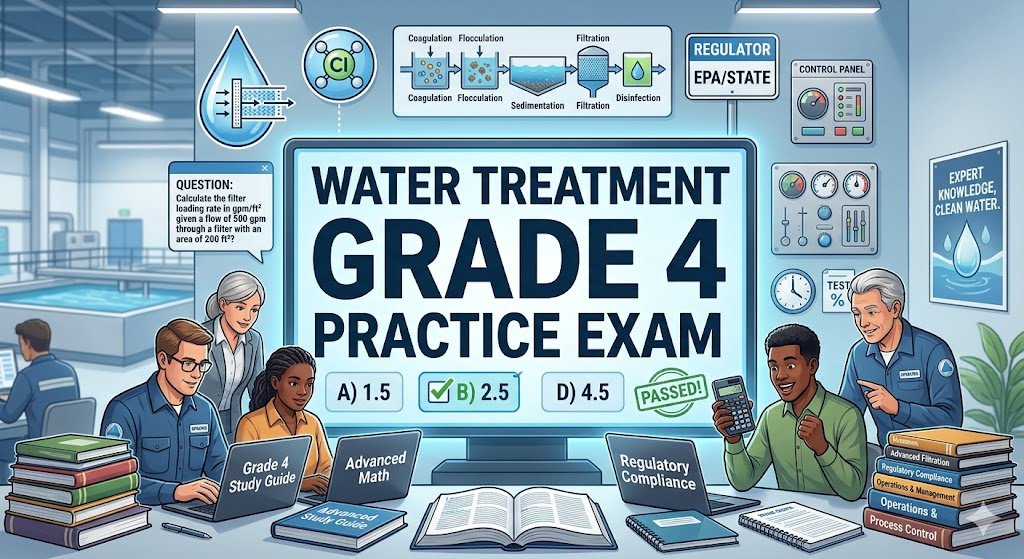
Additional Information
What the Course Entails and Exam Details
A typical Water Treatment Grade 4 curriculum or the scope of the exam itself covers an extensive range of advanced operational, regulatory, and managerial topics. Mastery of advanced math and complex process calculations is a key component. Core areas you can expect to be heavily emphasized include:
Advanced Water Treatment Processes: Detailed analysis and operation of conventional processes (coagulation, flocculation, sedimentation, filtration) and advanced technologies such as membrane filtration (RO, UF, NF), advanced oxidation, GAC (Granular Activated Carbon) absorption, and sophisticated disinfection methods beyond basic chlorination.
Water Chemistry & Microbiology (Advanced): High-level concepts in water chemistry (pH, alkalinity, hardness, specific contaminants), microbiology of waterborne pathogens, and the chemistry behind various treatment processes and contaminant removal.
Regulatory Compliance: An in-depth understanding of the Safe Drinking Water Act (SDWA), including complex state and federal regulations, specific MCLs (Maximum Contaminant Levels), monitoring requirements, reporting protocols, and public notification rules.
Operational Troubleshooting & Optimization: The ability to analyze data, interpret complex schematics, diagnose process upsets or equipment malfunctions, and implement sophisticated solutions to optimize plant performance, efficiency, and water quality.
Calculations & Mathematics (Advanced): Expect significant challenges in calculating complex chemical dosages, hydraulic loading rates, filter backwash requirements, detention times for multiple stages, pumping hydraulics, specific process efficiencies, and regulatory compliance metrics.
Plant Equipment & Instrumentation: Detailed knowledge of high-capacity pumps, motors, variable frequency drives (VFDs), complex instrumentation (analyzers, SCADA systems), chemical feed systems, and their maintenance.
Management & Leadership: Essential supervisory skills, including safety program development, operator training, emergency response planning, energy management, budgeting fundamentals, record-keeping, and public relations.
The actual exam structure is usually defined by the certifying body and commonly includes over 100 multiple-choice questions. A substantial portion will require application-level thinking and detailed calculation problem-solving. Some exams might also incorporate short-answer questions, scenario-based problems, or a practical component, though the primary format is written/computer-based multiple-choice. Expect a significant amount of time, possibly 4-6 hours, to complete this comprehensive assessment.
What to Expect in the Final Exam
While specific details can vary by state, province, or country, you can generally expect the following from your Grade 4 final exam:
Format: Primarily a robust set of multiple-choice questions designed to test knowledge, application, and analysis. Be prepared for complex math problems within this format.
Passing Score: The standard passing score is typically around 70% to 75% for the overall exam. However, some jurisdictions may require a minimum passing score on specific sections (e.g., calculations or safety) in addition to a cumulative passing score.
Time Limit: Expect a strict time limit, usually ranging from 4 to 6 hours. This reflects the complexity and depth of the material. Effective time management is crucial.
Calculators: Most exams allow and even encourage the use of specific types of non-programmable calculators. Check your specific certification authority's guidelines for approved models.
Closed Book (Typically): These exams are generally closed-book, meaning you must rely on your accumulated knowledge and the approved resources provided during the test (such as formula sheets or specific reference tables, if allowed).
Authorization: You will almost certainly need pre-authorization from your state or regional operator certification board to register for the exam, which typically requires documenting relevant education and extensive experience.
Identification: Bring official government-issued photo ID to the test center.
It is absolutely imperative to consult your local or state water operator certification agency for the exact, current details on their exam format, duration, allowed materials, and passing requirements.
How to Study and Exam Centers
Preparation is key for a Grade 4 exam, which demands a deep, synthesis-level understanding rather than just simple recall.
Actionable Study Strategies:
Deep Review of Reference Materials: Study the advanced treatment manuals published by organizations like the American Water Works Association (AWWA), your state’s specific environmental protection agency, or leading academic texts in water treatment engineering.
Master the Math: Spend dedicated time practicing advanced calculations. Understand the why and how of every formula, not just the formula itself. Use Grade 4-specific math worksheets and problems.
Utilize Practice Exams: This is one of the most effective tools. Take practice tests under timed conditions to experience the pacing and types of questions. Analyze every question you get wrong (and those you guessed on), understand the correct answer, and review the related material in your study guides. Look for practice exams specifically labeled "Grade 4" to ensure relevant difficulty.
Focus on Weak Areas: After initial practice, identify the topics where you struggle (e.g., membrane operation, complex chemistry, management scenarios, specific calculations) and dedicate focused study time to those specific concepts.
Form a Study Group: Collaborating with other experienced operators preparing for the same level can be incredibly beneficial. Discussing complex scenarios and working through problems together can reinforce learning.
Understand Regulations thoroughly: Download and study the most current state and federal regulations. Create summaries and flashcards for key standards and requirements.
Consider Advanced Courses: Enroll in advanced water treatment operator training courses offered by vocational schools, community colleges, or professional organizations.
Finding and Taking the Exam (Centers):
The process for taking the exam varies by location.
State Water Operator Certification Boards: This is always your starting point. Your state's Department of Environmental Protection, Department of Health, or a dedicated operator certification board is responsible for administering the program, setting the rules, and authorizing candidates.
Third-Party Testing Services: Many jurisdictions use specialized testing companies (such as PSI or Pearson VUE) to administer the computer-based exams.
Online/Remote Proctoring: Increasingly, some areas offer online exams with live remote proctoring, allowing you to take the test from a secure location using your own computer with specific security software.
Authorized Physical Testing Centers: Many physical testing centers, vocational schools, community colleges, or specific agency offices are authorized locations for computer-based or paper-and-pencil exams.
Action Plan to Find a Center:
Go to the official website of your state’s water operator certification program.
Find the section on "Examination" or "Certification."
Look for a list of approved testing centers, instructions on how to schedule an exam, or links to the authorized third-party testing service used in your area.
Carefully follow their specific registration and scheduling processes.
Job Opportunities from the Course
A Water Treatment Grade 4 certification is highly respected and significantly enhances your career trajectory, opening doors to advanced technical and leadership positions in both public and private water treatment sectors. Potential job roles and career paths include:
Senior Water Treatment Plant Operator
Water Treatment Plant Superintendent
Water Operations Supervisor
Water Quality Compliance Officer
Treatment Plant Manager / Chief Operator
Water Resource Manager
Technical Consultant in Water Treatment
Regulatory Analyst / Program Manager (for government agencies)
Water Treatment Educator/Instructor
Successfully achieving Grade 4 certification demonstrates to potential employers your exceptional level of skill, responsibility, and dedication, making you a strong candidate for leadership roles with increased compensation and impact on public health and environmental safety.
We hope this comprehensive guide and our targeted Grade 4 practice exams provide the clarity and confidence you need to excel in your certification journey. Good luck in your studies!
Frequently Asked Questions
Reviews
5.0
Based on 0 reviews
Leave a Review
No reviews yet. Be the first to review!