
Waterways Management Qualification Practice Test
$69.00
- Buy to unlock unlimited access to all Quiz questions and Answers in this Quiz.
- After purchase you can print a PDF of the whole quiz at any point. The PDF will contain the questions and the correct answers.
About this Exam
The Waterways Management Qualification is a vital certification for individuals aspiring to manage, regulate, and operate inland or coastal waterway systems effectively. This rigorous qualification validates comprehensive knowledge across diverse areas essential for ensuring safe navigation, environmental sustainability, efficient infrastructure usage, and effective traffic management. It is primarily designed for current or aspiring waterway managers, lockmasters, port authority personnel, navigation officers, environmental compliance specialists within the maritime sector, and any professional seeking to build a dedicated career overseeing the complex operations of our vital waterways. Successfully achieving this qualification demonstrates a commitment to professional excellence and safety within this critical infrastructure domain. Preparing with a dedicated practice test is often an invaluable step toward success.
Ready to test your knowledge?
Buy Now to Access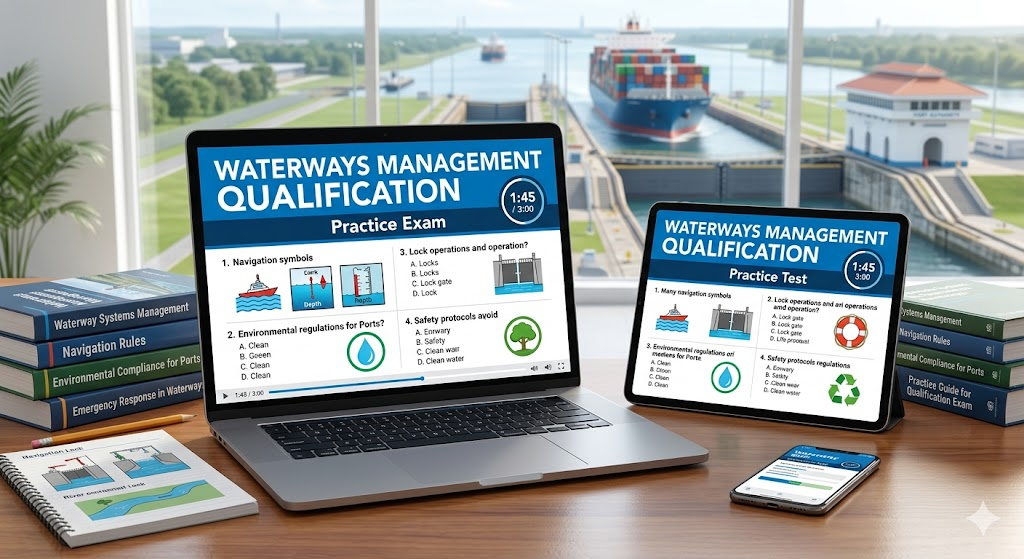
Additional Information
What the Course Entails and Exam Details
This certification program covers a broad spectrum of critical maritime topics. The curriculum is meticulously designed to equip candidates with the knowledge required for effective waterways oversight.
Core areas of study typically include:
Maritime Law and Regulations: Understanding international (e.g., IMO), national, and local legislation governing water transport and environmental protection.
Aids to Navigation (ATON): Comprehensive knowledge of buoyage systems, lighting, and signaling used to guide vessels safely.
Environmental Management: Protocols for pollution prevention (MARPOL), invasive species control (ballast water management), and habitat conservation.
Vessel Traffic Services (VTS): Principles of managing ship traffic in busy waterways and ports to prevent collisions and congestion.
Hydrography and Dredging: Basics of underwater surveying and the management of dredging operations to maintain navigable depths.
Infrastructure Maintenance: Oversight of locks, dams, bridges, and port facilities.
What to Expect in the Final Exam
The final examination for the Waterways Management Qualification is a rigorous assessment of both theoretical knowledge and practical application scenarios.
Candidates should expect the following format:
Format: The exam predominantly consists of multiple-choice questions designed to test knowledge retention and situational judgment. Some advanced versions may include case study analysis or short essay components.
Duration: The standard time allowance is typically between 120 and 180 minutes, depending on the specific certifying body.
Passing Score: A passing grade generally requires scoring 70% or higher.
Proctoring: The exam is strictly proctored, whether taken online or in person, requiring valid identification and adherence to anti-cheating protocols. No reference materials are usually permitted during the test.
How to Study and Exam Centers
Preparation is key to succeeding on this challenging exam. A structured study approach is highly recommended.
Study Strategies:
Utilize Official Practice Tests: Engaging with a Waterways Management Qualification Practice Test is the most effective way to familiarize yourself with the question format and identify knowledge gaps.
Review Core Textbooks and Regulations: Focus heavily on the official study guide provided by the certifying institution, as well as primary regulatory texts like COLREGs and local navigation rules.
Join Study Groups: Discussing complex scenarios with peers can offer new perspectives on traffic management and regulatory interpretation.
Exam Centers:
The exam is administered through several channels to accommodate candidates globally. It can often be taken at authorized physical testing centers, such as Pearson VUE centers, which offer secure, proctored environments. Additionally, many certifying bodies now provide remotely proctored online exams, allowing candidates to take the test from a secure home or office location. Be sure to register well in advance through the official portal of your chosen certifying organization.
Job Opportunities from the Course
Earning the Waterways Management Qualification opens doors to diverse and rewarding career paths in the maritime sector.
Potential job roles include:
Waterway Manager / Administrator
Port Operations Supervisor
Marine Inspector / Surveyor
Harbor Master (in smaller ports or as an assistant in larger ones)
Vessel Traffic Service (VTS) Operator / Manager
Maritime Environmental Compliance Officer
Coast Guard Civilian Logistics Specialist
Coastal Zone Manager
Frequently Asked Questions
Reviews
5.0
Based on 0 reviews
Leave a Review
No reviews yet. Be the first to review!