
Wear and Appearance of the Army Uniform Practice Test
$69.00
- Buy to unlock unlimited access to all Quiz questions and Answers in this Quiz.
- After purchase you can print a PDF of the whole quiz at any point. The PDF will contain the questions and the correct answers.
About this Exam
The "Wear and Appearance of the Army Uniform Practice Test" is a crucial resource for any Soldier aiming to master one of the fundamental pillars of Army professionalism. Based entirely on Army Regulation (AR) 670-1, this practice exam is designed to help Soldiers of all ranks, from fresh recruits to seasoned noncommissioned officers, ensure they are representing the U.S. Army correctly. Compliance with these standards is not merely about rules; it is a critical measure of unit discipline, pride, and military effectiveness. Mastering this material is essential for anyone who wears the uniform and wants to avoid administrative action and succeed in their military career.
Ready to test your knowledge?
Buy Now to Access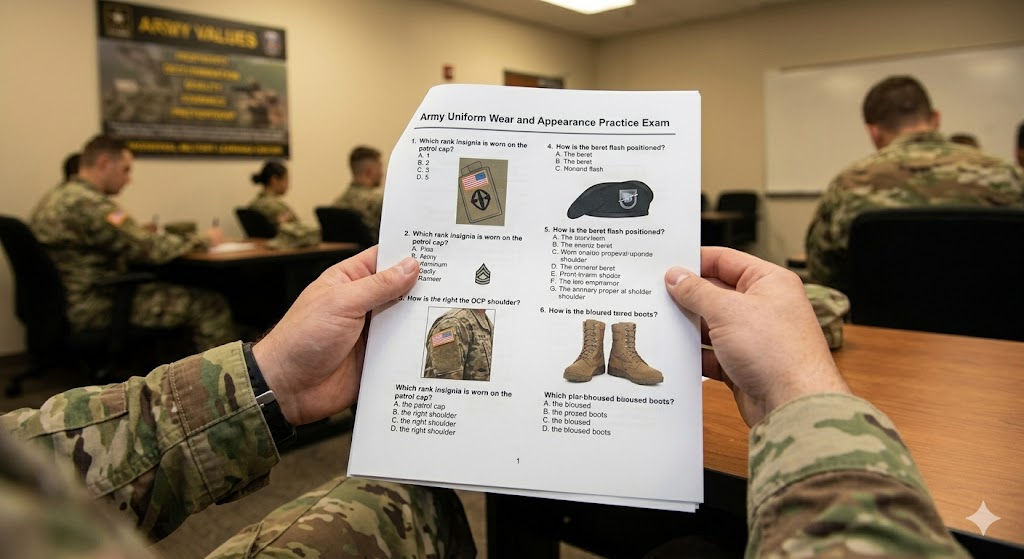
Additional Information
What the Course Entails and Exam Details
This practice test ensures proficiency in the specific rules and standards outlined in AR 670-1. While it is often studied as part of basic training, advanced leader courses, or pre-deployment preparations, it is every Soldier's personal responsibility to know and apply this knowledge daily. The core topics, which form the syllabus, cover:
Grooming Standards: Specific rules on haircuts, hair styles, facial hair (mustaches, shaving), and personal appearance for both male and female Soldiers.
Aparrel of Utility Uniforms: Detailed requirements for the proper fit, assembly, and wear of the Operational Camouflage Pattern (OCP) uniform, including blousing, sleeve rolling, and headgear.
Service and Dress Uniforms: The composition, classification, and occasions for wearing the Army Service Uniform (ASU) and the Army Green Service Uniform (AGSU).
Insignia, Awards, and Badges: Precise rules on the identification, classification, and placement of rank insignia, branch insignia, unit awards, personal decorations, special skill badges, and marksmanship badges for different uniform types.
Accouterments: Policies regarding the wear of nameplates, US Army tabs, berets, and organization-specific items.
Restrictions: Prohibited items and actions, including rules on jewelry, eyeglasses, and tattoos.
Heraldic Items: Oversight and policy on uniform quality and heraldic design.
What to Expect in the Final Exam
While the ultimate test is a physical inspection, formal evaluations of this knowledge, especially in school settings like the Noncommissioned Officer Professional Development System (NCOPDS), typically take a standardized format. You can expect:
Exam Format: Most formal knowledge tests on AR 670-1 use a standard multiple-choice or true/false structure, often delivered via a computer-based system. Some sections may include "hot spot" questions requiring you to identify the correct placement of an item on a diagram of a uniform.
Practical Component: In almost every scenario, the written test is a precursor to a graded practical application, such as a formal in-ranks inspection. Your ability to apply the knowledge is just as important as your ability to recall it.
Passing Score: For academic environments, a minimum passing score of 70% or 80% is standard. For professional development boards or special schools, a score of 90% or even 100% may be expected.
Time Limit: Exams are typically timed, allowing you approximately one minute per question, encouraging both accuracy and decisiveness.
How to Study and Exam Centers
The key to success on this exam is a combination of direct study and practical application. Your most effective strategies include:
Deep Dive into AR 670-1 and DA Pam 670-1: These are your primary sources. Read them. Then, read them again. Pay particular attention to the chapters relevant to your most-worn uniforms.
Utilize Official Army Apps and Guides: The Army often provides digital grooming and uniform guides. These are interactive and can provide visual reference points.
Flashcards and Practice Tests: Create or use digital flashcards to memorize dimensions, positions, and composition rules for every badge, award, and insignia. Take this practice test multiple times to get comfortable with the wording and format.
Practical Mock Inspections: The best way to study is to practice. Set up a mirror or have a peer conduct a full in-ranks inspection on you. Use the actual regulatory checklists to grade each other.
Exam Centers: For standardized military testing, you will take your exam at authorized locations, which are often internal to your unit or training center. These include unit learning centers, NCO academy testing computer labs, or designated education centers on a military installation.
Job Opportunities from the Course
Mastery of "Wear and Appearance of the Army Uniform" does not unlock a specific job; rather, it is a foundational requirement for success in every single military occupational specialty (MOS). Continuous compliance is a prerequisite for retention and promotion within the U.S. Army. Your commitment to these standards directly impacts your professional reputation and your path forward in roles such as:
Active Duty Soldier (All MOS)
Army Reserve Soldier (All MOS)
Army National Guard Soldier (All MOS)
Noncommissioned Officer (NCO) Leaders
Warrant Officers
Commissioned Officers
Drill Sergeants
Recruiters
Instructors and Facilitators in Army Schools
Any role within the Command and Staff structure.
Frequently Asked Questions
Reviews
5.0
Based on 0 reviews
Leave a Review
No reviews yet. Be the first to review!