
WebXam Agriculture, Food, and Natural Resources (AFNR) Practice Test
$69.00
- Buy to unlock unlimited access to all Quiz questions and Answers in this Quiz.
- After purchase you can print a PDF of the whole quiz at any point. The PDF will contain the questions and the correct answers.
About this Exam
The WebXam Agriculture, Food, and Natural Resources (AFNR) pathway assessments are crucial standardized tests designed specifically for high school Career-Technical Education (CTE) students across various agricultural programs. These comprehensive exams are not just a graduation requirement in many regions, but also act as powerful tools to validate the specialized technical skills and industry knowledge that students have acquired throughout their coursework. If you are aiming for a career in the dynamic field of agriculture, food production, or environmental conservation, preparing for and succeeding on this test is a foundational step. Using a high-quality practice test is an essential strategy for ensuring you are comfortable and ready for the final assessment environment.
Ready to test your knowledge?
Buy Now to Access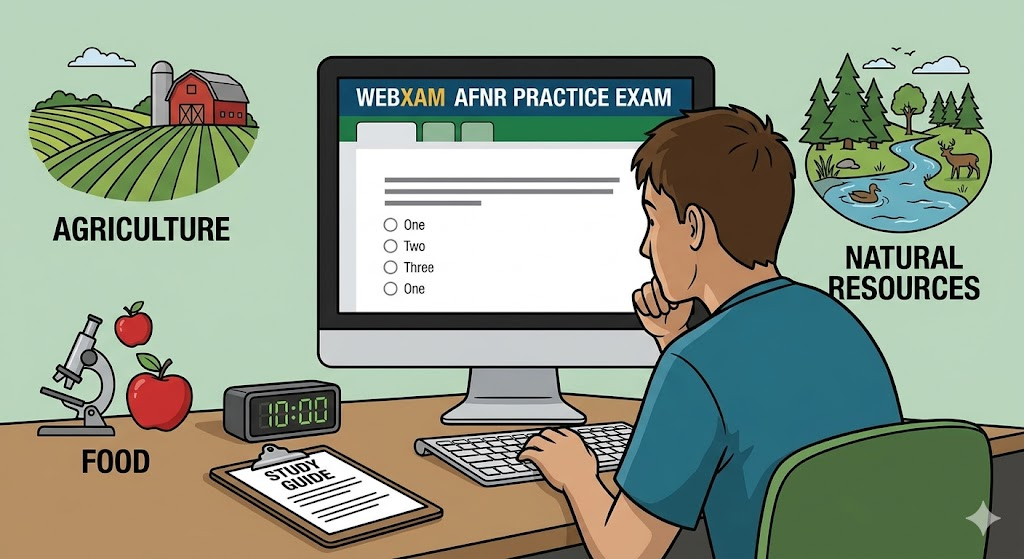
Additional Information
What the Course Entails and Exam Details
This examination covers a broad and diverse range of topics reflecting the complex world of modern agriculture and natural resource management. While specific course structures may vary, the content for the WebXam AFNR pathways generally draws from comprehensive curriculum areas including: Animal Science, Plant and Soil Sciences, Environmental and Natural Resource Management, Agribusiness and Economics, Agricultural Engineering, and Food Science and Technology. Students are expected to demonstrate critical thinking by applying their theoretical knowledge to practical scenarios, interpreting data related to field research, and solving common operational challenges within the industry. By engaging with these diverse subject areas, students gain the multifaceted skills required to address current issues in food security and sustainable resource use.
What to Expect in the Final Exam
You should expect the final WebXam AFNR assessments to be administered digitally via a secure online testing portal. The exams primarily utilize a multiple-choice format, which carefully evaluates your understanding across multiple performance indicators tied to state and industry educational standards. Although a specific passing score may be set by individual school districts or state CTE guidelines, your objective should always be to achieve high mastery to demonstrate robust proficiency. While a general time limit is usually assigned to each section, specific time constraints often reflect the depth of knowledge expected rather than extreme speed. A high score can signify exceptional career readiness and enhance opportunities for post-secondary education.
How to Study and Exam Centers
Effective preparation for the WebXam AFNR assessments requires a focused, multifaceted approach that combines consistent review with practical application. The cornerstone of your preparation strategy should be the dedicated use of a practice test like this one; simulating the real exam format helps you normalize the testing process and build the critical time-management skills essential for success. After completing each practice session, make a point to thoroughly analyze which areas you struggled with most so that you can create targeted study sessions centered on those complex concepts. Do not simply rely on independent study; integrate collaborative peer review groups where you can teach and explain complex agricultural concepts, as teaching others is proven to reinforce your own understanding. For the final examination, you will not need to find an external Pearson VUE or third-party testing location; these standard tests are seamlessly administered directly within your high school, vocational center, or an equivalent authorized CTE institution, often utilizing the very computer labs you are familiar with for daily instruction.
Job Opportunities from the Course
A strong performance on the WebXam AFNR assessments provides powerful validation of your career-technical skills, giving you a distinct advantage as you explore further education or jump directly into the workforce. This foundational certification signals to recruiters that you possess the rigorous knowledge and dedicated skill set required across a multitude of essential positions. Potential career paths and specific job titles unlocked by expertise in this field include, but are absolutely not limited to: Agricultural Field Technician, Veterinarian Assistant, Quality Control Inspector, Farm or Ranch Manager, Food Science Technician, Agribusiness Sales Representative, Environmental Analyst, Landscape Architect Assistant, and Forestry Aide. Success here clearly demonstrates your preparedness to tackle the evolving challenges and diverse operational roles crucial to sustaining our global food, fiber, and natural resource systems.
Frequently Asked Questions
Reviews
5.0
Based on 0 reviews
Leave a Review
No reviews yet. Be the first to review!