
WebXam Exercise & Athletic Training Practice Test
$69.00
- Buy to unlock unlimited access to all Quiz questions and Answers in this Quiz.
- After purchase you can print a PDF of the whole quiz at any point. The PDF will contain the questions and the correct answers.
About this Exam
The WebXam Exercise & Athletic Training Practice Test is a crucial tool designed for high school students or individuals pursuing career technical education (CTE) in the fields of sports medicine, personal training, or physical therapy. This comprehensive assessment mimics the final high school end-of-course exam, evaluating a student’s fundamental knowledge and skills required to safely and effectively work in the vast world of exercise science. This test is intended for those aspiring to enter an athletic training education program or who are working towards a vocational certificate, aiming to validate their understanding of biomechanics, injury prevention, and basic kinesiology.
Ready to test your knowledge?
Buy Now to Access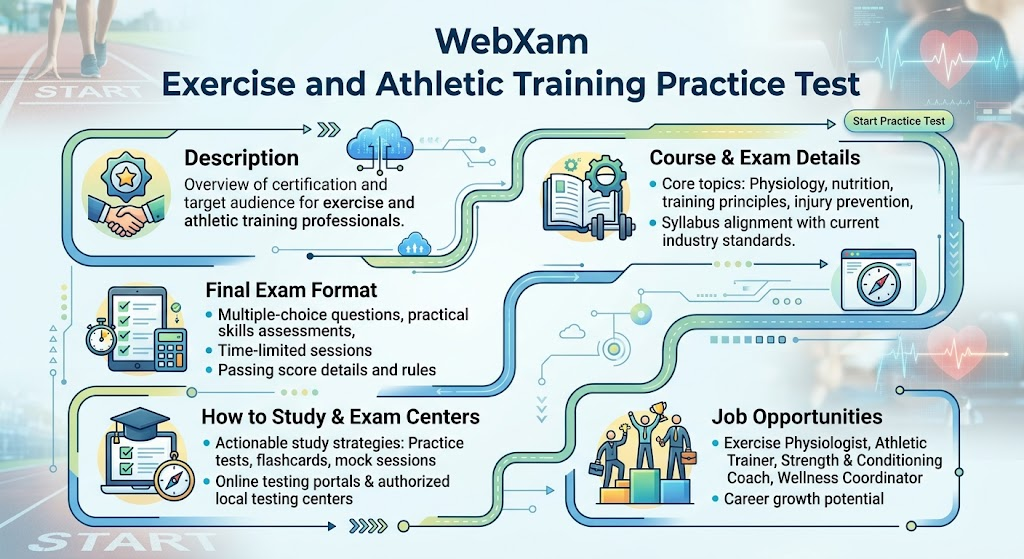
Additional Information
What the Course Entails and Exam Details
This examination assesses knowledge gained through specialized coursework typically offered in vocational schools or specialized high school programs. It focuses on several core domains foundational to the health and fitness industry. Students can expect to encounter questions covering basic human anatomy and physiology, the principles of strength and conditioning, fundamental biomechanics of movement, and essential skills in athletic injury assessment and acute care.
The standard examination is typically delivered online through the WebXam platform. It consists of multiple-choice questions developed to align with state-specific CTE standards. These questions are strictly cognitive, measuring theoretical knowledge and practical understanding. While the specific passing score can vary depending on the local educational agency or state mandate, achieving a high score is often a prerequisite for receiving certification credit or advanced placement. Students generally have a standard time block (often approximately one hour) to complete the test.
What to Expect in the Final Exam
You can expect an objective, computer-based test requiring critical application of knowledge rather than rote memorization. The final exam typically follows this structured multiple-choice format:
Format: Online, multiple-choice questions.
Number of Questions: Typically around 40-50 questions.
Time Limit: Approximately 60 minutes (though this may vary by specific state implementation).
Pass Mark: Generally 70% or higher is required, but this is set by individual school districts or state curriculum guidelines.
The questions are meticulously designed to simulate real-world scenarios that an athletic training student or entry-level fitness professional might encounter. You will not just be asked to label a bone; you might be asked to identify the most likely injury associated with a specific mechanism of movement. There is usually no negative marking for incorrect answers.
How to Study and Exam Centers
Effective preparation is key. Because this exam covers a broad spectrum of the physical sciences, a multi-faceted study approach is highly recommended.
Key Study Strategies:
Use Official Practice Tests: Utilizing the actual WebXam Exercise & Athletic Training Practice Test is the most effective way to become familiar with the question style and content.
Review Course Material: Go back through your textbooks, lecture notes, and lab manuals from your exercise science class.
Study Anatomy and Physiology: Pay particular attention to musculoskeletal anatomy, joint actions, and basic systems (e.g., cardiovascular and respiratory responses to exercise).
Understand Injury Mechanisms: Review common acute and chronic sports injuries and their typical rehabilitation or first-aid protocols.
Exam Centers:
Unlike national certifications taken at standardized centers (such as Pearson VUE), WebXam exams are usually administered locally.
Authorized Schools: The exam is typically administered directly at the student's high school or career center.
Proctoring: The test is proctored by a certified teacher or testing coordinator who ensures academic integrity.
Check with your vocational instructor or school counselor regarding the specific date, location, and login procedures for your WebXam testing session.
Job Opportunities from the Course
Successfully passing this end-of-course exam and completing your high school program is the first vital step toward a rewarding career in health and wellness. While this test itself does not confer a full, independent professional license, it serves as the essential stepping stone to advanced certifications and further academic study.
Career paths this training supports include:
Certified Personal Trainer
Athletic Training Student Aide
Physical Therapy Aide
Exercise Physiology Assistant
Group Fitness Instructor
Wellness Coach
Preparation for degree programs in Athletic Training or Kinesiology
Frequently Asked Questions
Reviews
5.0
Based on 0 reviews
Leave a Review
No reviews yet. Be the first to review!