
WebXam Finance Practice Test
$69.00
- Buy to unlock unlimited access to all Quiz questions and Answers in this Quiz.
- After purchase you can print a PDF of the whole quiz at any point. The PDF will contain the questions and the correct answers.
About this Exam
The WebXam Finance Practice Test is an essential preparatory tool for students enrolled in Career-Technical Education (CTE) finance programs, particularly within the state of Ohio. Developed by the Center on Education and Training for Employment (CETE) at The Ohio State University, this assessment is part of a statewide system designed to measure student technical skill attainment in various career pathways.
Specifically, the Finance Practice Test is designed for high school and adult students who are completing coursework in areas such as accounting, banking services, financial planning, and insurance. Its primary function is to help learners familiarize themselves with the style, structure, and content of the final end-of-course assessments, commonly known as post-tests. For educators, it offers a way to gauge student readiness and identify areas where additional instruction may be required before the official exam.
By engaging with the practice test, students can reduce test anxiety, improve their time management skills, and confirm their understanding of key financial concepts and practical applications. Successfully navigating the WebXam pathway, including passing the required post-tests, often serves as a key component for graduation requirements, demonstrating technical proficiency to future employers, and earning college credit.
Ready to test your knowledge?
Buy Now to Access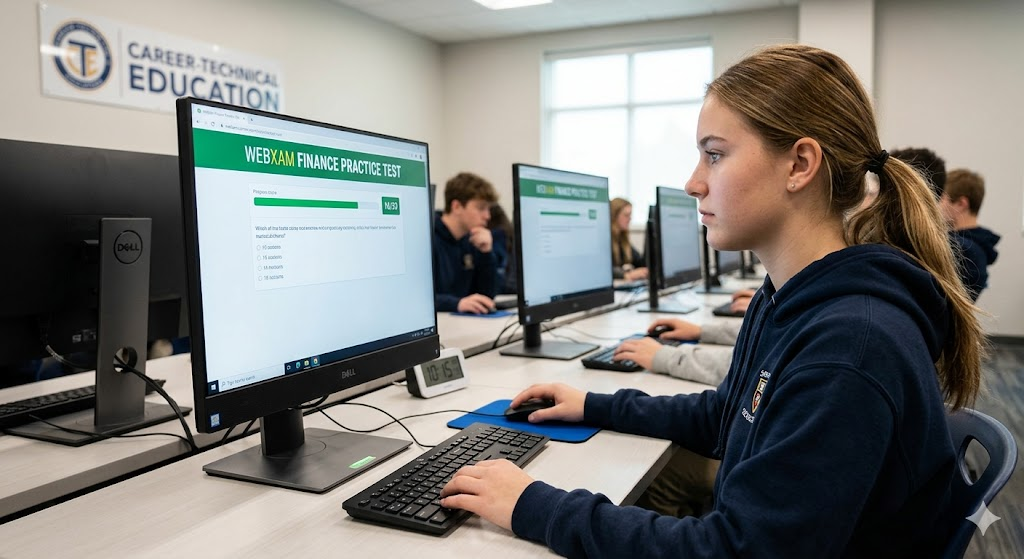
Additional Information
What the Course Entails and Exam Details
A standard Finance CTE pathway, which this WebXam practice test supports, covers a comprehensive range of topics essential for an entry-level career in the financial sector. While specific course titles can vary, the core knowledge and skills typically include:
Accounting Fundamentals: Understanding the accounting cycle, preparing financial statements (balance sheets, income statements), journalizing transactions, and payroll.
Banking and Financial Services: Principles of commercial and retail banking, understanding different types of accounts, loan processing, and regulatory compliance.
Business Finance and Economics: Micro and macroeconomic concepts, analyzing business performance, financial modeling, and budgeting.
Financial Planning and Investing: Fundamentals of personal finance, investment vehicles (stocks, bonds, mutual funds), retirement planning, and risk tolerance.
Risk Management and Insurance: Types of insurance (life, health, property), understanding risk assessment, and claims processing.
Professionalism and Ethics: Legal responsibilities, ethical dilemmas in finance, and soft skills required for client interaction.
The WebXam Finance Practice Test itself is a condensed, online evaluation. Unlike the comprehensive post-test, the practice test typically consists of 20 multiple-choice questions. These questions are a representative sample from the full item bank, designed to provide a quick assessment of a student’s overall knowledge across the various strands of the Finance pathway curriculum.
Upon completion of the practice test, students are provided with an immediate percentage score out of 20, allowing for a benchmark of their current standing.
What to Expect in the Final Exam
While the WebXam Finance Practice Test is 20 questions, the full, official "post-test" (end-of-course assessment) is a more robust examination.
For the official WebXam post-test, students can expect:
Format: The exam is entirely online and consists exclusively of multiple-choice questions.
Number of Questions: The final test usually contains between 40 to 100 questions, depending on the specific Finance course or pathway being assessed.
Time Limit: There is a strict time limit, typically ranging from 45 to 90 minutes, requiring efficient time management.
Passing Score: A passing score, often called "proficient," is determined by the Ohio Department of Education and Workforce and varies slightly by test, but is generally around the 60-70% range.
Rules: The final exam must be proctored, usually by a designated school staff member, and is closed-book with no external resources allowed.
How to Study and Exam Centers
Effective preparation for the WebXam Finance assessments requires a combination of reviewing course material and utilizing official practice resources.
Actionable Study Strategies:
Utilize the Practice Test Fully: Take the WebXam Finance Practice Test multiple times. Pay attention to the types of questions and the specific phrasing used, rather than just memorizing answers. This builds familiarity and reduces test-day surprises.
Review Course Standards: Obtain the "WebXam Performance Standards and Blueprints" from your teacher or the official WebXam news site. These documents explicitly outline what percentage of the test is dedicated to each topic, helping you prioritize your study time.
Simulate Test Conditions: When taking practice tests, time yourself. Create a quiet environment without distractions to build stamina and speed.
Focus on Key Terms: Create flashcards for critical financial definitions, formulas (e.g., for ratios, interest, and break-even points), and regulatory laws.
Take Advantage of Pre-tests: If your district offers WebXam "pre-tests" at the beginning of the course, use the feedback to establish a baseline and track your progress throughout the year.
Exam Centers and Location:
WebXam assessments are administered directly through authorized educational institutions, not through external centers like Pearson VUE.
School Administration: The primary location for taking the WebXam is within the school or career technical center where you are enrolled in the finance course.
Authorized Staff: The tests are scheduled and activated by a designated teacher or a District Testing Coordinator (DTC), ensuring security and proper proctoring protocols.
Online Portal: All WebXam assessments are taken through the secure, proprietary WebXam online portal.
Job Opportunities from the Course
Successfully completing a Finance CTE program and demonstrating proficiency through the WebXam can open doors to various entry-level career paths in a high-demand sector. The skills and credentials gained prepare students to enter the workforce directly or provide a strong foundation for post-secondary education.
A clear path from a Finance CTE course can lead to job titles such as:
Accounting Clerk
Bookkeeper
Bank Teller
Payroll Specialist
Junior Financial Analyst
Loan Processor
Tax Preparer Assistant
Insurance Agent Trainee
Billing Coordinator
Accounts Payable/Receivable Clerk
These roles are found in a variety of settings, including corporations, small businesses, public accounting firms, banks, credit unions, and insurance agencies. Continuing education with a degree (Associate’s or Bachelor’s) or further certifications can propel graduates into higher-level positions such as Certified Public Accountant (CPA), Certified Financial Planner (CFP), or Financial Manager.
Frequently Asked Questions
Reviews
5.0
Based on 0 reviews
Leave a Review
No reviews yet. Be the first to review!