
Welder Block 2 Practice Exam
$69.00
- Buy to unlock unlimited access to all Quiz questions and Answers in this Quiz.
- After purchase you can print a PDF of the whole quiz at any point. The PDF will contain the questions and the correct answers.
About this Exam
The Welder Block 2 exam is a pivotal assessment in a welding apprenticeship, marking the transition from foundational skills to intermediate proficiency. It is designed for apprentices who have completed their initial training blocks and are advancing toward becoming journey-level welders. This exam evaluates a candidate's grasp of complex welding theories, blueprint interpretation, and the practical application of various welding processes (like intermediate-level GMAW and FCAW) necessary for more challenging fabrication projects. Successfully navigating this exam demonstrates readiness for advanced training and a serious commitment to the trade.
Ready to test your knowledge?
Buy Now to Access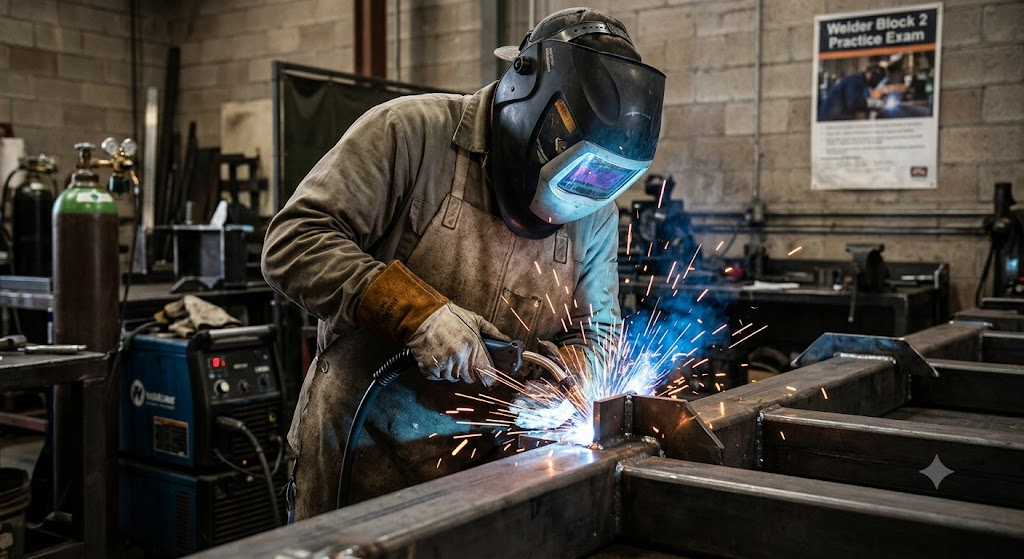
Additional Information
What the Course Entails and Exam Details
This technical training and the subsequent exam focus on the intermediate competencies critical for industrial welding success. Key areas covered include:
Intermediate Welding Processes: Detailed instruction and practical application of Gas Metal Arc Welding (GMAW) and Flux-Cored Arc Welding (FCAW) techniques on different materials (e.g., steel, aluminum) in intermediate positions.
Blueprint Reading & Trade Math: Mastering complex blueprint symbols, specifications, and applying intermediate trade math for precise fabrication and layout.
Advanced Metallurgy: Understanding the properties of various metals and how different welding procedures, heat inputs, and cooling rates affect material strength and structure.
Safety Standards (OH&S): Reinforcing comprehensive occupational health and safety regulations, hazard recognition, and safe work practices within industrial environments.
Interpretation of Welding Symbols: Developing the ability to accurately interpret complex welding symbols according to industry standards like AWS A2.4.
What to Expect in the Final Exam
The actual credentialing exam typically follows a theory-based format to thoroughly assess technical understanding.
Format: The final exam is primarily composed of multiple-choice questions.
Content: Questions cover a range of trade theory topics, safety regulations, blueprint reading scenarios, and technical specifics of welding processes.
Passing Score: A passing grade is generally established at 70%.
Time Limit: Candidates are usually provided with a fixed duration (often 3 to 4 hours) to complete the examination.
Rules: Standard examination rules apply; the test is usually closed-book, and candidates must adhere to testing center protocols.
How to Study and Exam Centers
Preparation involves a balanced approach of reviewing academic content and reinforcing practical understanding.
Study Strategies:
Review Textbooks & Class Notes: Thoroughly review the primary technical manuals, code books, and learning modules (such as Individual Learning Modules, or ILMs, used in Canada) from your Block 2 training.
Take Practice Exams: Utilize the provided practice test as a primary tool. Mimicking the real exam environment with timed practice sessions helps identify knowledge gaps and improves time management.
Focus on Trade Math & Blueprint Reading: These are often the most challenging sections. Dedicate specific time to solving problems and interpreting sample blueprints.
Hands-on Reinforcement: Whenever possible, relate theoretical questions back to your actual experiences in the shop during your apprenticeship training.
Exam Centers:
Block 2 exams are generally administered through local apprenticeship authorities, technical institutes, or community colleges. Candidates typically register through their regional apprenticeship board and are assigned a physical testing center to take the proctored exam in person.
Job Opportunities from the Course
Successfully completing your Block 2 training and passing the exam advances you through the apprenticeship program and makes you a much more valuable asset to employers. This certification progress leads toward diverse opportunities:
Intermediate Welder (GMAW/FCAW specialist)
Structural Steel Welder
Fabricator
Manufacturing Welder
Maintenance Welder
Pipeline Welder (often requiring further specialized certifications)
Pressure Vessel Welder (with additional endorsements)
Continuing through the blocks towards final Journeyperson certification guarantees significantly higher earning potential and career security.
Frequently Asked Questions
Reviews
5.0
Based on 0 reviews
Leave a Review
No reviews yet. Be the first to review!