
Welder Performance Qualification Practice Test
$69.00
- Buy to unlock unlimited access to all Quiz questions and Answers in this Quiz.
- After purchase you can print a PDF of the whole quiz at any point. The PDF will contain the questions and the correct answers.
About this Exam
The Welder Performance Qualification Practice Exam is your simulated gateway to validating the crucial, practical skills needed to become a certified professional welder. A performance qualification, unlike a standard knowledge-based test, primarily involves the physical act of creating specific welds to demonstrable standards. This process ensures that individuals possess the requisite skills to perform safely and produce quality welds in line with established codes and procedures.
This practice exam is specifically designed for aspiring welders, current students in welding programs, and existing professionals seeking to qualify for new welding processes, positions, or projects. It mirrors the structure and challenges of a real certification test, providing a valuable rehearsal that allows you to assess your readiness, identify skill gaps, and understand exactly what will be required to achieve your qualification. Successful completion of this type of qualification is vital for entry-level jobs and career advancement in numerous trades and industries.
Ready to test your knowledge?
Buy Now to Access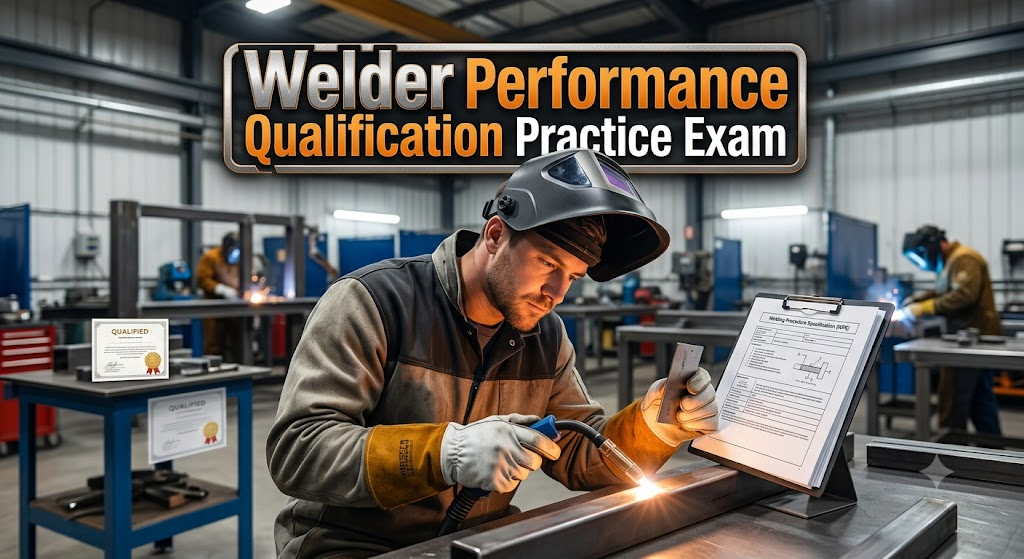
Additional Information
What the Course Entails and Exam Details
This comprehensive guide and practice exam framework detail the core practical skills you must master for a genuine performance qualification. While specific qualification standards can vary (e.g., AWS D1.1 for structural steel, ASME Section IX for pressure vessels), the fundamental elements tested remain remarkably consistent. The practice material ensures you are prepared for the key aspects of these qualifications.
The essential skills and topics typically tested in a welder performance qualification include:
Understanding Welding Procedure Specifications (WPS): Every qualification requires welding according to a pre-defined and documented WPS. The practice exam helps you learn to read, understand, and strictly follow these technical guidelines, including material specifications, filler metal types, shielding gases, heat inputs, and multi-pass techniques.
Welding Processes: You will practice and be tested on specific welding methods, most commonly:
SMAW (Shielded Metal Arc Welding): Stick welding, requiring precise arc control.
GMAW (Gas Metal Arc Welding): MIG welding, demonstrating control over wire feed and shielding gas.
GTAW (Gas Tungsten Arc Welding): TIG welding, requiring high dexterity for electrode and filler metal control.
FCAW (Flux-Cored Arc Welding): Semi-automatic process, similar to MIG but with dynamic wire options.
Welding Positions: True proficiency means welding in multiple spatial orientations. Practice includes positions designated as 1G (flat groove), 2G (horizontal groove), 3G (vertical groove), 4G (overhead groove), and the highly demanding 5G and 6G positions specifically for pipe welding. These determine the range of real-world work you are qualified to perform.
Material Types and Joint Configurations: Tests often involve common materials like carbon steel, stainless steel, or aluminum in various thicknesses, and practice includes different joint configurations such as butt welds, fillet welds, and potential single- or multi-pass operations.
Safety Practices: Understanding and adhering to rigorous safety standards – proper protective equipment (PPE), work area preparation, and safe handling of gases and electricity – are non-negotiable and scrutinized during the test.
A practice test simulates these exact scenarios, providing mock test coupons, sample WPSs, and a clear understanding of the parameters you will be required to meet in a real testing environment. It teaches you not just how to weld, but how to weld under exam conditions.
What to Expect in the Final Exam
While a "Practice Exam" helps you prepare, the final, official qualification test is the decisive event. Understanding the typical structure of the actual performance qualification is crucial for effective study.
The final, officially proctored exam generally follows this procedure:
Test Preparation: You will be provided with specific test pieces (coupons), necessary filler material, and the corresponding Welding Procedure Specification (WPS). An authorized test proctor or inspector will verify your material preparation and set up your equipment to meet the WPS criteria.
Visual Inspection (Initial): Before welding begins, the inspector will often visually check the fit-up and cleanliness of the joint.
The Practical Test (The Weld): Under strict supervision and potential time limits, you will perform the specified weld, adhering strictly to the WPS, safety guidelines, and allowed parameters. The inspector will observe your technique, electrode control, travel speed, and overall workmanship.
Visual Inspection (Post-Weld): Immediately upon completion, the weld is visually examined by the inspector for surface imperfections like cracks, porosity, undercut, underfill, and excessive reinforcement.
Destructive or Non-Destructive Testing: Most critically, the welded specimen must undergo subsequent testing to verify its internal integrity. Common methods include:
Guided Bend Tests (Destructive): Specimens are cut from the test piece and bent under force to look for internal flaws and assess ductility.
Tensile Tests (Destructive): To measure the joint's strength.
Radiographic Testing (X-ray, Non-Destructive): For internal examination without breaking the piece.
Ultrasonic Testing (Non-Destructive): Another non-destructive internal check.
Passing Score/Requirements: Performance qualifications are typically pass/fail, determined by whether the test specimen meets the strict acceptance criteria of the relevant welding code or standard (e.g., specific maximum flaw sizes in a bend test). There isn't usually a percentage score; your weld either meets the code or it doesn't.
Rules & Prohibitions: All safety protocols must be followed. Unauthorized assistance is strictly forbidden. Grinding and repair techniques are often governed by specific rules.
Your "practice exam" experience should be structured to simulate these exact conditions as closely as possible, helping you overcome test anxiety and perfect the necessary techniques in a low-stakes environment.
How to Study and Exam Centers
Preparation for a performance qualification is vastly different from studying for a typical multiple-choice test; it is fundamentally about extensive, deliberate practical experience. Here are actionable strategies:
Actionable Study Strategies:
Enroll in Professional Instruction: Hands-on training from experienced welding instructors at technical colleges, trade schools, or union halls is absolutely critical for learning proper technique, safety standards, and interpretation of WPSs.
Intensive Practical Practice: Dedicate countless hours in a welding booth, replicating all positions (1G-6G) and processes you intend to qualify for on different material thicknesses and joint types. Practice consistently following the specific details of sample WPSs.
Seek Regular Feedback: Have experienced welders or instructors visually inspect your practice welds, particularly looking for internal and external defects.
Mock Assessments (Use the Practice Exam Concept): Structurally replicate the entire test experience repeatedly. Get test coupons, follow a specific WPS, time yourself, and have a knowledgeable person visually "inspect" your final weld as a proctor would, or even arrange for mock bend tests if possible. This is the core of "taking a practice test."
Review Theoretical Basics & Safety: While primarily practical, understand the basic science of the welding processes you're using and, crucially, commit all welding safety rules to memory. There might be some minimal written component in some programs, though pure performance qualifications are mostly hands-on.
Study the Codes: Gain a familiarity with the codes (like AWS D1.1, ASME Section IX) your qualification may be based on, to understand the specific acceptance and rejection criteria.
Use Practice Tests: Utilize structured practice test materials, like sample exam scenarios and WPSs, to add realism and focus to your training sessions.
Exam Centers and Where to Take the Exam:
Authorized Test Facilities (ATFs): The most common way to take an official qualification is through an Accredited Test Facility authorized by organizations like the American Welding Society (AWS). ATFs are typically specialized training centers, technical schools, or union training facilities.
Technical Colleges and Trade Schools: Many local institutions offer welding programs and also function as authorized testing centers or can facilitate testing through affiliated ATFs.
Industry Facilities & Union Halls: Specific large-scale construction projects or trade unions often have their own internal or affiliated facilities for qualifying welders to their required standards.
How to Register: Search the websites of the certifying body (e.g., AWS) for a list of ATFs in your area. Contact the chosen center directly to understand their application process, specific qualification offerings, scheduling, and fees. They will guide you through the process of registering for an official test.
Using a comprehensive Welder Performance Qualification Practice Exam approach, complete with professional training and consistent practice, is unequivocally the most effective way to approach your official qualification with confidence and secure that vital certification.
Job Opportunities from the Course
Successfully achieving a Welder Performance Qualification isn't just about passing a test; it is the single most valuable credential for unlocking a vast array of job opportunities and career advancement in the professional welding world. A valid, documented performance qualification dramatically increases your employability and can lead to significantly higher earning potential.
Here are just some of the career paths and job titles this critical qualification opens doors to:
Structural Welder
Pipe Welder
Pressure Vessel Welder
Manufacturing & Production Welder
Aerospace Welder
Automotive & Transportation Welder
Maintenance & Repair Welder
Shipbuilder/Maritime Welder
Construction Welder (across numerous infrastructure projects)
Robotic Welding Technician (often requires basic manual welding qualifications as a base)
Quality Control Welder/Welding Inspector (understanding performance qualification is foundational knowledge)
Fabrication Shop Foreman
Underwater Welder (requires substantial additional training, but performance qualification is a necessary step)
Tradesperson in plumbing, pipefitting, ironworking, boilermaking, and sheet metal fabrication
This qualification serves as the tangible proof of your practical skill and dedication, making you a highly desirable candidate in industries ranging from basic manufacturing to advanced aerospace and critical infrastructure development. It is the cornerstone for building a safe, skilled, and rewarding career in welding.
Frequently Asked Questions
Reviews
5.0
Based on 0 reviews
Leave a Review
No reviews yet. Be the first to review!