
Welding Print Reading Practice Exam
$69.00
- Buy to unlock unlimited access to all Quiz questions and Answers in this Quiz.
- After purchase you can print a PDF of the whole quiz at any point. The PDF will contain the questions and the correct answers.
About this Exam
Mastering the language of welding prints is essential for success in the fabrication industry. This practice exam and study guide are designed for welders, quality inspectors, engineering technicians, and anyone who needs to accurately interpret detailed technical drawings. Gaining proficiency in welding print reading demonstrates your ability to understand complex designs, ensure project accuracy, and maintain high-quality standards. Whether you are just starting your career or looking to validate your existing skills, this guide will help you prepare effectively. A strong foundation in blueprint reading significantly boosts your employability and opens doors to advanced roles. This practice exam provides a structured way to assess your knowledge and focus your studies on critical areas.
Ready to test your knowledge?
Buy Now to Access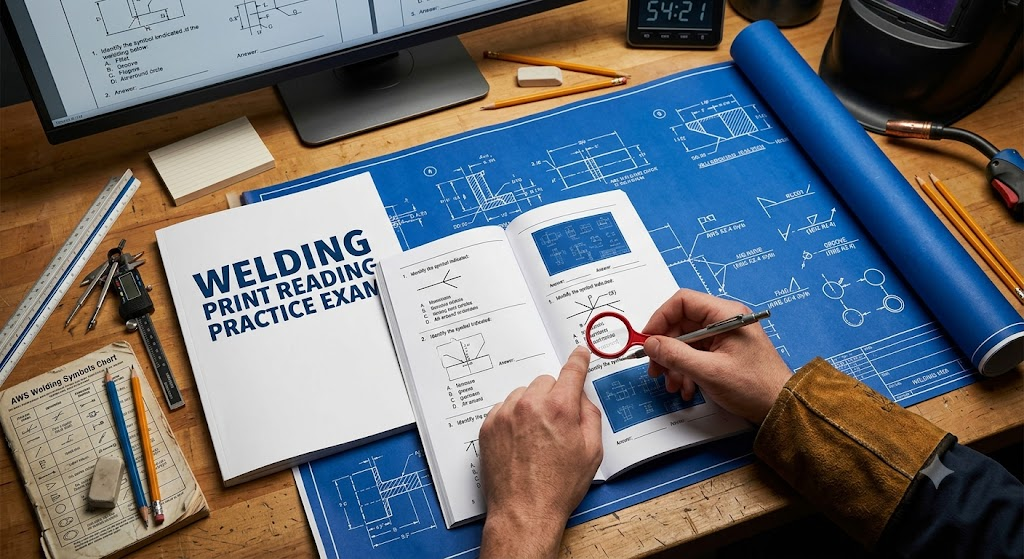
Additional Information
What the Course Entails and Exam Details
This study guide and practice exam cover the fundamental principles and specialized knowledge required to navigate welding prints with confidence. You will delve into the vast world of welding symbols, dimensions, tolerances, and the interpretation of various view types. Our comprehensive coverage includes identifying and decoding the American Welding Society (AWS) symbols for fillet, groove, plug, slot, spot, and seam welds, along with Nondestructive Testing (NDT) requirements. You will learn to analyze orthographic, isometric, sectional, and auxiliary views to form a complete mental picture of the final product. Expect to grasp how material specifications, welding processes, and quality standards are clearly communicated on blueprints. The knowledge gained through this guide aligns with common industry practices and standard certifications, ensuring your preparation is relevant and valuable.
What to Expect in the Final Exam
While specific exams and certifications differ, you can anticipate a theoretical testing format primarily comprised of multiple-choice questions. The actual final exam will test your speed and accuracy in interpreting various scenarios and symbols presented on detailed print samples. Expect sections where you must correctly identify specified weld types, interpret precise dimensions and tolerances, determine required inspection methods, and extract key project information from the print notes and title blocks. Passing scores generally range between 70% and 80%, so aiming for high proficiency across all topics is crucial. You will likely face a time limit, potentially between one and three hours, demanding efficient analysis and confident decision-making. Standard test environments often prohibit references, requiring you to recall symbols and standards accurately.
How to Study and Exam Centers
Effective preparation requires a combination of structured study, consistent practice, and exposure to real-world examples. Begin by thoroughly understanding the AWS A2.4 standard for symbols and terms, as this is the foundational language of the trade. Utilize comprehensive textbooks, online courses, and interactive study aids, including practice question banks and flashcards to reinforce key concepts. Repeatedly taking practice exams like this one is vital for identifying weak areas, improving recall speed, and familiarizing yourself with standard testing formats. Actively practice by examining actual welding prints from various industries and checking your interpretations against expert solutions or blueprints with known correct details. Consider enrolling in dedicated welding print reading courses offered by vocational schools, community colleges, or the American Welding Society (AWS) to receive expert instruction. For formal certification exams, candidates typically register through the relevant organization's website and select a testing center (such as Pearson VUE for some exams or AWS-authorized centers) or utilize online proctoring options where available.
Job Opportunities from the Course
A strong understanding of welding prints, validated by practice and potentially formal certification, significantly enhances career prospects and earning potential in numerous roles. The ability to decipher blueprints is a vital skill that unlocks a variety of engaging and well-paying opportunities:
Fabricator: Essential for understanding complex structural assemblies and executing precise builds.
Structural Welder: Required for following specified joint details, weld sizes, and sequences on large-scale projects.
Pipe Welder: Critical for navigating isometric drawings, specific codes, and ensuring leak-proof connections.
Welding Inspector (CWI/CAWI): Absolutely non-negotiable for verifying that all welds meet design specifications and safety standards.
Quality Control/Assurance Technician: Key for ensuring fabricated parts adhere to precise dimensional and quality tolerances.
Engineering Technician/Draftsperson: Necessary for communicating design intent through accurate drawings and collaborating effectively.
Production Supervisor/Foreman: vital for planning workflows, managing teams, and ensuring adherence to complex project plans.
Estimator: Crucial for accurately calculating material and labor requirements based on technical blueprints.
Welding Educator/Trainer: Essential for passing on this fundamental skill to the next generation of welders.
Frequently Asked Questions
Reviews
5.0
Based on 0 reviews
Leave a Review
No reviews yet. Be the first to review!