
West Coast EMT Block 4 Practice Test
$69.00
- Buy to unlock unlimited access to all Quiz questions and Answers in this Quiz.
- After purchase you can print a PDF of the whole quiz at any point. The PDF will contain the questions and the correct answers.
About this Exam
The West Coast EMT Block 4 Practice Test is a crucial milemarker for students enrolled in a comprehensive Emergency Medical Technician training program, specifically focused on the western region's standards.
This internal exam is designed to validate a student’s mastery of advanced foundational concepts, serving as a critical gateway before advancing to final practical evaluations and the national certification exam (NREMT).
It is specifically designed for EMT candidates who have completed the initial blocks of instruction and are now integrating complex patient care strategies.
Ready to test your knowledge?
Buy Now to Access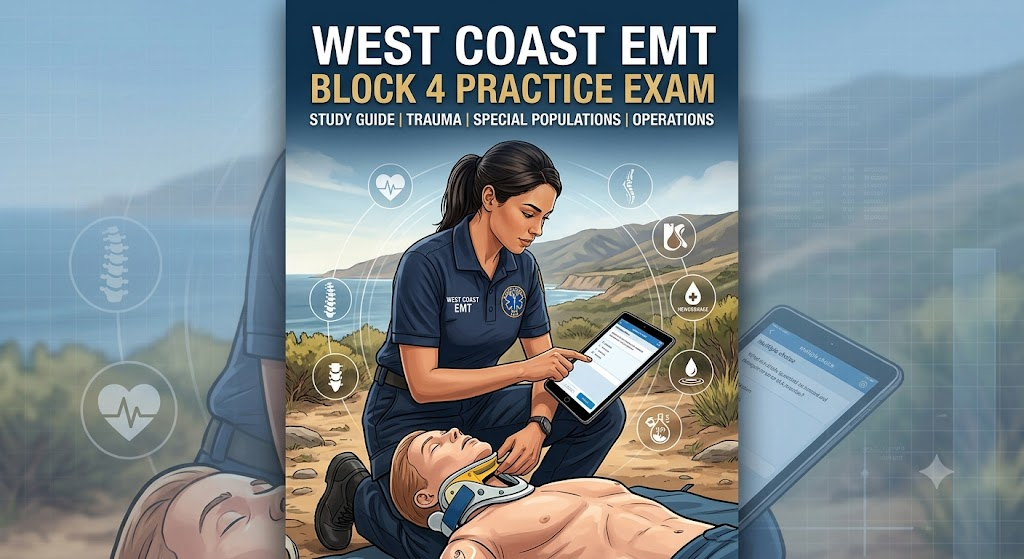
Additional Information
What the Course Entails and Exam Details
This phase of your EMT training moves beyond basic definitions and dives into critical thinking and decision-making for high-acuity scenarios.
The West Coast EMT Block 4 curriculum typically includes a heavy emphasis on:
Advanced Trauma Care: Master the assessment and management of multi-system trauma, dynamic mechanism of injury analysis, kinetic energy principles, and critical hemorrhage control.
Special Populations: Develop specialized knowledge for treating geriatric, pediatric, and obstetric patients, understanding their unique physiological and psychological needs during an emergency.
EMS Operations: Solidify your understanding of ambulance operations, scene management, mass casualty incidents (MCI), and the incident command system.
Integrative Medical & Trauma Scenarios: This block synthesizes previous learning, challenging you to manage patients with concurrent medical and traumatic emergencies simultaneously.
What to Expect in the Final Exam
You should approach the Block 4 exam as a simulation of the cognitive demands you will face on the NREMT.
The exam format is primarily computer-based, multiple-choice questions designed to test your application of knowledge, not just recall.
You can expect:
Scenario-Based Questions: Many questions present a clinical scenario and ask for the most appropriate next step in assessment or treatment.
Time Limit: While internal policies vary, these exams are typically timed to prepare you for the pacing required by the NREMT.
Passing Score: Students must achieve a minimum proficiency, often defined by the training institution (e.g., 75% or 80%), to receive their course completion certificate and be cleared for NREMT testing.
How to Study and Exam Centers
Preparation for Block 4 requires moving from rote memorization to active synthesis.
Study Strategies:
Utilize Practice Tests: Actively take simulated practice tests that offer detailed rationales for correct and incorrect answers to understand the "why" behind every protocol.
Review Scenario-Based Materials: Focus on case studies and scenarios that force you to prioritize care for polytrauma or complex medical patients.
Form Study Groups: Collaboratively discussing different patient management approaches is highly effective for internalizing the material.
Textbook Deep Dive: Pay close attention to the specific chapters in your AAOS or equivalent textbook covering Trauma, Operations, and Special Populations.
Exam Centers: The West Coast EMT Block 4 exam is an internal, proctored examination administered directly by your training institution (e.g., at the West Coast EMT campus or via their secure online testing portal).
Contact your lead instructor or course coordinator for specific scheduling instructions and technical requirements.
Job Opportunities from the Course
Upon successful completion of your full EMT program and subsequent state or national certification, you will be eligible for various vital roles within the healthcare and public safety sectors.
Common job titles include:
Emergency Medical Technician (EMT)
Ambulance EMT-B
ER Technician (Hospital Emergency Department)
Firefighter/EMT (Cross-trained roles)
Search and Rescue Team Member
Tactical EMT (Specialized law enforcement support)
Industrial or Event EMT
Frequently Asked Questions
Reviews
5.0
Based on 0 reviews
Leave a Review
No reviews yet. Be the first to review!