
West Coast EMT Block Two Practice Exam
$69.00
- Buy to unlock unlimited access to all Quiz questions and Answers in this Quiz.
- After purchase you can print a PDF of the whole quiz at any point. The PDF will contain the questions and the correct answers.
About this Exam
The West Coast EMT Block Two Practice Exam is a critical assessment designed for students enrolled in an Emergency Medical Technician (EMT) program.
This exam specifically targets the intermediate section of the EMT curriculum, serving as a comprehensive review of knowledge and skills acquired before progressing to advanced topics.
It is designed for aspiring EMS professionals who are already familiar with foundational life support and are now mastering more complex assessments and emergency medical scenarios.
Successful completion of this practice exam ensures that students are well-prepared for their program's final evaluation and, ultimately, the National Registry of Emergency Medical Technicians (NREMT) cognitive and psychomotor examinations.
Ready to test your knowledge?
Buy Now to Access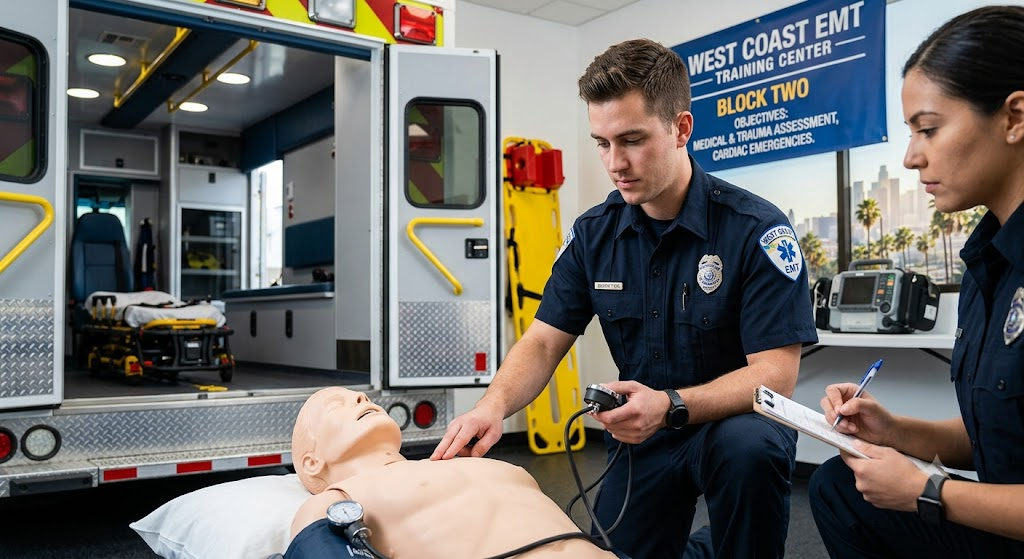
Additional Information
What the Course Entails and Exam Details
This phase of the EMT program transitions from basic interventions to detailed patient care management. The course entails a deep dive into medical and trauma emergencies, refining critical thinking. Key modules include:
Detailed Patient Assessment: Master comprehensive primary and secondary surveys for both medical and trauma patients, learning to identify life-threats and subtler signs of distress.
Medical Emergencies: Cover cardiac emergencies (including acute coronary syndrome and stroke), respiratory emergencies (asthma, COPD, pneumonia), and environmental, toxicological, and behavioral emergencies.
Trauma Management: Learn advanced management of specific traumatic injuries, including soft tissue injuries, shock, head, neck, and spinal trauma, and multisystem trauma.
Basic Life Support and Resuscitation: Refine CPR, AED use, and airway management techniques, including advanced ventilation.
Special Populations: Understand unique assessment and treatment considerations for pediatric, geriatric, and obstetric patients.
Basic Pharmacology for EMTs: Gain a thorough understanding of the specific medications an EMT is authorized to administer or assist with, including dosages, routes, and contraindications.
The exam details involve both a cognitive (written) component and a psychomotor (practical) skills component. Students must demonstrate proficiency in both areas.
What to Expect in the Final Exam
For your official final EMT course evaluation, students can expect a structured two-part assessment designed to ensure they are entry-level competent.
The Cognitive (Written) Exam
This part typically consists of 100 to 150 multiple-choice questions administered either on a computer or on paper.
It covers all information in the National EMS Education Standards relevant to the EMT level. Questions are designed to test not just recall, but your ability to apply knowledge in a scenario-based format.
Expect a time limit, often around 2 hours, for this section. A standard passing score is usually 70% to 80%, depending on your specific West Coast program's requirements.
The Psychomotor (Practical) Skills Exam
The practical component requires you to demonstrate your hands-on proficiency through several graded "stations."
You must pass every station, typically within specified time limits (e.g., 10 minutes per station). Passing is based on successful completion of a checklist of critical skills.
Missing a "critical criterion" (e.g., failing to manage an airway, failure to ensure scene safety) will result in automatic failure of that station, regardless of other points earned.
Common stations for the practical exam include:
Patient Assessment – Medical
Patient Assessment – Trauma
Cardiac Arrest Management / AED
BVM Ventilation of an Apneic Adult Patient
Oxygen Administration
Bleeding Control / Shock Management
Various immobilization and splinting techniques (e.g., long bone, joint, traction splint).
How to Study and Exam Centers
Preparation for the West Coast EMT Block Two exam requires a combination of self-directed study and practical application.
Actionable Study Strategies
Scenario-Based Practice: Create scenarios with classmates where you practice running a "call" from dispatch to transport, integrating all necessary skills and assessments.
Skill Checklists: Obtain the official NREMT psychomotor skill sheets and practice every step until they are instinctive.
Flashcards for Pharmacology: Use spaced-repetition flashcards to memorize medication names, mechanisms of action, indications, and, crucially, contraindications and side effects.
Utilize Ride-Alongs: Maximize your required clinical rotations and ambulance ride-alongs by actively participating in patient assessments and skills, under supervision.
Practice Quizzes and Mock Exams: Take multiple "Block Two" level practice exams to identify knowledge gaps and get comfortable with the multiple-choice format.
Exam Centers and Procedures
For the course practice and final exams, your primary location will be your specific EMT training center or school, which is authorized by the county or state EMS authority.
Your instructor will guide you on scheduling and specific rules for these in-house assessments.
For the subsequent NREMT examinations:
Cognitive Exam: You will register through the NREMT portal and schedule your exam at a Pearson VUE testing center, which are located throughout the West Coast and nationwide.
Psychomotor Exam: The practical exam is usually hosted by a state-approved EMT training program, which may or may not be your original school. A state EMS official typically proctors this exam.
Job Opportunities from the Course
Upon completion of the West Coast EMT program and successful certification, you will be eligible for various rewarding career paths. Some typical job titles include:
EMT-Basic
Ambulance Driver
Emergency Room Technician (ER Tech)
First Responder
Event Medical Technician (for concerts, sporting events, and festivals)
Search and Rescue Technician
Tactical EMT (with additional training)
Firefighter/EMT (required for many fire departments)
This certification serves as a foundational step for those looking to advance into Paramedicine, Nursing, or Physicians Assistant programs.
Frequently Asked Questions
Reviews
5.0
Based on 0 reviews
Leave a Review
No reviews yet. Be the first to review!