
West Coast EMT Program Practice Exam
$69.00
- Buy to unlock unlimited access to all Quiz questions and Answers in this Quiz.
- After purchase you can print a PDF of the whole quiz at any point. The PDF will contain the questions and the correct answers.
About this Exam
The West Coast EMT Program is designed to equip aspiring Emergency Medical Services (EMS) professionals with the critical skills and knowledge necessary to respond to medical emergencies. This program is ideal for individuals seeking to start a career as an EMT, providing the foundational training required for state certification and national licensure. Whether you are aiming to work on an ambulance, in a hospital emergency room, or as part of a fire department, this course is your first step into the fast-paced world of emergency medicine.
Ready to test your knowledge?
Buy Now to Access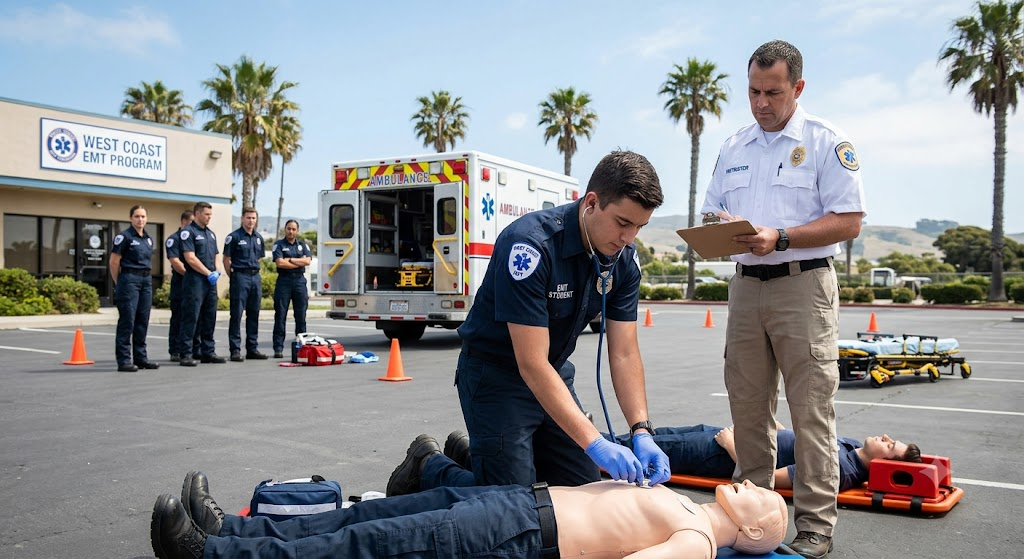
Additional Information
What the Course Entails and Exam Details
The course covers a comprehensive range of topics essential for pre-hospital care. Students will dive deep into anatomy and physiology, patient assessment (both medical and trauma), airway management, pharmacology, and shock resuscitation.
The syllabus is structured around the National EMS Education Standards, ensuring that you receive training on:
Medical emergencies (respiratory, cardiovascular, diabetic, etc.)
Trauma care (soft tissue injuries, spinal immobilization, bleeding control)
Special populations (pediatrics, geriatrics, obstetrics)
EMS operations (ambulance safety, disaster response)
The program includes both didactic (classroom) learning and hands-on practical skills labs to ensure proficiency in life-saving techniques.
What to Expect in the Final Exam
The final examination is a rigorous evaluation designed to ensure you are ready for entry-level EMS duty. It typically consists of two main components:
Cognitive Exam:
This is a computer-based, multiple-choice exam that tests your knowledge across the entire curriculum. You can expect questions on airway, ventilation, oxygenation; trauma; cardiology; medical emergencies; and EMS operations. The exam requires you to demonstrate critical thinking and the ability to apply your knowledge to clinical scenarios.
Psychomotor (Practical) Exam:
In this section, you will be required to demonstrate hands-on proficiency in several critical skills. This often includes patient assessment (both medical and trauma), bag-valve-mask ventilation, spinal immobilization, and other life-saving interventions.
You must pass both the cognitive and psychomotor components to successfully complete the program. Specific passing scores and time limits for the cognitive exam are usually set in accordance with the National Registry of Emergency Medical Technicians (NREMT) standards or specific state requirements, which will be detailed by your program instructors.
How to Study and Exam Centers
Preparation is key to succeeding on the West Coast EMT Program final exam. Here are actionable study strategies:
Review Regularly: Don’t cram. Review your textbook and lecture notes weekly.
Utilize Practice Exams: Take as many practice exams as possible. These help familiarize you with the question format and identify areas where you need more study. Focus on understanding why a certain answer is correct.
Form Study Groups: Collaborating with classmates can help clarify difficult concepts and reinforce learning.
Practice Practical Skills: Spend extra time in the skills lab. Memorize the steps (the "skill sheets") for patient assessment and interventions until they become second nature.
Exam Centers:
The psychomotor exam is typically conducted at the specific school or training facility where you completed your EMT course.
For the cognitive exam (especially if it is the NREMT exam required for licensure), you will need to register through the appropriate national or state portal. These exams are usually administered at authorized Pearson VUE testing centers, which have multiple locations throughout the West Coast and nationwide.
Job Opportunities from the Course
Upon successful completion of the course and obtaining your certification, a variety of rewarding career paths will open up to you. Some of the specific job titles and career paths this certification unlocks include:
Ambulance EMT (Private or Municipal)
Emergency Room Technician (ER Tech)
Firefighter/EMT (requires further fire academy training)
Flight EMT (with additional experience and training)
Tactical EMT (working with law enforcement)
Industrial EMT (at remote worksites or large manufacturing facilities)
Event Medic (at concerts, sports venues, and festivals)
Frequently Asked Questions
Reviews
5.0
Based on 0 reviews
Leave a Review
No reviews yet. Be the first to review!