
West Virginia Brokers Practice Exam
$69.00
- Buy to unlock unlimited access to all Quiz questions and Answers in this Quiz.
- After purchase you can print a PDF of the whole quiz at any point. The PDF will contain the questions and the correct answers.
About this Exam
The West Virginia Brokers Practice Exam is an essential assessment designed for experienced real estate salespersons who are ready to advance their careers and manage their own brokerages in the Mountain State.
This exam is the final hurdle to obtaining a West Virginia Real Estate Broker’s License, signifying a high level of expertise in real estate law, finance, management, and ethical practice.
It validates your competency to operate independently, supervise other licensees, and handle complex real estate transactions within the unique legal framework of West Virginia.
Ready to test your knowledge?
Buy Now to Access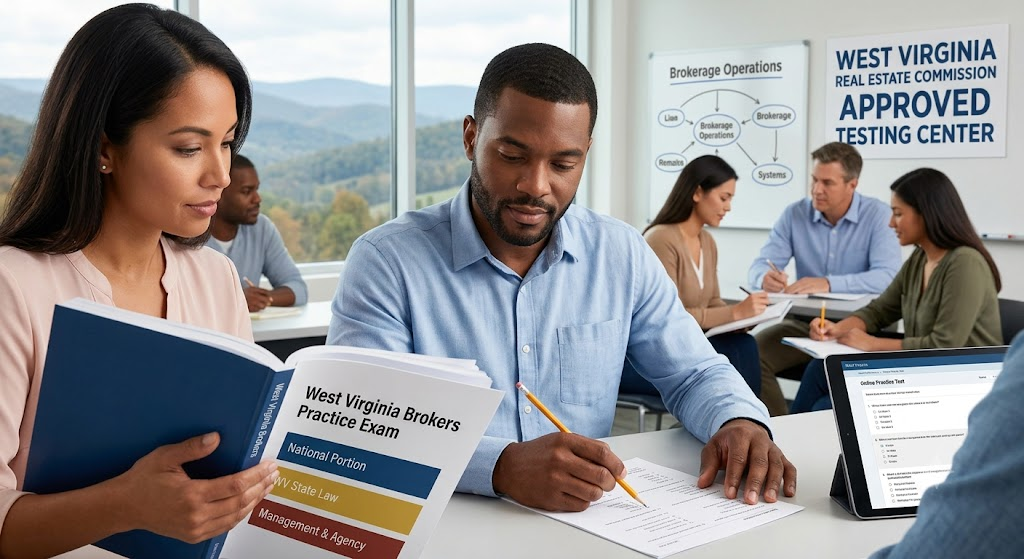
Additional Information
What the Course Entails and Exam Details
To qualify for the West Virginia Broker licensure process, applicants typically must completed approved, advanced real estate education.
While specific course providers vary, the curriculum universally covers both broad national principles and specific West Virginia regulations. Core topics include:
Advanced Real Estate Law and Litigation (contracts, agency, property ownership, land use)
Brokerage Management and Operations (business planning, trust accounts, recruiting, supervision)
Real Estate Finance (mortgages, financing types, lending laws, appraisal)
Risk Management and Ethics (fair housing, environmental issues, disclosure requirements)
West Virginia License Law and Commission Rules (state-specific definitions, advertising rules, disciplinary procedures)
Closing Real Estate Transactions (settlement statements, closing procedures, tax implications)
What to Expect in the Final Exam
The West Virginia Real Estate Broker License Examination is administered in two distinct parts on the same day. It is a computer-based, multiple-choice test.
You must pass both sections to qualify for licensure.
The National Portion: This section covers general real estate principles and practices applicable across the United States. You can expect questions on general agency relationships, contracts, finance, and valuation.
The State Portion: This critical section focuses strictly on West Virginia statutes, rules of the West Virginia Real Estate Commission (WVREC), and state-specific practices regarding licensing, trust funds, and managing broker responsibilities.
Passing Score: A passing score is required on each individual section. Consult the official exam candidate handbook for the current scaled score requirements.
Time Limits: You will be given separate time limits for the National and State portions. A combined appointment usually lasts approximately 4 to 5 hours, including administrative time.
How to Study and Exam Centers
Preparation is key to success on the West Virginia Brokers Exam. It requires a significant shift from the perspective of a salesperson to that of a supervising manager.
Effective Study Strategies:
Utilize Official Resources: Your primary resource is the West Virginia Real Estate Commission (WVREC) website and the Candidate Handbook provided by the exam administrator. These documents detail the exam content outline and state-specific laws.
Review Core Brokerage Material: Dedicate substantial time to studying advanced topics you may not encounter daily as a salesperson, particularly trust account management, brokerage operations, and supervising licensees.
Take Targeted Practice Exams: Engage with simulation exams that mimic the format, difficulty, and time constraints of the actual test. Focus heavily on practice questions regarding West Virginia License Law.
Where to Take the Exam (Exam Centers):
The West Virginia Real Estate Broker License Examination is administered by a contracted testing service (e.g., Pearson VUE).
You cannot take the official exam until your broker license application has been approved by the West Virginia Real Estate Commission.
Once approved, you will receive eligibility information to schedule your exam appointment directly with the testing service. Testing is offered at numerous computerized testing centers located in major cities throughout West Virginia and neighboring states.
Job Opportunities from the Course
Earning your West Virginia Real Estate Broker License unlocks the full spectrum of leadership and entrepreneurial roles in the real estate industry. You are no longer required to work under the supervision of another broker.
Designated/Qualifying Broker: You can open and operate your own independent real estate brokerage firm.
Associate Broker: You may choose to hold a broker's license but continue working as a salesperson under another broker, often with advanced management responsibilities.
Managing Broker/Branch Manager: You can manage a specific branch office of a larger real estate franchise.
Real Estate Team Leader: Successfully leading a structured real estate team often requires a broker license for full compliance.
Property Manager: High-level commercial or residential property management operations may require a broker license.
Real Estate Instructor: Share your expertise by teaching pre-licensing or continuing education courses.
Real Estate Consultant: Provide expert advice to investors, developers, or corporations regarding real estate acquisitions and management.
Frequently Asked Questions
Reviews
5.0
Based on 0 reviews
Leave a Review
No reviews yet. Be the first to review!