
Western Civilization I Ancient Near East to 1648 Practice Test 2026 | Exam Prep Questions and Answers
$69.00
- Buy to unlock unlimited access to all Quiz questions and Answers in this Quiz.
- After purchase you can print a PDF of the whole quiz at any point. The PDF will contain the questions and the correct answers.
About this Exam
The Western Civilization I Ancient Near East to 1648 examination is a comprehensive test designed to measure foundational knowledge of historical developments shaping the Western world. It spans crucial eras, from the dawn of civilization in Mesopotamia and Egypt through the classical periods of Greece and Rome, and culminates in the transformative events of the Renaissance, Reformation, and the Religious Wars ending in 1648. This exam is ideal for students seeking to earn college credit via testing, history enthusiasts validating their knowledge, or individuals requiring prerequisites for advanced humanities and social science degrees. Passing this exam demonstrates a rigorous understanding of the political, cultural, social, and economic forces that established Western tradition.
Ready to test your knowledge?
Buy Now to Access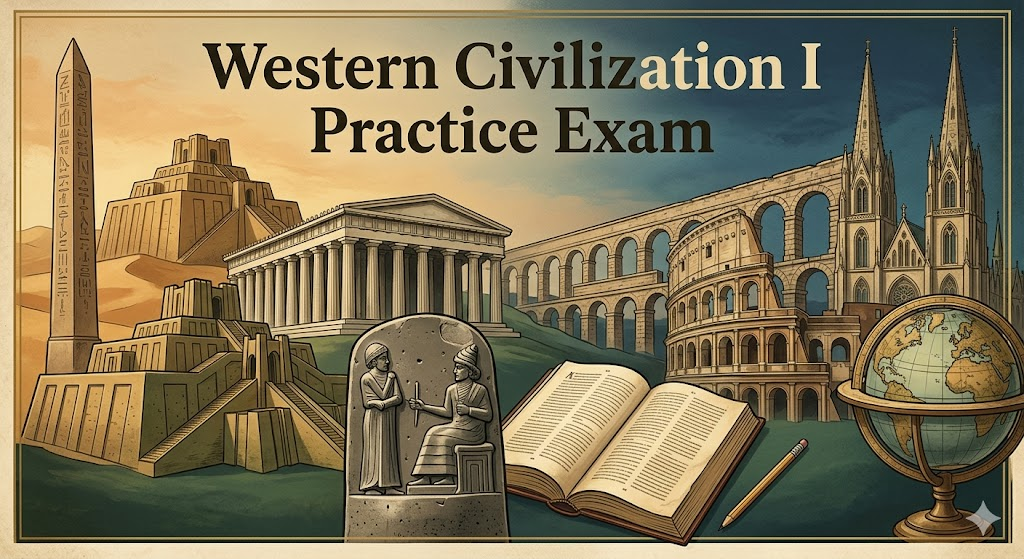
Additional Information
What the Course Entails and Exam Details
The content covered in this examination encompasses a vast temporal and geographical scope, requiring a detailed understanding of diverse cultures and eras. It entails specific knowledge regarding the development of early complex societies in the Ancient Near East and their contributions to law and religion. It requires mastery of Classical Greece and the Hellenistic world, including philosophy, politics, and the Peloponnesian War. Furthermore, it demands significant knowledge of the Roman Republic and Empire, its rise, decline, and legacy in law and governance. The course also details the complex dynamics of Medieval Europe, focusing on feudalism, the role of the Church, the Crusades, and the emergence of nation-states. Finally, it entails critical analysis of the Renaissance, the Protestant and Catholic Reformations, and the resulting Age of Religious Wars leading up to the Peace of Westphalia in 1648.
What to Expect in the Final Exam
While specific formats may vary depending on the exact governing body administering your test, such as CLEP or DSST, candidates should typically prepare for a computer-based examination. The exam usually consists of approximately 100 to 120 multiple-choice questions. These questions evaluate not only factual recall but also the ability to analyze historical data, interpret primary sources, and understand cause-and-effect relationships. There is generally a strict time limit of approximately 90 minutes to complete the test. The passing score varies by institution and governing body, but usually requires achieving a scaled score that indicates proficiency in the subject matter. It is imperative to familiarize yourself with the specific rules and time limits of your chosen exam platform before test day.
How to Study and Exam Centers
Preparation for this exam requires a structured and dedicated study plan. Begin by obtaining the detailed official 2026 content outline and specific practice questions to gauge your current knowledge baseline. We recommend utilizing comprehensive introductory Western Civilization textbooks and supplement them with reliable study guides. Flashcards are highly effective for memorizing key dates, historical figures, and significant events across the millennia covered. Implement a regimen of taking full-length, timed practice exams to build test-taking endurance and manage pacing. Understanding the context and "why" behind historical shifts is just as important as knowing the "what."
Regarding exam centers, standardized history exams for college credit are widely accessible. They are typically administered at authorized physical testing centers, often located on college campuses or in Pearson VUE centers globally. It is crucial to verify the exact location and proctoring requirements in advance. In recent years, many exam providers also offer secure online proctoring options, allowing you to take the exam securely from a private, suitable location with reliable internet access. Always register in advance and bring the required identification to your testing location or online session.
Job Opportunities from the Course
A strong understanding of Western Civilization I is a foundational academic achievement that, while not a direct job certification, is highly valued and often required for careers in the humanities, education, and public service. This knowledge contributes to critical thinking and analytical skills that are essential in numerous professional roles. While usually part of a broader degree, proficiency in this subject can contribute to the following career paths:
Archivist Assistant
Museum Docent or Exhibit Assistant
History Teacher (Secondary Education, with licensure)
Historical Research Assistant
Political Science Analyst
Librarian (Academic or Public, requires further study)
Cultural Resource Manager
Foreign Service Officer
Journalist (Focusing on culture, politics, or history)
Pre-Law Student (The historical foundation is excellent for legal studies)
Public Policy Aide
Curator Assistant
Frequently Asked Questions
Reviews
5.0
Based on 0 reviews
Leave a Review
No reviews yet. Be the first to review!