
Western Governors University (WGU) ACCT2020 D196 Principles of Financial and Managerial Accounting Practice Test
$69.00
- Buy to unlock unlimited access to all Quiz questions and Answers in this Quiz.
- After purchase you can print a PDF of the whole quiz at any point. The PDF will contain the questions and the correct answers.
About this Exam
Welcome to your study guide for the Western Governors University (WGU) ACCT2020 D196 Principles of Financial and Managerial Accounting Practice Test. This course and its final examination are fundamental pillars for students pursuing degrees in accounting, finance, or business management. It bridges the gap between basic business understanding and sophisticated financial analysis.
D196 is designed for aspiring accountants and business leaders. It teaches you not only how to read the primary financial statements (Financial Accounting) but also how to use internal cost data to make critical strategic decisions (Managerial Accounting). This practice test (WGU calls it a Pre-Assessment) is your diagnostic tool, designed to assess your mastery of the material before you attempt the final proctored exam (the Objective Assessment, or OA).
Ready to test your knowledge?
Buy Now to Access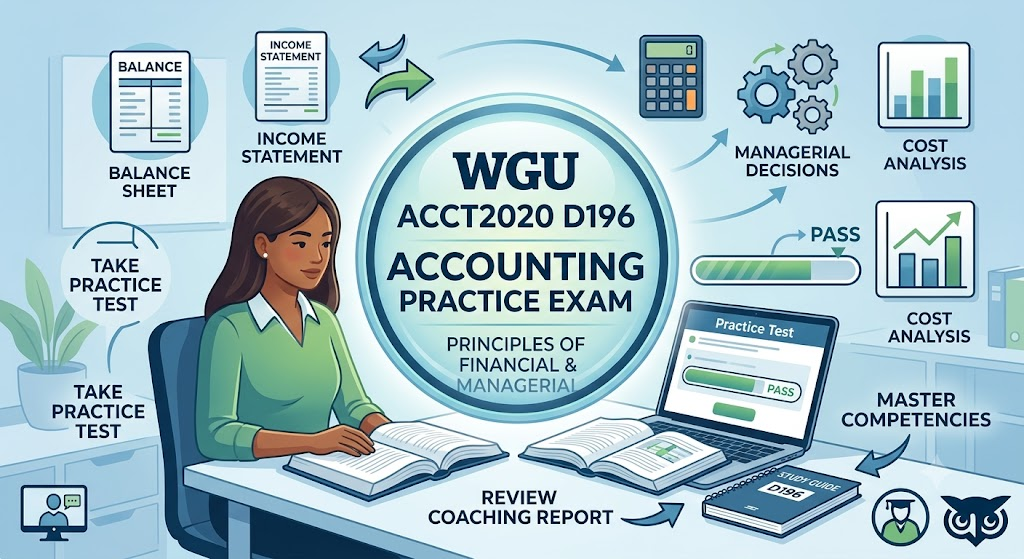
Additional Information
What the Course Entails and Exam Details
The WGU ACCT2020 D196 course is a broad but deep exploration of both major branches of the accounting discipline. It ensures you can interpret a company’s past performance and project its future trajectory.
Core Topics and Syllabus:
The course is divided into fundamental competency areas that map directly to the exam questions.
A. Principles of Financial Accounting:
The Accounting Cycle: Understanding how business transactions become financial statements, including debits, credits, and the adjustment process.
Financial Statement Preparation: Mastering the four primary reports: The Income Statement, Balance Sheet, Statement of Retained Earnings, and Statement of Cash Flows (using the indirect method).
Transaction Analysis: Applying the accounting equation (Assets = Liabilities + Equity) to various business scenarios.
Regulatory Framework: Basic familiarity with Generally Accepted Accounting Principles (GAAP).
B. Principles of Managerial Accounting:
Cost Classifications: Differentiating between direct/indirect, variable/fixed, and product/period costs.
Cost-Volume-Profit (CVP) Analysis: Calculating break-even points and target profit levels.
Budgeting: Preparing comprehensive master budgets, operating budgets, and financial budgets.
Variance Analysis: Comparing actual performance against budgeted performance to identify operational efficiencies and weaknesses.
Decision Making: Using relevant costs for choices like make-or-buy or special orders.
Exam Details (The Practice Test vs. Final Exam):
It is crucial to understand that WGU separates the assessment process. This study guide focuses on the Practice Test (Pre-Assessment, or PA). The PA is designed to be a complete simulation of the final Objective Assessment (OA). Passing the PA is typically a prerequisite to attempting the OA.
The PA is taken through your student portal and provides an identical experience to the final exam.
Unlike the final OA, the PA is not proctored.
The PA can be taken multiple times, though your score is only recorded for your review.
After the PA, you receive a coaching report that lists exactly which competencies you mastered and where you require further study.
What to Expect in the Final Exam
While you are preparing for the practice test, the goal is success in the final, high-stakes examination. That final test is the proctored Objective Assessment (OA). Here is what you must expect.
Format: The final OA is a single, comprehensive examination taken entirely online. It is an "objective" test, meaning it consists mostly of multiple-choice questions, with some potential for interactive elements like numerical input problems or simple transaction analysis grids. There are no essay questions.
Passing Score Requirements: WGU does not use a fixed numerical percentage (like 70% or 80%) for every exam. They utilize a competency-based "cut score." You are required to achieve a score that demonstrates competency across all key topic areas. Your results will show "Pass," "Conditional Pass," or "Not Passed."
Time Limits: The OA is a timed examination, usually allowing approximately two (2) hours for completion.
Proctoring Rules: The final OA is mandatory proctored online. You must take the exam in a private, well-lit room, and you must utilize an approved webcam so a live proctor can monitor you throughout the entire duration. You will be asked to scan your environment to ensure academic integrity.
How to Study and Exam Centers
Preparation for D196 requires more than just reading; you must actively engage with numerical concepts. Here are actionable study strategies and essential logistics for completing your assessments.
Actionable Study Strategies:
Deep Dive into WGU Course Material: Start and finish with the material provided in your WGU portal. Their embedded text, practice quizzes, and module exercises are aligned precisely with the exam objectives.
Focus on the "Why" and "How": Accounting is not just memorization; it is application. When you record a journal entry, understand why you are impacting those specific accounts and how it affects the financial statements.
Utilize WGU Video Cohorts: Look for recorded cohorts or live webinars offered by the WGU course instructors. These experts often walk through the most complex problems, especially budgeting and the Statement of Cash Flows.
Take the Practice Test Early (and Wisely): Do not wait until you feel fully prepared to take the PA. Use it as a diagnostic tool. Take your first attempt after completing about 60–70% of the material.
Analyze Your Coaching Report: This is your map to success. The PA's coaching report tells you exactly which competencies you have mastered. Ignore the passed sections for a moment and ruthlessly focus your study only on the sections where you showed weakness. Re-take the PA only after you have genuinely restudied those identified modules.
Exam Centers and Logistics:
Where and how do you take these assessments? WGU offers a fully remote testing model.
WGU Pre-Assessment (Practice Test): This test is accessed entirely through the WGU student portal. You can take it on your own schedule from any computer with internet access. No physical exam center is required.
WGU Objective Assessment (Final Exam): The final OA is not taken at physical third-party centers (like Pearson VUE or Prometric) or local authorized schools. Instead, WGU utilizes an authorized Online Proctoring service (such as Examity, though this partner may vary). This allows you to take the secure, high-stakes final exam from the comfort of your own home or office, provided you meet the proctoring requirements (private room, specific technology setup).
Job Opportunities from the Course
D196 is not just a hurdle to jump; it is a foundational skill set that directly enables numerous career paths. This course is an ideal starting point for entry-level and mid-level accounting, auditing, and financial management roles. Here are specific career opportunities unlocked by completing D196 and your subsequent degree path:
Staff Accountant
Managerial Accountant (Cost Accountant)
Financial Analyst
Tax Associate
Auditor (Internal or External)
Budget Analyst
Accounting Manager
Business Analyst
Credit Analyst
Financial Reporting Specialist
You are now equipped with the essential knowledge, strategy, and roadmap for success in WGU ACCT2020 D196. Dive into the material, leverage the coaching report, and approach both the practice and final assessments with confidence. Your foundation in principles of accounting starts here. Good luck!
Frequently Asked Questions
Reviews
5.0
Based on 0 reviews
Leave a Review
No reviews yet. Be the first to review!