
Western Governors University (WGU) ACCT6000 C254 Fraud and Forensic Accounting Practice Exam
$69.00
- Buy to unlock unlimited access to all Quiz questions and Answers in this Quiz.
- After purchase you can print a PDF of the whole quiz at any point. The PDF will contain the questions and the correct answers.
About this Exam
The WGU ACCT6000 C254 Fraud and Forensic Accounting Practice Exam serves as a vital tool for students enrolled in Western Governors University’s graduate accounting program. This course, often designated as C254, is meticulously designed to provide a comprehensive framework for detecting, preventing, and investigating financial statement fraud. The certification is tailored for aspiring forensic accountants, fraud investigators, internal and external auditors, corporate compliance professionals, and anyone seeking to understand the intricate patterns and psychology of financial misconduct. Successfully mastering this course and its subsequent exam signals to employers that you possess the advanced skills needed to navigate the increasingly complex landscape of financial crime.
Ready to test your knowledge?
Buy Now to Access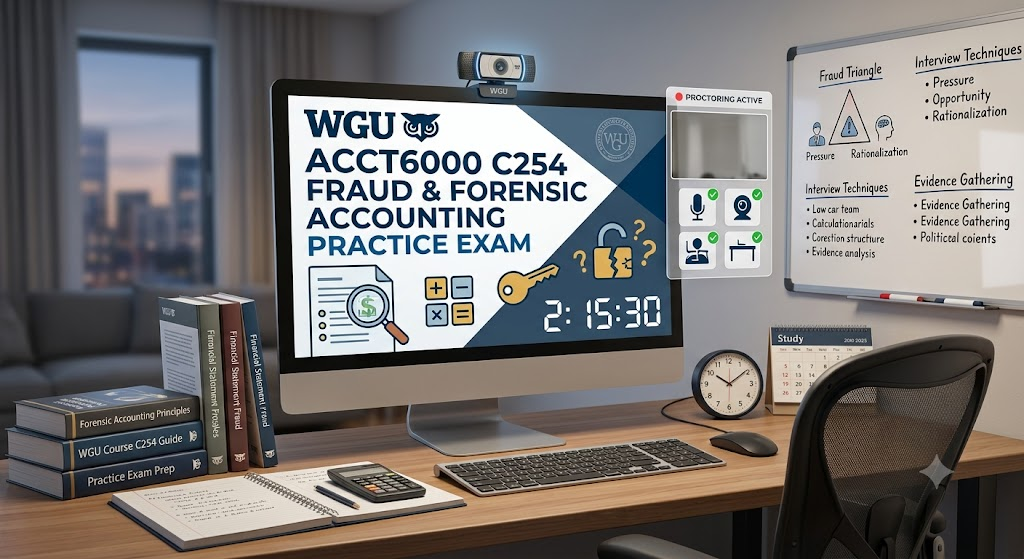
Additional Information
What the Course Entails and Exam Details
This rigorous course delves deep into the mechanisms and patterns of financial statement fraud. You will explore the theoretical foundation of fraudulent activities, analyzing the psychological, criminological, and environmental factors—the classic 'fraud triangle' of pressure, opportunity, and rationalization—that contribute to such behavior. The syllabus encompasses:
A complete framework for detecting and preventing financial statement fraud.
In-depth analysis of specific types of fraud, including revenue- and inventory-related fraud, as well as complex liability, asset, and inadequate disclosure schemes.
Understanding the profession’s focus and critical legislation governing fraud and reporting standards.
Exploring the human element of fraud and the concepts of occupational fraud and violating trust.
Evaluating ethical responsibilities and accounting professional standards with a focus on integrity, transparency, and accountability.
Developing and implementing systematic investigation protocols, from conducting structured interviews to gathering and preserving critical physical and digital evidence, ensuring admissibility in legal proceedings.
The use of forensic analytical tools and data technology for detection and investigation.
Preparation of clear, evidence-based investigative reports and communication of findings to stakeholders and legal bodies.
This comprehensive curriculum prepares you not only to identify the telltale signs of fraudulent activity but also to build strong prevention and investigation processes.
What to Expect in the Final Exam
While the exact final exam details are specific to the current WGU course iteration, and students should always check their specific course materials, standard WGU assessments for such courses generally follow a structured format. Students can typically expect:
Format: A significant portion, if not all, of the final exam (the 'Assessment') is likely in a multiple-choice format, requiring the application of knowledge to various scenarios.
Competency-Based: As part of WGU's competency-based education, the exam will assess your mastery of the specific competencies outlined in the course. You will be expected to achieve a score that demonstrates this mastery, often framed as passing against a predetermined proficiency standard.
Time Limit: Expect a set duration for the exam, typically within the range of 2 to 3 hours, designed to allow ample time to consider and answer all questions while maintaining exam integrity.
Proctoring: Almost all final exams at WGU are proctored. This means you will take the exam via an online proctoring service from the comfort of your own standard-compliant workspace. Strict rules apply, including the requirement for an external webcam, a working microphone and speakers, an ID check, and monitoring by a remote proctor who will ensure you follow all rules, including those regarding authorized materials and environment. Always review WGU’s specific proctoring requirements for your course.
How to Study and Exam Centers
Preparation for this exam demands an active, strategic approach. While physical exam centers are limited and usually only required under exceptional circumstances, WGU is built for remote, proctored exams. Here’s how to succeed:
Study Strategies:
Engage Fully with Course Materials: Work through every module and chapter, leveraging all readings, interactive scenarios, activities, and knowledge checks provided within the WGU system. These are your primary learning tools.
Practice Active Recall: Don’t just read; quiz yourself frequently on key concepts, regulations (like specific laws mentioned in the syllabus), fraud categories, and investigative steps. Create flashcards for critical terms and principles.
Utilize Practice Assessments: Take full advantage of any practice quizzes or the full practice exam provided in the course. Use these to identify knowledge gaps, practice time management, and become comfortable with the question style. Analyze every incorrect answer to understand the underlying logic.
Review Case Studies: Pay close attention to case studies and real-world examples. Understanding how fraud theory applies in practice will significantly enhance your analytical skills for the exam.
Focus on the ‘Why’: Don’t just memorize definitions; understand the underlying principles and ethical responsibilities. Think about why internal controls exist and how different types of fraud compromise them.
Seek Faculty Support: WGU provides excellent faculty and learning resource specialists. Reach out with questions, for clarification on difficult concepts, or for personalized guidance.
Practice Investigative Thinking: Approach questions analytically, looking for patterns, inconsistencies, and potential control weaknesses, just as a forensic accountant would.
Understand the Exam Format and Rules: Review WGU’s proctoring rules thoroughly well in advance of your exam date. Ensure your computer system and external webcam meet all requirements.
Exam Procedures (Centers):
You will not typically visit a physical testing center. You will take the proctored final exam online from your own standard, clean workspace, using an external webcam and appropriate proctoring software. Schedule your exam session through WGU's online system, ensuring you have a quiet environment and reliable internet access. The system will guide you through the proctoring setup process before allowing you to begin the exam.
Job Opportunities from the Course
A strong understanding and successful completion of this fraud and forensic accounting course can open doors to various professional paths. While this single course may be part of a larger degree, its specialized nature is highly valued in fields including:
Forensic Accountant
Fraud Investigator
Internal Auditor (with a specialized focus on fraud risk and detection)
External Auditor
Corporate Compliance Officer
Risk Management Professional
Loss Prevention Specialist
Asset Tracing Specialist
Positions within Law Enforcement (e.g., specific white-collar crime units, or with agencies like the Ethics and Anti-Corruption Commission or Directorate of Criminal Investigations equivalent)
Regulatory Body Analyst
Certified Fraud Examiner (CFE) Aspirant (this course provides excellent foundational knowledge for the CFE credential)
Specialized consultant within public accounting firms or forensic boutiques.
Frequently Asked Questions
Reviews
5.0
Based on 0 reviews
Leave a Review
No reviews yet. Be the first to review!