
Western Governors University (WGU) C839v5 / D334 Algorithms Practice Test
$69.00
- Buy to unlock unlimited access to all Quiz questions and Answers in this Quiz.
- After purchase you can print a PDF of the whole quiz at any point. The PDF will contain the questions and the correct answers.
About this Exam
Embarking on the journey toward a career in cybersecurity or information assurance often begins with a solid foundation in cryptographic principles. Western Governors University (WGU) offers the C839v5 / D334 Introduction to Cryptography courses as critical building blocks. This guide is designed to prepare you for the practice exams for these courses and, ultimately, your final assessment. These intro-level courses are meticulously designed for students in cybersecurity, network engineering, and related programs who need a strong theoretical and practical understanding of how data is secured through encryption. Mastering this content demonstrates your commitment to data integrity, confidentiality, and secure communication—core pillars of modern IT infrastructure.
Ready to test your knowledge?
Buy Now to Access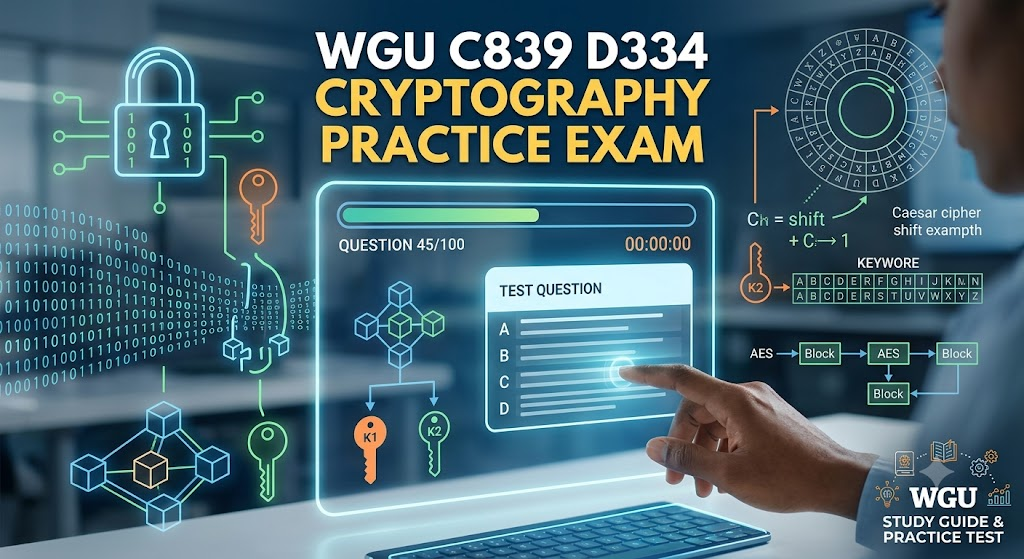
Additional Information
What the Course Entails and Exam Details
WGU’s C839v5 and D334 (often a newer version of the same introductory topic) cover a broad spectrum of cryptographic concepts and historical developments. The syllabus, while competency-based, typically covers the following core topics:
Cryptographic Foundations & History: An exploration of the origins of cryptography, historical ciphers, and key concepts like the CIA triad (Confidentiality, Integrity, Availability) and non-repudiation.
Symmetric Cryptography: Deep dives into symmetric algorithms where the same key is used for both encryption and decryption. This includes both block ciphers (e.g., DES, AES, Feistel network) and stream ciphers (e.g., RC4).
Asymmetric Cryptography: Understanding public-key infrastructure and algorithms where different keys are used for encryption and decryption. Concepts include RSA, Diffie-Hellman key exchange, Elliptic Curve Cryptography (ECC), and digital signatures.
Hash Functions & Data Integrity: Mastering the role of hash functions in verifying data integrity and authenticity. Key topics include message authentication codes (MACs) and algorithms like SHA.
Key Management & PKI: Learning the complexities of generating, distributing, storing, and revoking cryptographic keys, as well as the structures and operations of Public Key Infrastructure (PKI).
Security Principles & Attacks: Understanding Kerckhoffs's Principle, types of cryptanalytic attacks (brute force, frequency analysis, known plaintext, etc.), and methods like rainbow tables and salting.
Cryptography Applications: Real-world examples of cryptography in action, including transport layer security (TLS), secure communication protocols, and potentially advanced or emerging topics.
Success in this course relies on demonstrating competence across these key knowledge areas, as measured by WGU's objective assessment (OA).
What to Expect in the Final Exam
The final assessment for both C839v5 and D334 is an objective assessment (OA) that will test your foundational knowledge and ability to apply cryptographic concepts. Here’s what you can expect:
Format: The exam typically consists of multiple-choice and potentially multiple-answer questions, designed to evaluate your recall, understanding, and application of the material.
Length: You should prepare for a comprehensive exam, often consisting of around 100 questions that cover the entire breadth of the course material.
Time Limit: A standard WGU OA time limit is usually around 120 minutes. Effective time management is key, ensuring you can thoughtfully respond to all questions.
Passing Score: WGU uses scaled scores based on a determined cut score that reflects proficiency and mastery. You must achieve competency (scaled score above the passing threshold) to pass the course. The practice exam will have its own scaled indicator of your preparedness.
Proctoring: This is a proctored, high-stakes exam. Whether taken online or at a testing center, you will be strictly monitored by a live or recorded proctor to ensure exam integrity. You will be required to show ID and clear your workspace.
How to Study and Exam Centers
Preparation is paramount for the WGU Introduction to Cryptography courses. A combined approach using course materials, official WGU practice tests (Pre-Assessments), and effective external resources is most successful.
Actionable Study Strategies:
Engage with Course Materials: Thoroughly read and take detailed notes on all WGU-provided course content, modules, textbooks, and interactive elements. Don't skim. Understand the mechanisms of each algorithm.
Master the Pre-Assessment (PA): Treat the official WGU C839v5 / D334 Pre-Assessment (PA) as a vital part of your study process. Take it once to identify weak areas. After focused study, take it again (or parts of it) to ensure improvement and confidence. The PA is closely aligned with the format and content complexity of the actual OA.
Utilize Flashcards & Spaced Repetition: Use tools like Quizlet or digital flashcards to memorize key terms, algorithm names, their specific features (e.g., key sizes, block sizes), historical ciphers, and cryptographic attacks. Focus on reinforcing knowledge over time.
Practice Questions: Search for additional high-quality practice questions and quizzes, including those that might be linked to relevant certifications (e.g., EC-Council's ECES). While some may differ slightly, they will reinforce the core mathematical and conceptual foundations. Note: Ensure questions are reputable and aligned with current cryptographic standards.
Watch Expert Videos: Educational platforms and YouTube often have video series that visually explain complex cryptographic algorithms (like RSA and AES). Seeing the process step-by-step can enhance conceptual understanding.
Join Study Groups: Participate in WGU student communities and study groups. Discussing concepts with peers can clarify understanding and introduce new perspectives.
Exam Centers & Formats:
Online Proctoring (Default): WGU predominantly uses third-party online proctoring services (e.g., Examity) for their exams. You can take the OA from the comfort and privacy of your own secure, quiet space (e.g., home, private office). You will need a reliable computer, stable internet, a webcam, a microphone, and to comply with specific workspace setup requirements.
Testing Centers: While online proctoring is the standard, WGU sometimes offers options for testing at authorized physical testing centers (which may be affiliated with Pearson VUE or other providers). Check with WGU's assessment scheduling system or student services for available in-person options and locations if online proctoring is not viable for you.
To be eligible to take the actual OA, you typically need to pass the PA and have your instructor approve your readiness, particularly for subsequent attempts after a non-passing score. The official PA score and feedback are crucial indicators of when you are prepared.
Job Opportunities from the Course
Successfully navigating the content of WGU's Introduction to Cryptography courses opens the door to numerous vital roles in the expanding cybersecurity and information security field. While a full degree or additional certifications might be required for advanced positions, this knowledge is a non-negotiable requirement for roles such as:
Cryptographer (Junior/Introductory Levels)
Cybersecurity Analyst
Information Security Specialist
Security Administrator
Network Security Engineer
IT Auditor (Security Focus)
Penetration Tester / Ethical Hacker (Foundational understanding is crucial)
Incident Response Analyst
Security Architect (Path towards advanced architectural roles)
Cryptanalyst (Introductory levels/foundation for research)
Mastering cryptography is a foundational achievement, marking you as a capable security professional prepared to address critical data protection challenges across diverse industries. Good luck with your studies and your exams!
Frequently Asked Questions
Reviews
5.0
Based on 0 reviews
Leave a Review
No reviews yet. Be the first to review!