
Western Governors University (WGU) C859 Introduction to Programming in Python Practice Test
$69.00
- Buy to unlock unlimited access to all Quiz questions and Answers in this Quiz.
- After purchase you can print a PDF of the whole quiz at any point. The PDF will contain the questions and the correct answers.
About this Exam
Welcome to your study guide for the WGU C859 Introduction to Programming in Python course, a pivotal point in your educational journey with Western Governors University! This course is meticulously designed for students enrolled in WGU's technology-related degree programs who are either completely new to the world of coding or looking to solidify their fundamental programming skills using one of the most accessible and in-demand languages in the industry. It aims to demystify programming logic and equip you with the practical ability to read, write, and troubleshoot essential Python scripts, laying a robust foundation for all your future developer and technical roles.
Ready to test your knowledge?
Buy Now to Access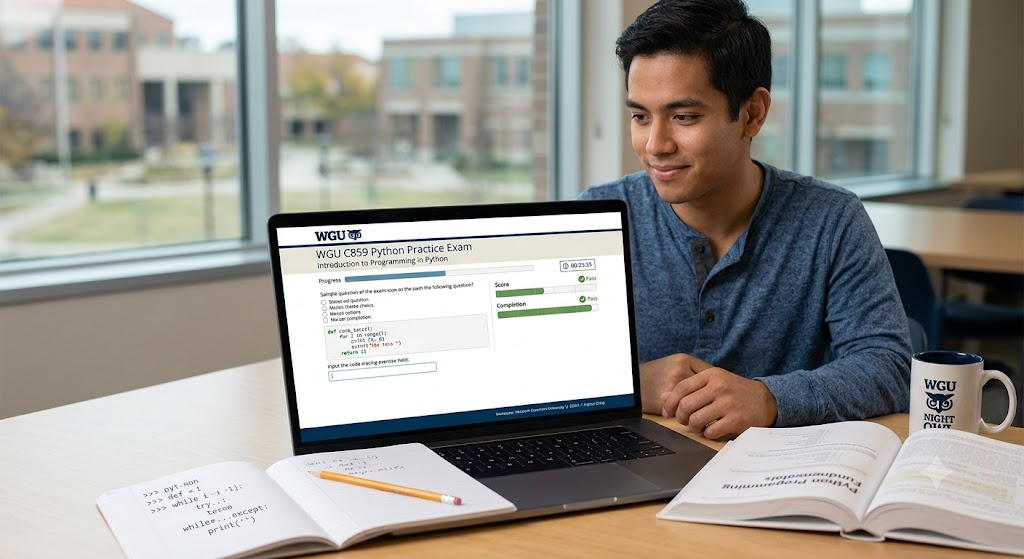
Additional Information
What the Course Entails and Exam Details
WGU C859 introduces you to the core principles and practicalities of the Python language. Throughout this course, you will engage deeply with fundamental programming concepts, progressing from basic syntax to constructing more complex solutions.
Key areas covered include:
Python Syntax and Structure: Learning how to correctly format and execute Python code.
Variables and Data Types: Understanding and manipulating different types of data, such as strings, integers, floats, booleans, and compound structures like lists, tuples, and dictionaries.
Control Flow: Mastering if, elif, and else statements for decision-making and various loops (for, while) for iterative tasks.
Functions and Modules: Writing and calling your own reusable blocks of code and harnessing the power of Python's built-in and external libraries.
File Handling: Gaining the skills to read from and write to external files, crucial for data processing and persistence.
Error Handling and Debugging: Learning robust methods (try...except blocks) to manage unexpected inputs and troubleshoot errors effectively in your scripts.
The associated exam, your ultimate goal, will comprehensively test these competencies. While you are currently focused on a practice test as a vital study tool, preparing for the final exam itself is where all your efforts will converge.
What to Expect in the Final Exam
While exact exam details can evolve, you should approach the WGU C859 final assessment (often referred to as an Objective Assessment in WGU's nomenclature) with expectations for both conceptual understanding and practical application.
Format: The exam typically includes a combination of multiple-choice questions (testing your grasp of definitions, syntax rules, and conceptual knowledge) and, crucially, a significant practical coding component. You will likely be required to write complete, working Python scripts to solve specific, stated problems within the WGU proctored exam environment. This practical element ensures you not only know the theory but can also do the work.
Passing Score Requirements: WGU exams operate on a Pass/Fail basis, but you must achieve a specific "cut score" (competence score), which is detailed in your degree plan and specific to the course. There are typically different versions of the exam with varying difficulty, so focusing on thorough competence, not just the minimum, is highly recommended.
Time Limit: You will be under a defined time constraint, which will be clearly communicated before you launch the exam. A common limit is around 2 to 3 hours, but this is always subject to change. Managing your time across different sections, especially the coding challenges, is key.
Specific Rules: All final WGU assessments must be taken in a proctored environment, typically via an external webcam and WGU’s official secure proctoring software. This ensures academic integrity. No outside materials, unless explicitly stated as allowed by your instructor, are permitted.
How to Study and Exam Centers
Preparation for WGU C859 is fundamentally about practice and application. Use your WGU access to its full potential!
Actionable Study Strategies:
Official Learning Material: Thoroughly engage with WGU's course materials – read every chapter, watch every video, and complete all the embedded exercises and labs. They are designed precisely to align with the exam's learning objectives.
Code, Code, Code: Don't just read about Python; write Python! Actively practice every concept you learn in your own local environment or online code editors. Create your own mini-projects to reinforce variables, loops, functions, and file processing.
Utilize the Practice Test! This is exactly why you're here. The WGU C859 practice test, or "Pre-Assessment" as WGU often calls them, is an invaluable tool. Take it under timed conditions and review your results. It will give you a clear indication of your areas of strength and, more importantly, highlight specific competencies you need to review. Take the practice test multiple times as your skills improve.
Seek Help When Needed: Leverage your WGU course instructors and the student community. They are great resources for understanding tricky concepts and overcoming obstacles. Don't be afraid to ask questions!
Complementary Resources: While official materials are paramount, exploring other reputable online tutorials, documentation (python.org), and interactive coding platforms can provide diverse perspectives and additional practice problems.
Where and How to Take the Exam: WGU exams are primarily delivered via online proctoring, allowing you to take the exam from the comfort and quiet of your home, following established proctoring protocols. This means you will need:
A compatible computer with an acceptable internet connection.
An external webcam with specific resolution and positioning capabilities.
A working microphone.
To schedule your exam appointment through your WGU student portal. WGU partners with organizations like Pearson VUE for their proctoring, but the delivery is managed securely online. While Pearson VUE has physical test centers, WGU is built around the convenience of online proctoring for these types of assessments. Check your degree plan and specific instructions on the course page to confirm all requirements and procedures for scheduling and launching your proctored exam.
Job Opportunities from the Course
Successfully navigating WGU C859 and subsequent courses, earning your IT-related degree, is your gateway to a vast and exciting landscape of career paths. Introductory Python skills are in incredibly high demand across numerous sectors!
Here are specific job titles and career paths this foundational knowledge can help you unlock:
Junior Python Developer: Write and maintain Python code for various applications and platforms, working under more senior developers.
Data Analyst: Use Python's powerful data libraries (even introductory ones set you up for further learning) to clean, analyze, and visualize data for business insights.
Quality Assurance (QA) Automation Engineer (Introductory Level): Create automated scripts with Python to test software functionality and quality.
Systems Administrator (with Scripting Focus): Automate repetitive system management tasks and processes using Python scripts.
Support Engineer: Resolve technical issues, often using basic scripting to diagnose problems or automate support workflows.
Technical Support Specialist: Transition into technical support where basic programming understanding helps troubleshoot issues for clients or users.
Entry-Level Software Developer (Broad): Build a strong foundation to progress into software development with other languages and technologies as well.
DevOps Engineer (Foundational Level): Utilize scripting to help bridge the gap between development and operations teams, automating infrastructure and deployment tasks.
Technical Content Writer or Educator (Foundational): Combine communication skills with programming knowledge to create documentation, tutorials, or educational content in technology.
We hope this study guide provides you with a clear roadmap to success for your WGU C859 Introduction to Programming in Python Practice Test and, ultimately, your final exam. Embrace the challenge, practice diligently, and trust in your ability to master this fundamental and valuable skill! Good luck!
Frequently Asked Questions
Reviews
5.0
Based on 0 reviews
Leave a Review
No reviews yet. Be the first to review!