
Western Governors University (WGU) D583 Foundations in Public Health Practice Exam
$69.00
- Buy to unlock unlimited access to all Quiz questions and Answers in this Quiz.
- After purchase you can print a PDF of the whole quiz at any point. The PDF will contain the questions and the correct answers.
About this Exam
The Western Governors University (WGU) D583 Foundations in Public Health course, and its associated practice exam, is a critical component of WGU’s undergraduate public health degrees. This course provides students with a foundational understanding of the history, principles, and practice of public health in the United States. Designed primarily for self-paced adult learners seeking to enter or advance in the field of public health, the D583 Foundations in Public Health Practice Exam serves as a vital diagnostic tool. It allows students to assess their readiness for the high-stakes objective assessment, highlighting knowledge gaps and building the confidence needed to succeed in the course.
Ready to test your knowledge?
Buy Now to Access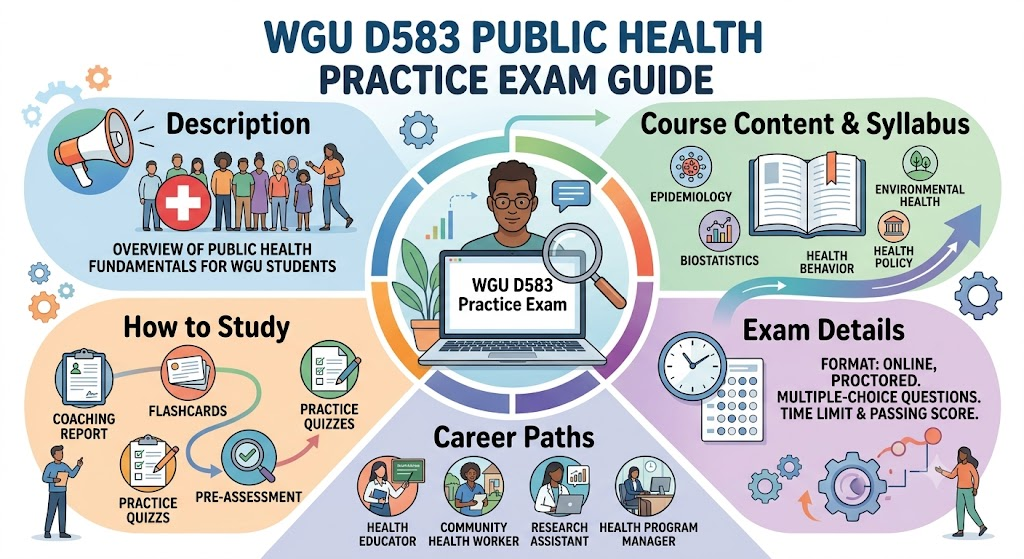
Additional Information
What the Course Entails and Exam Details
The WGU D583 course, "Foundations in Public Health," delivers a comprehensive overview of the field, introducing students to core concepts and methodologies essential for effective public health practice. Students explore the socio-ecological model and how various factors, from individual behaviors to structural policies, influence population health outcomes. A significant portion of the course is dedicated to understanding the five core disciplines of public health: biostatistics, epidemiology, environmental health, health policy and management, and social and behavioral sciences. This foundational knowledge equips students to understand public health problems from multiple perspectives and begin thinking critically about potential solutions. Furthermore, the course typically covers key public health frameworks, essential public health services, and the historical milestones that have shaped the current landscape of the field.
What to Expect in the Final Exam
The final step to proving competency in WGU D583 is passing the Objective Assessment, which is the high-stakes final exam. The associated practice exam is designed to mirror this experience closely. Both exams are fully online, multiple-choice tests administered through an approved remote proctoring service. This means you will take the test in a secure environment using your webcam. The format focuses heavily on application, asking you to solve problems, interpret scenarios, and select the best course of action based on the public health principles you have learned. While the exact number of questions and time limit may vary slightly with course updates, the Objective Assessment is a timed event, often lasting several hours, and a minimum passing score (typically indicating a "competent" understanding) is strictly required to pass the course. The practice exam, while not determining your final grade, provides an accurate reflection of this format and difficulty.
How to Study and Exam Centers
Effective studying for the WGU D583 Public Health Practice Exam involves a structured approach utilizing WGU's resources. Your primary study material should be the comprehensive online course text, as it covers all competencies the exam will test. After thoroughly reviewing each module, actively engage with the content by utilizing flashcards for key terms, diagrams for public health frameworks, and practice quizzes provided within the course. One of the most effective strategies is to take the D583 pre-assessment multiple times. This practice test, distinct from the final practice exam, helps identify weak areas early, enabling you to focus your efforts. Analyze your pre-assessment "Coaching Report," which pinpoints specific competencies where you need improvement. There are no physical exam centers to visit; both the practice and the final exams are taken online through secure proctoring from the comfort of your home or office, ensuring maximum flexibility for busy students.
Job Opportunities from the Course
A strong performance on the D583 Foundations in Public Health course, confirmed by success in the practice and final exams, signals a solid foundation for many rewarding career paths. This course is a stepping stone for various entry-level positions and sets the stage for leadership roles in the future. Here is a list of job titles and career paths this public health competency unlocks:
Public Health Educator: Develop and implement community health education programs and campaigns.
Community Health Worker: Serve as a bridge between communities and healthcare systems, advocating for public health needs.
Health Program Manager (Entry-Level): Oversee and manage small-scale public health programs and projects within organizations.
Disease Intervention Specialist: Investigate and track the spread of communicable diseases within populations.
Research Assistant (Public Health): Support public health research projects with data collection, analysis, and administrative tasks.
Health Policy Analyst (Junior): Contribute to the analysis of health-related policies and their impact on communities.
Environmental Health Specialist (Junior): Work in enforcing public health and safety regulations related to environment and sanitation.
The WGU D583 Foundations in Public Health Practice Exam is a powerful tool on your journey to mastering these essential skills and achieving your public health career goals.
Frequently Asked Questions
Reviews
5.0
Based on 0 reviews
Leave a Review
No reviews yet. Be the first to review!