
Western Governors University (WGU) EDUC2226 D664 Learners and Learning Science Practice Test
$69.00
- Buy to unlock unlimited access to all Quiz questions and Answers in this Quiz.
- After purchase you can print a PDF of the whole quiz at any point. The PDF will contain the questions and the correct answers.
About this Exam
The Western Governors University (WGU) EDUC2226 D664 Learners and Learning Science Practice Test is an essential preparatory tool designed for students enrolled in WGU’s education degree programs. This practice test is specifically crafted to evaluate your understanding of key educational theories and cognitive science principles before you attempt the final Objective Assessment. It is designed for future educators, including K-12 teacher candidates, who need to prove their mastery of how students develop and how learning occurs. Passing the practice test signifies you are ready to demonstrate these competencies in the actual high-stakes final exam.
Ready to test your knowledge?
Buy Now to Access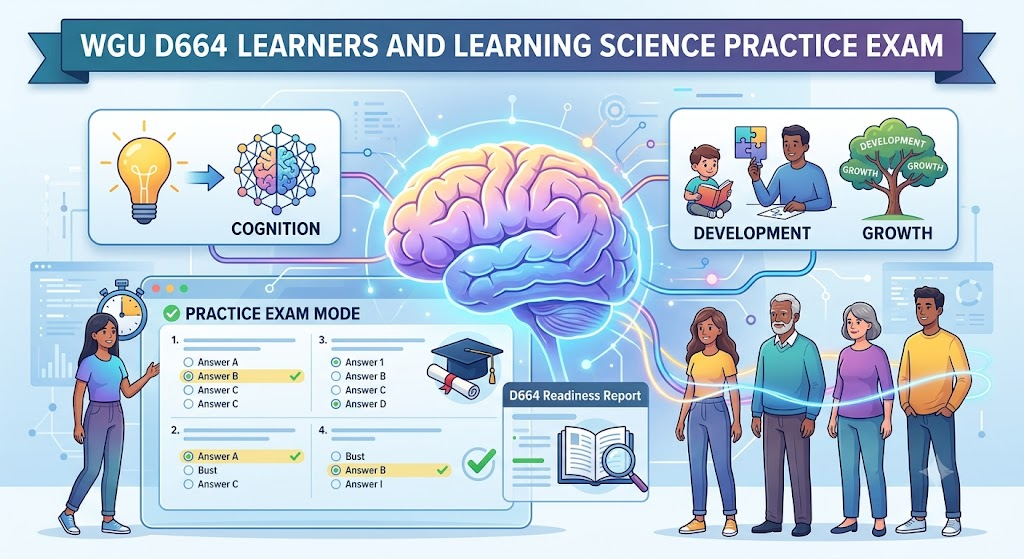
Additional Information
What the Course Entails and Exam Details
This WGU course, EDUC2226 D664 Learners and Learning Science, covers a wide spectrum of psychological and cognitive principles fundamental to effective teaching. Students delve into the main branches of educational psychology, focusing on how different factors influence the learning process. The course is built around several key domains and competencies:
Human Growth and Development: Understanding physical, social-emotional, and cognitive milestones across different age groups, from early childhood through adolescence.
Cognitive Learning Theories: Mastering major frameworks such as Piaget's cognitive development stages and Vygotsky’s social development theory, including the Zone of Proximal Development.
Behavioral Learning Theories: Exploring classical and operant conditioning, and how behaviorism informs classroom management and instructional design.
Social and Emotional Development: Analyzing how students’ self-concept, motivation, and social skills affect their academic performance.
Information Processing: Detailing how the human brain receives, processes, and stores knowledge, including strategies to enhance memory and recall.
Individual Differences and Diversity: Adapting instruction to accommodate diverse learning styles, exceptionalities, and cultural backgrounds.
The course is self-paced but culminates in a high-stakes final assessment that verifies mastery of these critical topics.
What to Expect in the Final Exam
The final step in completing the EDUC2226 D664 course is the high-stakes final assessment, known at WGU as an Objective Assessment (OA). While this article focuses on the practice test, understanding the final is crucial. The final OA for Learners and Learning Science is typically a proctored, online examination consisting of multiple-choice questions or other similar objective question types (like drag-and-drop or hot-spot). Unlike the practice test, the final exam results are official.
Exam Format: Multiple-choice, objective questions (typically around 60-70 questions).
Passing Score: Students must achieve a score that meets or exceeds a predetermined cut score, defined by WGU competency standards.
Time Limit: Usually 90-120 minutes.
Testing Environment: Secure, remotely proctored. You must have a working webcam and microphone. The proctor will verify your identity, inspect your workspace, and monitor you throughout the entire exam duration to maintain academic integrity.
How to Study and Exam Centers
How to Study
Effective preparation for the D664 final exam begins with a thorough and strategic approach to the course materials. Here are recommended strategies:
Complete Coursework: Systematically work through all assigned WGU learning materials, readings, and interactive elements. These are explicitly aligned with the competencies being assessed.
Leverage the Practice Test: This is your most valuable diagnostic tool. Take the WGU EDUC2226 D664 Learners and Learning Science Practice Test early on to identify your strengths and weaknesses. The practice test results usually provide feedback on which competencies need the most focus.
Review Competency Reports: For the practice test, carefully review your Coaching Report to understand why certain answers were correct or incorrect, ensuring you grasp the underlying principles.
Active Learning: Create detailed flashcards for key terms (e.g., scaffolding, schema, intrinsic motivation). Teach concepts to a study partner or summarize chapters in your own words.
Utilize Faculty: Attend webinars and use the educational psychology course faculty hours for one-on-one support when complex topics (like dynamic assessment) are unclear.
Exam Centers
WGU does not typically use traditional, physical exam centers (like Pearson VUE) for its objective assessments in the same way some other institutions do. Instead, WGU utilizes an online proctoring system. This means you can take the actual final exam (the OA) from the comfort of your own home, provided you meet the strict technological requirements.
Online Proctoring: Assessments are delivered securely over the internet and monitored in real-time by a third-party proctoring service (e.g., Examity or a similar vendor).
Scheduling: You can schedule your exam 24/7, offering flexibility, but it must be within your term.
Authorized School Locations: In limited scenarios, some students may seek authorization to test at an established WGU test center or an authorized testing location if they face significant technological or environmental challenges at home. However, online proctoring is the default and standard procedure for nearly all students.
Job Opportunities from the Course
Successfully completing this course and the broader education degree program (which often requires this competency) can unlock several impactful career paths. These roles are essential in supporting educational outcomes and human potential across various fields:
K-12 Teacher (All grade levels and subject areas)
Instructional Designer
Educational Consultant
Corporate Trainer
Adult Education Instructor
Curriculum Developer
Human Resources (Training & Development focus)
Educational Researcher
School Psychologist (Requires further advanced degrees)
Frequently Asked Questions
Reviews
5.0
Based on 0 reviews
Leave a Review
No reviews yet. Be the first to review!