
Western Governors University (WGU) HLTH2160 D393 History of Healthcare in America Practice Exam
$69.00
- Buy to unlock unlimited access to all Quiz questions and Answers in this Quiz.
- After purchase you can print a PDF of the whole quiz at any point. The PDF will contain the questions and the correct answers.
About this Exam
Embark on a fascinating journey through the evolution of the United States healthcare system with our comprehensive study guide. Designed specifically for students enrolled in Western Governors University's (WGU) HLTH2160 D393 History of Healthcare in America course, this guide provides essential support as you prepare for your final course assessment (the Objective Assessment). Whether you're pursuing a degree in a health-related field or simply curious about the historical forces that shaped modern American healthcare, this course and our tailored resources are your roadmap to understanding. The course and practice exam details will equip you with the knowledge and confidence required to master the competencies and excel.
Ready to test your knowledge?
Buy Now to Access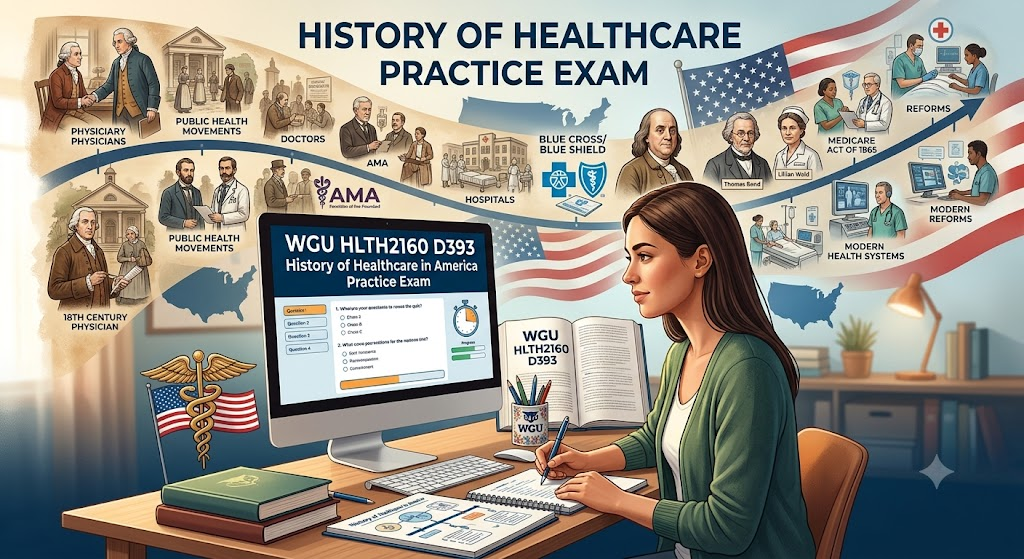
Additional Information
What the Course Entails and Exam Details
This rigorous and insightful course delves deep into the key events, policies, figures, and societal changes that have defined healthcare in America from colonial times to the present day. Students can expect to cover a diverse range of topics, including:
Early American Medicine: Explore healthcare practices during the colonial era and the role of traditional healers, domestic care, and the earliest medical institutions.
The Professionalization of Medicine: Understand the impact of the American Medical Association (AMA), the development of medical education and standards, and the landmark Flexner Report.
The Evolution of Hospitals: Trace the transformation of almshouses and pesthouses into the large-scale, technologically advanced hospital systems of today.
Public Health Movements: Learn about the rise of public health initiatives, major sanitation reforms, vaccination campaigns, and the historical battle against infectious diseases.
The History of Health Insurance: Dive into the origins of employer-sponsored health insurance (e.g., Blue Cross/Blue Shield) and the eventual introduction of government-sponsored programs.
Key Health Policies and Legislation: Examine the impact of major historical acts and policies, including the historical context of Medicare, Medicaid, and modern-day reforms.
Key Historical Figures: Discover the contributions and influence of pioneering doctors, nurses, reformers, and policymakers who shaped the American medical landscape.
Access, Equity, and Contemporary Issues in Historical Context: Understand how issues of access, cost, quality, and social determinants of health have presented historically and continue to influence the modern system.
The associated assessment (your final exam for the course) is WGU's Objective Assessment (OA), which evaluates your mastery of these competencies. Our guide focuses on providing effective strategies, practice techniques, and contextual understanding to prepare you for this final hurdles, often making extensive use of available practice/pre-assessments. The WGU HLTH2160 D393 History of Healthcare in America course culminates in an Objective Assessment designed to test your knowledge of this entire historical narrative and its application.
What to Expect in the Final Exam
While exact details can vary, here is what students can typically expect in the final Objective Assessment (OA) for WGU's D393 course:
Format: The exam is typically composed of multiple-choice questions, with some potential for other structured objective formats. The questions are designed to test not only recall of key events, dates, and figures, but also your understanding of historical context, cause-and-effect relationships, policy impacts, and overall systemic evolution. You will need to demonstrate mastery of the required competencies to pass.
Competency-Based: Remember that WGU uses a competency-based model. To "pass" this course and assessment, you must demonstrate "competency"—meaning you must meet or exceed the required cutoff score set for the assessment based on extensive psychometric standards, rather than achieving a letter grade like an "A" or "B".
Time Limits: Like most WGU OAs, this exam will have a specific time limit (often ranging from 2 to 3 hours). It is crucial to manage your time effectively during the test.
Proctoring Rules: The final Objective Assessment is rigorously proctored online. This means you will take the exam from a quiet, secure, and private location, and your session will be monitored in real-time by a live proctor via your computer's webcam and microphone. The proctor will verify your ID, check your testing environment to ensure it meets strict requirements, and guide you through the initial setup and monitoring. Specific rules include having a clean desk, a suitable webcam position, no other individuals in the room, and the inability to leave your seat or use certain electronic devices during the exam. WGU will provide detailed information and required technical specifications to ensure you are compliant.
Specifics: WGU's testing process uses a dedicated secure browser and proctoring software. You will be required to show your WGU student ID or other acceptable government-issued photo ID at the start of the session. A quick room scan with your camera is also standard.
How to Study and Exam Centers
Preparation is key to success on any competency-based assessment. For WGU HLTH2160 D393, actionable study methods and understanding the testing process are critical.
Actionable Study Strategies:
Master the Competencies: Begin by carefully reviewing the specific course competencies and learning objectives outlined by WGU. Your goal is to demonstrate that you possess this required knowledge and skill set.
Deep Dive into Course Materials: Your primary resources are the WGU-provided textbooks, course modules, lecture notes, videos, and any supplemental readings. Be a meticulous note-taker. Focus on understanding key figures, pivotal laws, timeline evolution, major concepts, and cause-and-effect in historical health context.
Create Timelines and Vis Aids: Visualize the history! Construct detailed timelines noting significant events, figures, and historical shifts. Use mind maps or flowcharts for complex policies or system evolutions.
Engage with Community: Participate in WGU course chatter or student discussion groups. Sharing insights and discussing topics with peers can clarify difficult concepts.
Utilize Practice Assessments: Take full advantage of WGU’s Pre-Assessment (PA) or any available course-specific practice exams. These are vital tools to:
Familiarize yourself with the types of questions (multiple-choice structure) and topics.
Gauge your readiness and identify specific content areas where you need additional study.
Access a detailed Coaching Report after taking the PA, which breaks down your performance by competency and topic, directing you exactly where to focus your review.
Practice time management.
Focus on coaching report guidance: Once you've completed your Pre-Assessment, carefully review the coaching report for actionable direction. This report details your strong and weak points across the course objectives, allowing you to tailor your study plan and optimize your preparation efforts.
Actively Engage with Study Questions: Don't just read the material; apply it. Answer study guide questions, practice writing summaries of major topics, and try to explain complex historical trends.
Manage Study in Chunks: Avoid cramming. Break down the extensive historical narrative into manageable, chronological, or thematic study blocks and review consistently.
Check-in with Mentors/Course Instructors: Don't hesitate to reach out to your WGU Mentor or the course instructors with questions or for additional resources and guidance. They are there to support your learning.
Exam Centers and How to Take the Exam:
WGU OAs are NOT typically taken at external testing centers or specific schools. This is a crucial point for understanding the WGU model for standard internal assessments. As an online university, WGU leverages advanced online proctoring technology.
Taking the Exam Online: You will take your proctored Objective Assessment remotely, from a suitable private space (like your home office or a quiet, private room) using your own compliant computer, webcam, and microphone.
Scheduling: You can schedule your proctored exam time directly through the WGU student portal, choosing a time that fits your schedule, within the designated time range for your course term. You will typically be able to select from various available proctoring appointment slots.
Technical and Environmental Requirements: Before your scheduled time, you must ensure your computer meets all technical specifications and that you have a suitable testing environment, as verified during the initial setup and monitoring process on exam day. WGU will provide all necessary software, instructions, and environmental guidelines in advance to ensure a smooth testing experience. You will typically use specific software and a dedicated testing browser for the assessment.
Job Opportunities from the Course
While a single course does not directly unlock an entire career path, successfully completing WGU's HLTH2160 D393 History of Healthcare in America is a critical milestone and a foundational component of many WGU health-related and professional degree programs (e.g., in Healthcare Administration, Public Health, Nursing, Health Services Management). The specific knowledge, context, and understanding of the historical and current healthcare system that you gain will significantly enhance your professional readiness and value in various roles. Job opportunities, career paths, and specific job titles are unlocked by earning your full WGU degree in conjunction with the knowledge gained through courses like this one. Here are potential roles and career paths where this subject matter proficiency is highly relevant and advantageous within a broader educational and career context:
Healthcare Administrator / Manager
Health Policy Analyst
Public Health Educator or Advocate
Health Information Manager or Analyst
Quality Improvement Coordinator
Healthcare Consultant
Project Manager in Health Organizations
Educational Roles in Health Organizations
Healthcare Policy Researcher
Regulatory Compliance Officer
Community Health Worker or Coordinator
Positions in Health Insurance Companies
This comprehensive historical understanding provides critical context for interpreting contemporary healthcare system dynamics, addressing challenges, and navigating the complexities of healthcare management, policy, and service delivery in any of these roles. By successfully mastering the content in D393, you contribute significantly to the knowledge base required for success in these and other relevant fields, all as part of your larger educational and career progression. Remember that most of these careers require a full degree and sometimes further specialization or certifications beyond this single course. Good luck on your journey and your upcoming assessment!
Frequently Asked Questions
Reviews
5.0
Based on 0 reviews
Leave a Review
No reviews yet. Be the first to review!