
Western Governors University (WGU) ITAS2110 D430 Fundamentals of Information Security Practice Exam
$69.00
- Buy to unlock unlimited access to all Quiz questions and Answers in this Quiz.
- After purchase you can print a PDF of the whole quiz at any point. The PDF will contain the questions and the correct answers.
About this Exam
The Western Governors University (WGU) ITAS2110 D430 Fundamentals of Information Security course is a cornerstone for students launching a career in information technology and cybersecurity. This comprehensive course introduces learners to the essential concepts and principles required to protect vital information assets in modern organizational environments. It is meticulously designed for students beginning their degree path, ensuring they possess the baseline knowledge necessary to tackle more advanced security certifications and coursework within their program.
Ready to test your knowledge?
Buy Now to Access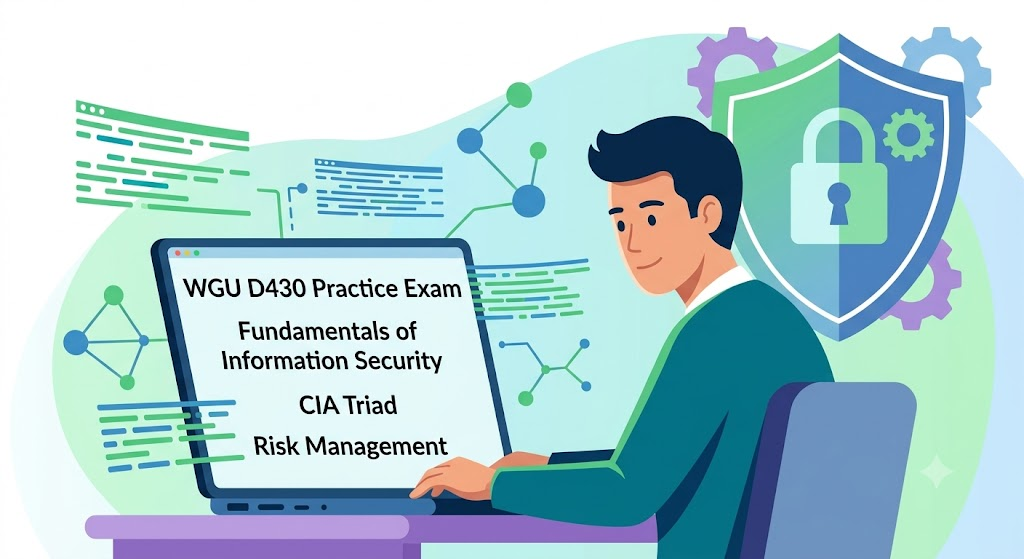
Additional Information
What the Course Entails and Exam Details
This foundational course delves deeply into the core pillars of securing information and information systems. The provided practice exam is engineered to simulate the actual Objective Assessment (OA), offering a clear benchmark of your understanding across key syllabus areas, which typically include:
The CIA Triad: Applying the critical concepts of Confidentiality, Integrity, and Availability to real-world scenarios.
Risk Management: Mastering the identification, assessment, and effective mitigation of risks to an organization's critical assets.
Threats and Vulnerabilities: Recognizing a wide array of common security threats, including malware, sophisticated social engineering attacks, and network-based exploits.
Access Control: Evaluating different mechanisms used to manage user and system access, focusing on authentication, authorization, and accounting.
Cryptography: Understanding the fundamental role of encryption and decryption tools in securing data both at rest and in transit.
Network Security: Learning the baseline strategies for defending network infrastructure, including the deployment of firewalls and Virtual Private Networks (VPNs).
Security Laws, Ethics, and Compliance: Developing a strong awareness of major relevant laws, industry regulations, and ethical responsibilities.
What to Expect in the Final Exam
While you are preparing with this practice exam, your ultimate goal is to conquer the official WGU D430 Objective Assessment (OA). The final OA is a proctored, high-stakes examination that officially validates your mastery of the course material.
Exam Format: Like the practice exam, the final OA is primarily composed of multiple-choice and situational application questions.
Time Limit: WGU establishes a specific, timed testing window for the OA (typically 90-120 minutes), demanding efficient time management.
Passing Score: The official "cut score" required to pass is set by WGU and is visible within your student portal. Your goal during practice should be to score consistently and significantly above this threshold.
How to Study and Exam Centers
Achieving success in D430 requires a proactive and structured study approach, combining thorough review with rigorous practice testing.
Actionable Study Strategies:
Engage the Learning Resources: Immerse yourself fully in the WGU-provided learning materials, which often include interactive platforms like uCertify or Zybooks. Prioritize completing all quizzes and module assessments.
Develop Key Terminology Mastery: Building a comprehensive glossary of definitions, abbreviations, and acronyms is essential. Use digital flashcards to ensure rapid recall during the pressure of the exam.
Leverage the Practice Exam Effectively: Treat the WGU D430 Practice Exam (Pre-assessment) as your most valuable diagnostic tool. Take it early to pinpoint your weak areas, review the corresponding material, and retake it until you are achieving excellent scores.
Connect with Course Instructors: Don’t isolate yourself. If you are struggling with complex topics, immediately schedule a one-on-one session with your WGU Course Instructor.
Exam Centers and Process:
Online Proctoring: As a WGU student, you will not visit a physical testing facility for this internal exam. Both the practice exam and the official Objective Assessment are administered online.
Secure Environment: You will take the OA from your home or office, proctored live via a webcam by an approved WGU proctoring service (like Examity or Honorlock). It is your responsibility to ensure your testing environment is quiet, private, and meets all technical specifications.
Job Opportunities from the Course
Successfully completing the ITAS2110 D430 course and earning your degree opens doors to a wide range of vital entry-level and foundational roles within the IT sector, including:
IT Support Specialist / Help Desk Technician
Junior Network Administrator
Security Operations Center (SOC) Analyst (Tier 1)
Entry-Level Cybersecurity Analyst
System Administrator (Entry-Level)
Junior IT Auditor
Frequently Asked Questions
Reviews
5.0
Based on 0 reviews
Leave a Review
No reviews yet. Be the first to review!