
Western Governors University (WGU) ITEC2034 D385 Software Security and Testing Practice Test
$69.00
- Buy to unlock unlimited access to all Quiz questions and Answers in this Quiz.
- After purchase you can print a PDF of the whole quiz at any point. The PDF will contain the questions and the correct answers.
About this Exam
Welcome to your essential preparation guide for the WGU ITEC2034 D385 Software Security and Testing Practice Test. This course is a critical component of the Western Governors University Information Technology degree programs, specifically designed for students pursuing careers in cybersecurity, software development, and quality assurance. This exam validates a student's fundamental understanding of how to integrate security principles throughout the entire software development lifecycle (SDLC). It targets aspiring IT professionals who need to move beyond simple coding to understanding robust, defensive software construction and comprehensive testing methodologies.
Ready to test your knowledge?
Buy Now to Access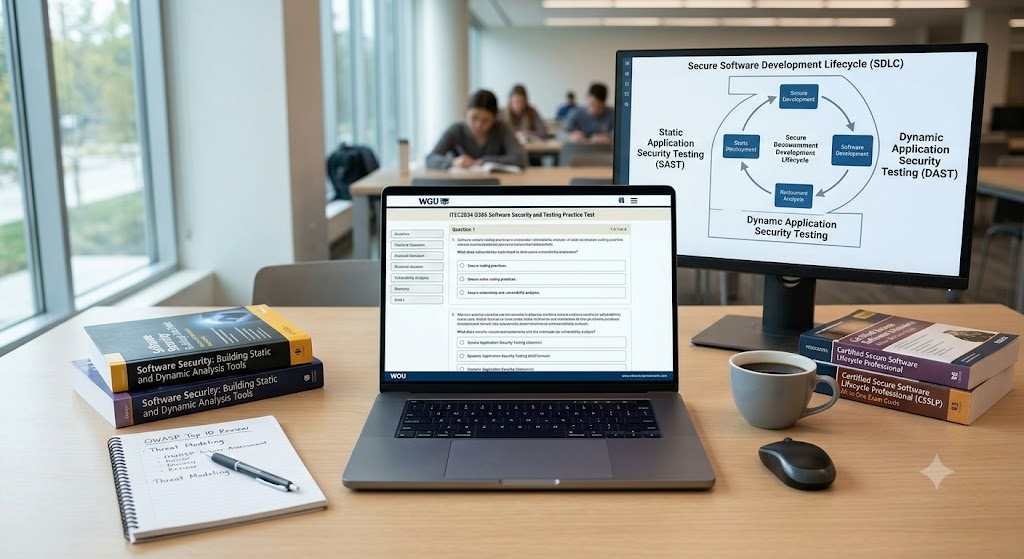
Additional Information
What the Course Entails and Exam Details
The ITEC2034 D385 course focuses heavily on the defensive aspect of software engineering. Students will dive deep into analyzing vulnerabilities and implementing countermeasures. Key competency areas and skills covered include:
Secure Software Concepts: Understanding the core principles of CIA (Confidentiality, Integrity, Availability) and authentication within applications.
The OWASP Top 10: A detailed study of the most critical web application security risks and how to mitigate them.
Static Application Security Testing (SAST): Learning how to analyze source code or binaries without executing the program to find security flaws.
Dynamic Application Security Testing (DAST): Mastering black-box testing techniques to find vulnerabilities in running applications.
Threat Modeling: Understanding how to identify, communicate, and understand threats and mitigations within the context of protecting something of value.
Vulnerability Management: The process of identifying, classifying, prioritizing, remediating, and mitigating software vulnerabilities.
The examination structure for ITEC2034 D385 is typically a single, objective assessment. This means students are evaluated based on their ability to choose the correct answer from multiple-choice questions or similar objective formats, rather than completing performance-based tasks like live coding.
What to Expect in the Final Exam
While the exact nature of the WGU objective assessment (OA) for D385 is subject to change, students can generally expect the following format for their proctored final exam:
Format: Multiple-choice questions, which may include scenario-based questions where you must apply security principles to a hypothetical coding or architectural situation.
Competency-Based Assessment: Unlike a traditional university that might grade on a curve, WGU measures mastery. You must demonstrate that you meet the required cut score to pass the unit.
Time Limit: Typically, objective assessments are timed, often ranging from 90 to 120 minutes.
Passing Score: The cut score (passing threshold) is determined by WGU and is not always publicly disclosed as a rigid percentage, as it is based on achieving competency across all domain areas.
Rules: This is a proctored exam. You will be required to have a webcam and microphone, and an external proctor will monitor your environment and your screen throughout the duration of the test.
How to Study and Exam Centers
Preparing for the ITEC2034 D385 OA requires a focused and active study approach. WGU provides significant resources that should be your first line of defense. Follow these actionable strategies:
Thoroughly Review Course Material: Start by methodically working through the provided WGU learning modules and textbooks.
Take the Pre-Assessment Seriously: The Pre-Assessment (PA) is designed to mimic the final Objective Assessment in content and style. Take this early to gauge your baseline, and then again after studying to measure readiness. Use the coaching report from the PA to identify weak areas.
Master the OWASP Top 10: This framework is foundational to the exam. Know the definitions, common examples of attack vectors, and specific coding remediations for each of the ten risks.
Understand SAST vs. DAST: You should clearly be able to differentiate when to use static versus dynamic testing and the pros/cons of each methodology.
Utilize Quizlet and Cohorts: Many WGU students benefit from shared Quizlet flashcards for vocabulary (e.g., threat modeling, CVE, cross-site scripting). Participate in scheduled cohorts or view recordings where Course Instructors review difficult concepts.
Simulate Test Conditions: When taking practice exams, do so in a quiet environment, timed, and without consulting notes, to prepare yourself for the final assessment's rigor.
Exam Center Information: Because WGU is an online university, you do not typically go to a physical "exam center" like Pearson VUE for objective assessments. Instead, the final exam is proctored online. You will use a WGU-approved third-party proctoring service (such as Examity) to take the exam from the comfort of your own home or a quiet, secure location.
Job Opportunities from the Course
Successfully mastering the concepts in ITEC2034 D385 directly prepares you for several critical, high-demand roles in information technology. Employers across all industries are desperately seeking professionals who can build secure software rather than patching it later. This course unlocks career paths such as:
Junior Security Analyst
Software Quality Assurance (SQA) Engineer
Application Security Associate
Cybersecurity Compliance Officer
Information Security Specialist
DevSecOps Engineer (Associate level)
Good luck with your studies and your upcoming assessment!
Frequently Asked Questions
Reviews
5.0
Based on 0 reviews
Leave a Review
No reviews yet. Be the first to review!