
Western Governors University (WGU) ITEC2104 C175 Data Management - Foundations Practice Exam
$69.00
- Buy to unlock unlimited access to all Quiz questions and Answers in this Quiz.
- After purchase you can print a PDF of the whole quiz at any point. The PDF will contain the questions and the correct answers.
About this Exam
The Western Governors University (WGU) ITEC2104 C175 Data Management - Foundations exam is a critical milestone for students in various IT and data-related programs at WGU.
It is specifically designed for individuals pursuing certifications or degrees that require a strong, base-level competency in how data is structured, managed, and accessed within a relational database system.
This exam validates your ability to grasp essential database architecture, understand fundamental SQL operations, and effectively manage foundational data modeling principles.
Think of it as the base layer of your data science or IT career, proving you can navigate the core structures that power modern applications.
Ready to test your knowledge?
Buy Now to Access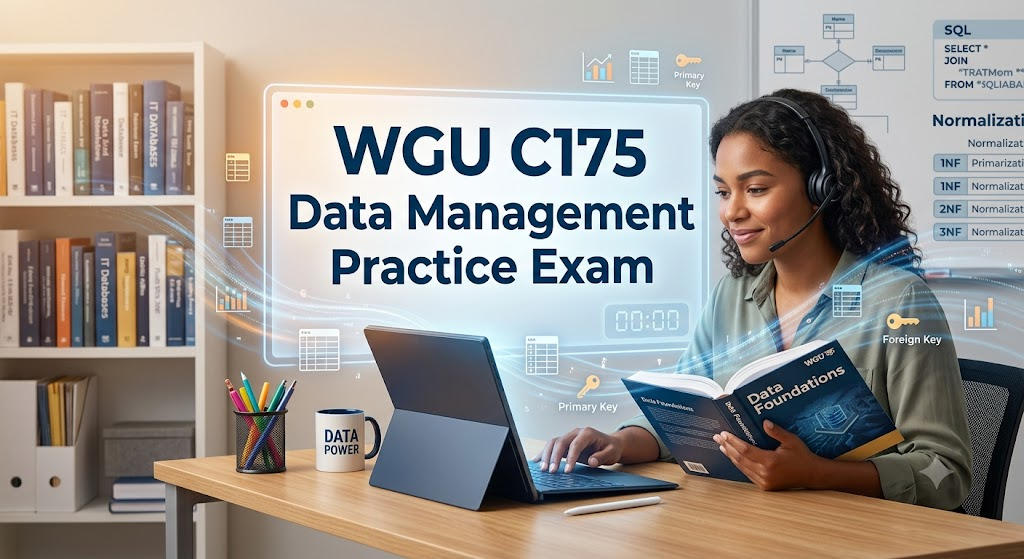
Additional Information
What the Course Entails and Exam Details
The C175 course dives into the absolute essentials of data management, moving beyond simple data entry to the core design principles and languages used. The course syllabus typically covers:
Database Concepts & Architecture: Understanding the different types of databases, their histories, and the fundamental components that make a database work efficiently.
Data Modeling: Learning how to design conceptual, logical, and physical data models, defining entities, attributes, and relationships.
Data Normalization: Mastering the crucial skill of organizing data to eliminate redundancy and improve data integrity (1NF, 2NF, 3NF, BCNF).
Structured Query Language (SQL): Hands-on experience with SQL to define database structures (DDL - CREATE, ALTER, DROP) and manipulate data (DML - SELECT, INSERT, UPDATE, DELETE), including essential JOIN operations and aggregation.
Database Design: Applying knowledge to create well-structured, efficient relational database schemas.
The final exam, often referred to as an "Objective Assessment (OA)" within WGU's competency-based system, generally consists of a substantial number of questions covering these core areas. Note: As passing scores, time limits, and exact question counts can occasionally shift, students should always check their specific course page on the WGU portal for the most current information. Expect a rigorous, comprehensive test of both your conceptual understanding and your practical ability to apply these concepts.
What to Expect in the Final Exam
When you step into the official final Objective Assessment (OA), you can expect a mix of question formats designed to challenge both your recall of definitions and your ability to apply concepts.
The exam usually features:
Multiple-Choice Questions: Assessing your understanding of terms, syntax, and theoretical principles.
Scenario-Based Questions: Presenting business problems or data structural challenges and requiring you to choose the best solution.
Simulation or Query Items: These specific questions might ask you to select the correct SQL syntax for a task or identify the appropriate database design for a given scenario.
Success in the final OA is based on demonstrating competency. While a numerical "passing score" isn't always publicly declared in a traditional 0-100% format (it's competent vs. not competent), you will receive feedback on your performance and a coaching report. Your goal is to achieve mastery across all the core competent areas listed on the exam. Time limits are generous but structure the experience, so efficient recall and problem-solving are key. The OA is a high-stakes, proctored environment, ensuring integrity and standardizing the competency.
How to Study and Exam Centers
Preparation for the WGU C175 Data Management Foundations exam requires a balanced approach of theory and practice. Utilize the excellent, often interactive WGU-provided materials and textbook recommendations as your primary study resource. For hands-on experience, nothing beats actually writing and executing SQL queries. Practice creating tables, querying data with various JOINs and filters, and updating records in a test database environment. There are many free online SQL sandboxes available. Use flashcards for key definitions and syntax (normalization rules, SQL commands). Take advantage of WGU coaching and cohort resources if available.
Importantly, WGU provides a "Pre-Assessment" (PA), which serves as an official practice exam. You should always take the PA seriously! It closely mirrors the structure, content, and difficulty of the final OA. Re-take the PA multiple times, focusing heavily on reviewing the explanations for why answers are correct or incorrect. Treat the PA as a diagnostic tool to identify your weak spots and guide your final review.
Regarding exam locations, WGU courses are completely online, including final exams. For the official final OA, you will take the exam from the comfort of your own home or suitable location. However, this isn't an "open book" scenario. It is administered via a secure, online proctoring service. This involves specific hardware and software requirements (webcam, microphone, safe browser). You will schedule a time slot, connect with an online proctor who will verify your identity, inspect your workspace, and monitor you throughout the exam to ensure all rules are strictly followed.
Job Opportunities from the Course
Mastering the foundations of data management opens doors to a wide array of career paths in technology and data analysis.
Successful completion of this course and the final competency demonstrates strong, desirable skills relevant to roles such as:
Database Administrator
Data Analyst
Data Architect
Database Developer
BI (Business Intelligence) Developer
SQL Developer
Data Engineer
Quality Assurance (QA) Analyst
IT Project Manager (with data focus)
Network Administrator (data aspects)
These positions span multiple industries, and a robust understanding of database fundamentals is a transferable skill that will continue to be in high demand.
We hope this study guide article provides you with a clear roadmap and the confidence needed to tackle the WGU C175 Data Management - Foundations Practice Exam and Final OA. Good luck with your studies!
Frequently Asked Questions
Reviews
5.0
Based on 0 reviews
Leave a Review
No reviews yet. Be the first to review!