
Western Governors University (WGU) ITEC2114 D337 Internet of Things (IoT) and Infrastructure Practice Test
$69.00
- Buy to unlock unlimited access to all Quiz questions and Answers in this Quiz.
- After purchase you can print a PDF of the whole quiz at any point. The PDF will contain the questions and the correct answers.
About this Exam
WGU D337, officially "Internet of Things (IoT) and Infrastructure," is a key competency-based course designed for students in Western Governors University's IT and cybersecurity programs. This exam assesses your fundamental knowledge of how connected devices, systems, and the underlying infrastructure work together in the vast Internet of Things ecosystem. It is intended to prepare future tech professionals to understand, design, and secure the networks and technologies that power smart homes, industrial systems, and modern connectivity. The corresponding Objective Assessment (the final exam) is a critical step in demonstrating this understanding. While you are likely taking WGU D337 IoT and Infrastructure Practice Exams as part of your preparation, this guide is designed to help you succeed in the actual, official examination.
Ready to test your knowledge?
Buy Now to Access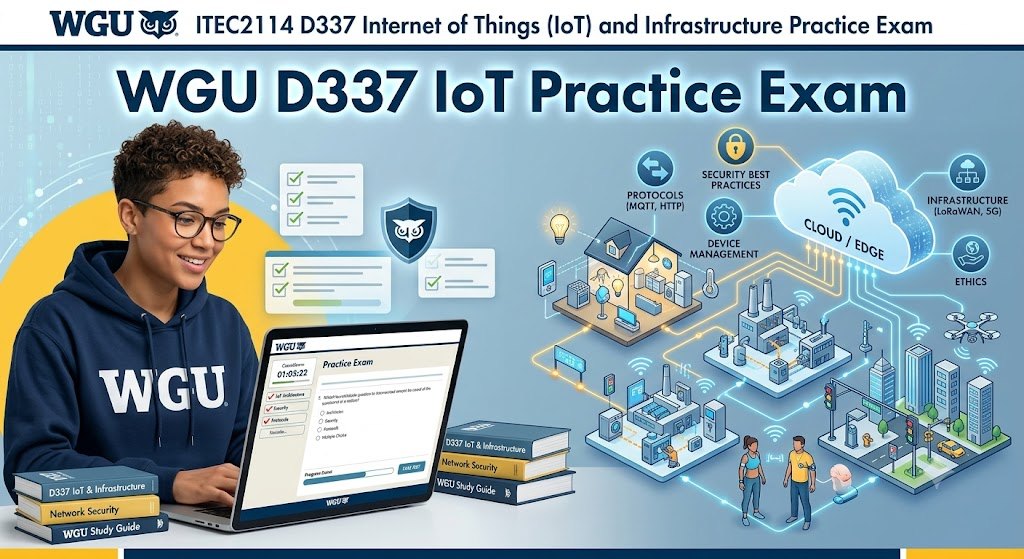
Additional Information
What the Course Entails and Exam Details
The WGU D337 course provides a comprehensive deep dive into the following core topics. Expect both your study materials, practice tests, and the final exam to cover these areas:
IoT Fundamentals and Architecture: Understanding the different components of an IoT ecosystem, the general architecture, and how data moves through it.
Infrastructure and Networking: Knowledge of communication protocols (like MQTT, HTTP, and LoRaWAN), cellular networks, Wi-Fi, and standard infrastructure requirements for connected systems.
IoT Device Management: The lifecycle, configuration, and maintenance of the physical devices themselves.
Cloud and Edge Computing: The roles and differences of central cloud platforms vs. localized "edge" or "fog" computing in processing data.
Data Collection and Analytics: How data is generated, collected, and used for meaningful insights. You may encounter processing models like Lambda and Kappa.
Cybersecurity in IoT: Crucial security considerations, common risks (like botnets), encryption methods, best practices, and relevant standards from organizations such as the Internet of Things Security Foundation (IoTSF) and NIST.
Ethical Computing Principles: The ethical, social, and privacy implications of extensive IoT deployments.
Standards and Compliance: Familiarity with the rules and guidelines governing IoT technology.
What to Expect in the Final Exam
The actual WGU D337 Objective Assessment is a proctored, time-limited examination. The format is typically:
Format: Primarily multiple-choice questions, which may include standard, multiple-select, and potentially other interactive question types depending on WGU's current assessment structure.
Time Limit: Students are generally given a fixed duration to complete the exam. Expect it to be around 2-3 hours. The practice test environment will often mirror this to help you gauge your pacing.
Passing Score: WGU uses competency-based assessments and does not typically publish a specific numerical passing score. Instead, you must meet the predefined competency cut-off for each section and overall. However, study resources and unofficial guides often indicate a performance level you should aim for to demonstrate mastery.
Specific Rules: The final exam is high-stakes and proctored. This means your computer, room, and screen will be monitored. Ensure your system meets the specified WGU proctoring requirements (e.g., specific webcam placement, clear environment) well in advance.
How to Study and Exam Centers
Preparation for the WGU D337 exam involves combining multiple study methods and utilizing all available resources:
WGU Course Materials: Go through the complete WGU learning modules, including textbooks, interactive activities, and simulations. These are the primary source of knowledge for the assessment.
Take the WGU Pre-Assessment (and Practice Tests): This is one of the most critical steps. WGU provides a specific Pre-Assessment (PA) which serves as your primary practice test. Treat the PA like the real exam: take it under timed, proctored-style conditions. Analyze the results to understand your weak areas. Don't memorize the questions, but understand the concepts behind them. Use external D337 IoT Practice Tests from reputable educational providers for variety and depth.
Study Guides and Quizzes: Utilize WGU study guides and student-created quiz banks (ensuring they are from recent years and accurate). Review the core topics from the syllabus in detail.
Practice with Labs and Simulations: Complete all provided lab activities to get a practical grasp of the concepts.
WGU Learning Communities and Mentors: Engage in WGU student forums and seek guidance from course instructors and mentors.
Proctoring and Exam Locations: The final D337 Objective Assessment is taken via online proctoring, where you can schedule and take the test from the comfort of your own home, provided you meet the strict equipment and environmental requirements. You do not typically take this exam at specific physical WGU campus testing centers, but through an authorized proctoring service. If online proctoring is not an option for some reason, WGU would provide instructions on alternative proctoring arrangements at authorized centers or physical test locations. You can check your student portal for specific scheduling and system check guidelines.
Job Opportunities from the Course
A strong understanding of IoT and modern infrastructure is highly relevant in today's tech landscape and can significantly enhance your career prospects in various roles. Completing this course and the associated program prepares you for job titles such as:
IoT Engineer: Designing and building end-to-end IoT solutions.
Cloud Architect: Designing complex network architectures, including integration with cloud and edge systems.
Network Infrastructure Specialist: Focus on the underlying communication protocols, security, and scalability of IoT networks.
IoT Developer: Programming the applications and logic within IoT devices and associated cloud platforms.
Systems Administrator (with IoT focus): Managing and maintaining diverse, connected device ecosystems and infrastructure.
Cyber Security Analyst (IoT/Infrastructure specialty): Specializing in identifying and mitigating risks within connected and infrastructure environments.
Data Engineer: Analyzing and processing the massive data streams generated by IoT systems for business insights.
By combining thorough study with effective practice tests, you will be well-equipped to achieve competency on your WGU D337 Objective Assessment and embark on a rewarding career path in the dynamic fields of Internet of Things and Infrastructure. Good luck!
Frequently Asked Questions
Reviews
5.0
Based on 0 reviews
Leave a Review
No reviews yet. Be the first to review!