
Western Governors University (WGU) ITEC2119 D282 Cloud Foundations Practice Exam
$69.00
- Buy to unlock unlimited access to all Quiz questions and Answers in this Quiz.
- After purchase you can print a PDF of the whole quiz at any point. The PDF will contain the questions and the correct answers.
About this Exam
Welcome to your comprehensive study guide for the WGU D282 Cloud Foundations Practice Exam.
This essential resource is tailored specifically for students enrolled in Western Governors University’s ITEC2119 Cloud Foundations course. The D282 course serves as a vital entrance into the expansive world of cloud computing, introducing learners to foundational cloud concepts, various service models, security principles, and the business value that cloud technology delivers in the modern digital era.
The WGU D282 Cloud Foundations Practice Exam is your gateway to understanding and confidence.
It is designed to prepare aspiring IT professionals and career switchers to not only pass the required assessments but to develop a real, usable foundation in cloud technologies. This practice tool simulates the style, content, and difficulty of the subsequent evaluations. This guide and the practice material are your partners in building crucial understanding, identifying knowledge gaps, and ensuring you are ready to succeed. Taking the time to master this content is a direct investment in your degree and your future career.
Ready to test your knowledge?
Buy Now to Access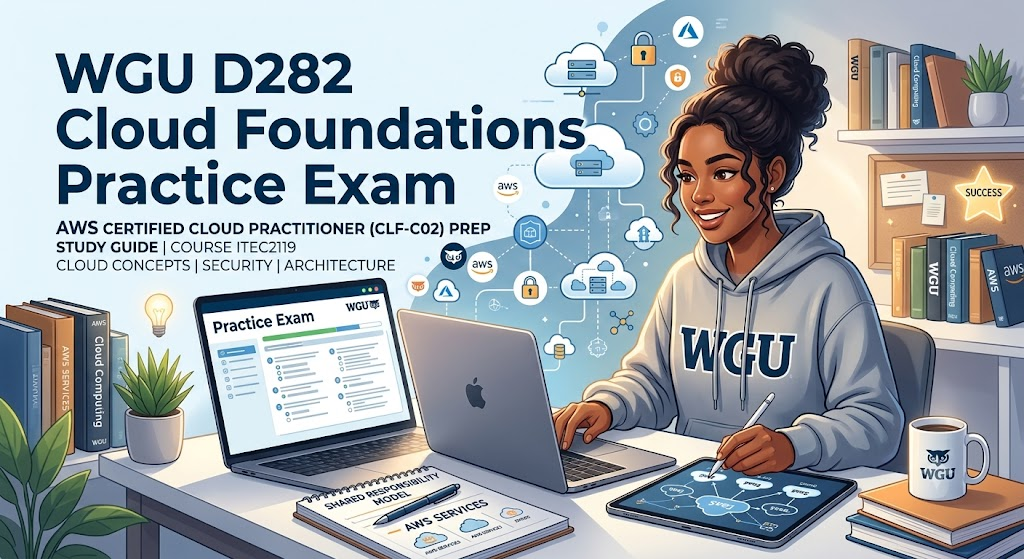
Additional Information
What the Course Entails and Exam Details
WGU’s Cloud Foundations course (D282 ITEC2119) provides a broad and detailed overview of fundamental cloud principles and technologies, primarily aligning its curriculum and assessment targets with the prestigious AWS Certified Cloud Practitioner (CLF-C02) industry certification.
Core Topics Covered:
Cloud Concepts: Understanding what the cloud is, its key characteristics (on-demand self-service, broad network access, resource pooling, rapid elasticity, and measured service), distinct deployment models (Public, Private, Hybrid), and the fundamental benefits over traditional IT.
Security & Compliance: Grasping the unique security model in the cloud, including the critical Shared Responsibility Model, core security concepts (authentication, access control, encryption), regulatory frameworks (GDPR, HIPAA), and security features specific to major providers, with an emphasis on AWS services.
Technology & Cloud Services: Diving into the actual technologies. This includes compute services (like virtual machines and serverless computing), diverse storage solutions, networking concepts (virtual networks, subnets, CDNs), and managed database services.
Cloud Architecture & Business Value: Understanding basic cloud design principles, how businesses leverage the cloud to innovate and achieve strategic goals, and the fundamental components of successful cloud implementation.
Billing, Pricing & Support: Navigating the financial aspect, including common pricing models, cost management tools, and the various levels of technical support and documentation available from cloud providers.
WGU Practice Exam Details (Illustrative):
WGU often provides specific internal pre-assessments and practice questions designed to mirror the format and content of the real evaluated step. While the exact details can vary, you can generally expect:
Format: Multiple choice and multiple response questions.
Question Style: A blend of knowledge-based definitions and foundational scenario questions testing your grasp of core concepts.
Number of Questions: Typically in the range of 60 to 70 questions, mirroring the actual assessment density.
Time Limit: Generally allows for 90 to 120 minutes, simulating a realistic testing environment and helping you with time management.
Specific Rules: WGU practice exams are typically non-proctored, allowing you to use them purely as a learning tool. Look for features that provide immediate feedback and detailed explanations for all answers.
What to Expect in the Final Exam
It is essential to recognize that the final step in proving competency for WGU D282 often involves achieving success on the external industry-standard certification exam. For this course, that target is the AWS Certified Cloud Practitioner (CLF-C02). While WGU has internal steps, this external validation is key.
Key Facts About the Final (AWS Certified Cloud Practitioner) Exam:
Official Vendor: Amazon Web Services (AWS).
WGU Compentency Requirement: Success on this external certification exam is typically required by WGU to fulfill the D282 course competency units.
Exam Format: Multiple choice and multiple response questions.
Number of Questions: Typically around 65 questions.
Passing Score: AWS uses a scaled score from 100 to 1000, with a benchmark often set around 700. Note: Exact passing criteria are determined by AWS and may be subject to adjustment, so always check official AWS and WGU current guidelines.
Time Limit: Usually 90 minutes.
Rules & Proctoring: This is a high-stakes, proctored exam. You can take it either in a physical testing center or securely online with remote proctoring. Valid identification is mandatory, and you must maintain a secure, private testing area throughout the session. Real understanding of the material is critical, and the use of 'brain dumps' is strictly prohibited and can invalidate your results.
How to Study and Exam Centers
Effective studying is about comprehensive understanding and confidence, not just memorization.
Study Strategies:
Engage Deeply with WGU Resources: Thoroughly work through all learning materials provided in the WGU D282 course, including textbooks, video lectures, practice exercises, and study guides. Connect with your Course Instructor and use academic coaching when needed.
Utilize WGU’s Pre-Assessments: WGU’s internal pre-assessments are crucial. Take them early to establish your baseline and identify weak points. Focus your study efforts on those specific areas, and take the pre-assessments again to track progress. Review both correct and incorrect answers and their explanations.
Leverage Official AWS Skill Builder: The AWS Skill Builder platform is a goldmine for cloud learners. Their free "AWS Cloud Practitioner Essentials" course is highly recommended and covers all the official CLF-C02 objectives extensively.
Practice with Reputable External Exams: Seek out well-regarded practice exams tailored to the current CLF-C02 version. Reputable platforms like Tutorial Dojo, specialized IT practice sets, and official AWS question sets are excellent sources. Practice under timed conditions to simulate the real experience.
Hands-on Exposure (console): Even for a foundational exam, minimal hands-on time in the AWS Free Tier console can solidify definitions and concepts. Look at service descriptions, explore simple configurations, and see how billing information is presented.
Collaborate & Coach: Don’t isolate your study. Engage with fellow WGU students in forums, and don’t hesitate to reach out to your instructor or academic coach for personalized feedback and support.
Exam Centers:
For WGU’s Practice/Internal Assessments: These are typically delivered online, allowing you to take them from the comfort of your own home with a secure, standard computer and internet setup.
For the External AWS Certified Cloud Practitioner Exam: This is a professional-grade exam that you will register for with a proctoring vendor like Pearson VUE. You have two main choices:
Online Proctoring: Securely test from home or office with a remote proctor. You will need to meet strict system requirements, have a quiet, private area, and follow specific security procedures, including a room scan.
Authorized Physical Testing Centers: Register for a seat at an official Pearson VUE testing center in your location. This provides a formal, controlled environment without the need to manage your own secure testing space. WGU often provides students with vouchers and clear instructions for this final, crucial registration step.
Job Opportunities from the Course
A strong cloud foundation, validated by passing the D282 course and earning the AWS Certified Cloud Practitioner certification, is highly sought after by employers across diverse industries. This qualification opens doors to an expansive and rewarding career path in the booming cloud computing sector.
Cloud Support Associate: Provide entry-level technical support for cloud services, assisting users with basic setup and troubleshooting.
Junior Cloud Administrator: Support the daily management, deployment, and monitoring of a company’s cloud infrastructure.
Cloud Operations Specialist: Focus on the ongoing monitoring, reporting, and operational efficiency of cloud-based systems.
IT Support Technician (Cloud-Enhanced): Standard IT support roles benefit significantly from cloud knowledge as more business systems move to the cloud.
Junior Security Analyst (Foundational): Start your career in cloud security by understanding core security principles and configurations within a major cloud provider.
Technical Sales/Solutions Associate: Understand the value proposition of cloud solutions and basic service types to support sales and customer interaction.
Business/Cloud Analyst: Analyze business requirements and use foundational cloud knowledge to assess solution options and cost-effectiveness.
Long-Term Career Path Potential (Requires Continued Education & Experience):
Cloud Architect (AWS, Azure, etc.)
DevOps Engineer
Cloud Security Specialist
Cloud Data Specialist
Cloud FinOps Analyst (Cost Management)
Cloud Consultant
Your journey to a successful cloud career starts right here with D282!
Frequently Asked Questions
Reviews
5.0
Based on 0 reviews
Leave a Review
No reviews yet. Be the first to review!