
Western Governors University (WGU) MGMT6010 C207 Data Driven Decision Making Practice Exam
$69.00
- Buy to unlock unlimited access to all Quiz questions and Answers in this Quiz.
- After purchase you can print a PDF of the whole quiz at any point. The PDF will contain the questions and the correct answers.
About this Exam
The Western Governors University (WGU) C207 Data-Driven Decision Making course, often associated with the Master of Business Administration (MBA) program and other business degrees, is a critical competency-based requirement for modern professionals. This course is designed to equip students with the analytical skills necessary to interpret complex data, apply statistical methods, and make informed, evidence-based business decisions. It moves beyond theoretical understanding, focusing on the practical application of data analysis to solve real-world organizational challenges. This course is ideal for current and aspiring leaders who need to harness the power of data to drive strategy, improve operational efficiency, and gain a competitive edge.
Ready to test your knowledge?
Buy Now to Access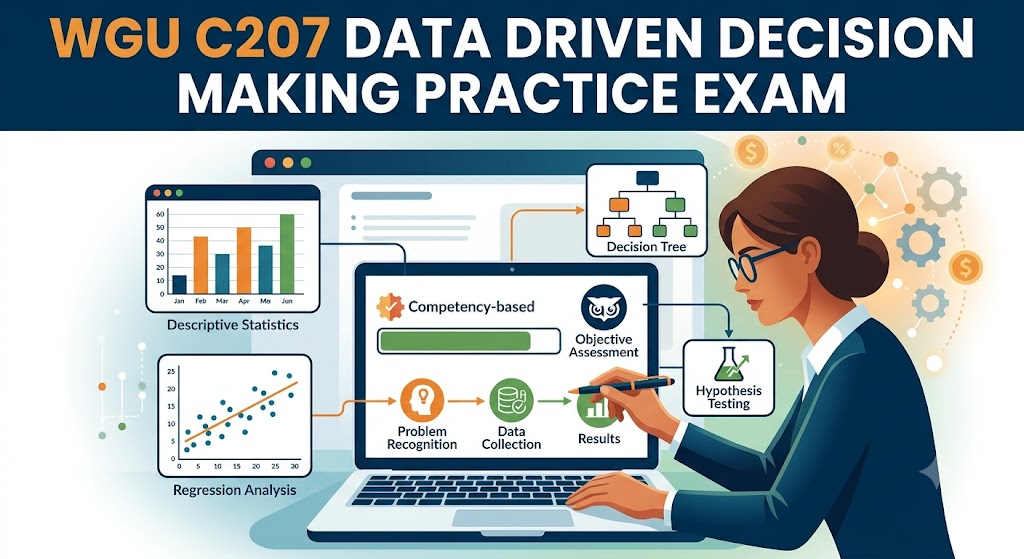
Additional Information
What the Course Entails and Exam Details
The C207 course covers a comprehensive range of topics essential for making sound business decisions backed by data. Students will delve into multiple key areas, including:
Decision-Making Models: Understanding frameworks such as the Davenport-Kim three-stage model, which includes problem recognition, solving the problem, and communicating results.
Data Collection and Quality: Learning to identify reliable data sources, recognizing common collection errors, and understanding various types of bias (e.g., measurement bias, conscious bias) that can compromise analysis.
Descriptive Statistics: Calculating and interpreting measures of central tendency (mean, median, mode) and dispersion (standard deviation, variation, range) to summarize datasets.
Inferential Statistics: Applying probability concepts, hypothesis testing, and p-values to draw meaningful conclusions about populations from sample data.
Correlation and Regression Analysis: Analyzing relationships between variables, building predictive models, and interpreting regression outputs in a business context.
Data Visualization: Selecting the appropriate charts, graphs, and visual tools to present data clearly and support a decision-making narrative.
Analytical Methods: Differentiating between and applying descriptive, predictive, and prescriptive analytics.
What to Expect in the Final Exam
The final step to proving competency in C207 is passing the Objective Assessment (OA). This is a timed, proctored, online examination that focuses on your ability to apply the course concepts. Here is what you can expect:
Format: The C207 OA consists primarily of multiple-choice and scenario-based questions. These scenarios require you to analyze a given business situation, interpret provided data, and select the best analytical approach or decision.
Length and Time: The exam typically contains around 60 to 70 questions. Candidates are generally given between 2 to 3 hours to complete the assessment.
Scoring: As WGU is a competency-based institution, you will receive a grade of either "Pass" or "Not Pass." Your result is based on achieving a score at or above the cut score set by the university.
Proctoring: The exam is administered online and requires a strict proctored environment. Students must use an external webcam and comply with WGU's specific rules regarding their testing room and identification.
Resources: While you may need to perform basic calculations, the focus is on interpretation. A basic on-screen calculator or an approved physical calculator is typically permitted.
How to Study and Exam Centers
Effective preparation is key to succeeding in C207. Here are actionable study strategies:
Take the Pre-Assessment (PA) Early: Start by taking the diagnostic Pre-Assessment. This will give you a clear baseline of your current understanding and highlight specific areas that need the most focus.
Utilize WGU Course Materials: The official course text and interactive modules are your primary resources. Go through each section, take the embedded quizzes, and complete all practice exercises.
Watch Recorded Cohorts: WGU mentors frequently provide "cohort" videos, including popular ones like "Are You Smarter Than a 5th Grader" and Jeopardy-style reviews. These are highly effective for reinforcing concepts and hearing explanations in different formats.
Focus on Interpretation over Calculation: While you should understand the formulas, the OA is more about knowing when to use a specific statistical test and what the results mean for a business.
Use Flashcards for Vocabulary: The course introduces significant terminology, such as ANOVA, p-values, regression, and experimental design. Memorizing definitions will help you parse questions more quickly.
Form a Study Plan: Map out your study time, giving more weight to high-value topics like inferential statistics and decision-making frameworks.
Exam Center Information: WGU is an online university, and all assessments, including the C207 OA, are taken through the WGU student portal via a third-party online proctoring service. This means you do not go to a physical Pearson VUE center. You will schedule your exam in advance and take it from a quiet, private location (such as your home or office) that meets the university's strict proctoring requirements.
Job Opportunities from the Course
A strong foundation in data-driven decision-making is one of the most sought-after skills in the modern job market. Completing this course and demonstrating competency opens the door to numerous career paths and advanced roles, including:
Data Analyst
Business Analyst
Marketing Analyst
Operational Manager
Product Manager
Financial Analyst
Management Consultant
Supply Chain Analyst
Healthcare Data Analyst
Project Manager
By mastering these skills, you position yourself as a strategic leader capable of guiding an organization using evidence, minimizing risk, and identifying growth opportunities in any industry.
Frequently Asked Questions
Reviews
5.0
Based on 0 reviews
Leave a Review
No reviews yet. Be the first to review!