
Western Governors University (WGU) MGMT6020 C215 Operations Management Practice Exam
$69.00
- Buy to unlock unlimited access to all Quiz questions and Answers in this Quiz.
- After purchase you can print a PDF of the whole quiz at any point. The PDF will contain the questions and the correct answers.
About this Exam
This comprehensive study guide is meticulously crafted for students preparing to conquer the Western Governors University (WGU) MGMT6020 C215 Operations Management Practice Exam and the ultimate Objective Assessment.
This exam serves as a critical checkpoint within the WGU MBA program, designed to validate a student's competency in the essential frameworks of supply chain efficiency. This includes demand forecasting, quality control, process design, inventory strategies, and the logic behind master production scheduling (MPS).
This guide targets emerging leaders and business professionals who must understand how integrated operational decisions directly impact a company's bottom line and competitive edge.
Ready to test your knowledge?
Buy Now to Access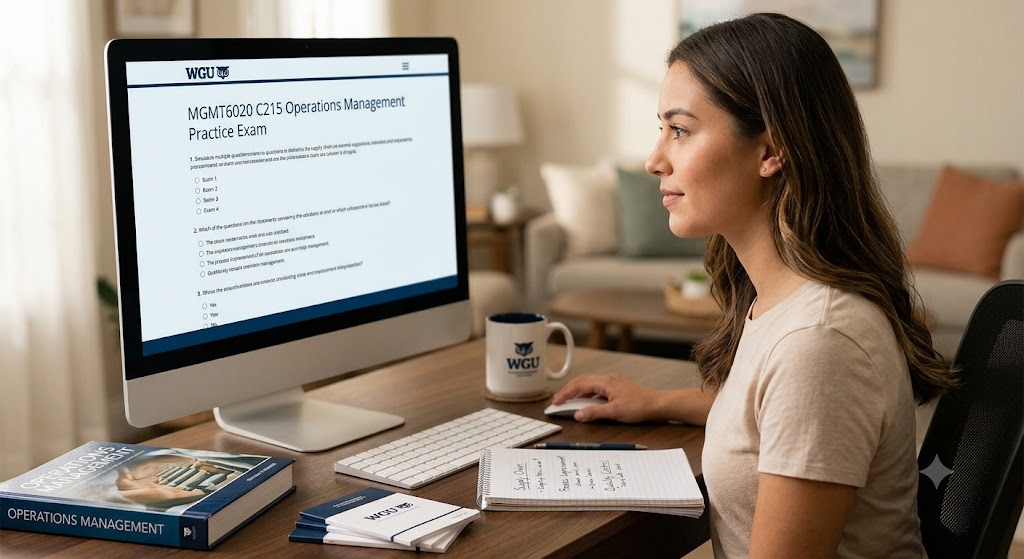
Additional Information
What the Course Entails and Exam Details
The WGU C215 Operations Management course (3 Competency Units) provides an in-depth exploration of how organizations plan, execute, and control the processes that create goods and services.
The material is structured around several core competencies, which are all covered in detail during the course and the final exam:
Process Management: Analyzing flow and increasing process efficiency.
Quality Management: Implementing tools for Total Quality Management (TQM) and Six Sigma.
Inventory Management: Designing optimal inventory levels using strategies like Economic Order Quantity (EOQ) and Just-In-Time (JIT).
Capacity Planning & Resource Management: Balancing facility design and effective capacity, including detailed MPS and Materials Requirements Planning (MRP) calculations.
Supply Chain Design: Evaluating sourcing decisions and navigating global logistics.
Demand Forecasting: Utilizing historical data and predictive modeling.
A primary goal of the course is to ensure students can synthesize these disparate operational functions, understanding, for instance, how a small forecasting error can ripple through the entire master schedule and trigger costly material shortages.
What to Expect in the Final Exam
The WGU C215 final Objective Assessment is the sole high-stakes barrier to completing this course. It is not a test of raw rote memorization but rather a measure of competency. Here is what to expect:
Format: The exam consists entirely of digital, closed-book questions. This includes standard multiple-choice items and "select all that apply" scenarios. There are typically around 75–80 questions.
Time Limit: Students are generally allotted 2–3 hours to complete the entire assessment.
Passing Requirements: While specific raw scores are proprietary, WGU uses a scaled passing score system that requires students to demonstrate competency across all domains. You must meet the cut score for the entire exam to pass.
Key Question Types: Be prepared for:
Applied Scenarios: You will face a "realistic operational challenge" (e.g., a supplier delay) and must select the single best, logically consistent corrective action.
Constraint Analysis: You must identify bottlenecks (e.g., physical or policy constraints) and recommend schedule adjustments.
Concept Applications: You must understand how to interpret quality tools (like a Pareto chart) rather than just list their definitions.
Calculator Rules: You may be allowed to use a simple, non-programmable, approved financial or scientific calculator for basic arithmetic, though complex formula memorization is usually discouraged in favor of conceptual understanding.
How to Study and Exam Centers
Your path to success relies on structured practice and simulation.
Comprehensive Study Strategies:
Active Practice over Reading: Do not just re-read the textbook. Focus your energy on completing the provided WGU practice exams multiple times. Analyze not just which answer is correct, but why the others are incorrect.
Master the Integreted Flow: Study the logical progression of operational planning: Forecast -> Master Production Schedule (MPS) -> Materials Requirements Planning (MRP) -> Execution. Know how data from one feed influences the next.
Utilize Live Cohorts: WGU strongly encourages attendance in live cohort sessions led by course instructors. These are often described by successful students as "gold" for simplifying complex concepts like MRP logic or bottlenecks.
Scenario-Based Thinking: When studying, ask yourself: "Given X (a demand spike), what happens to Y (inventory) and Z (capacity gap)?" Build this integrated thinking.
Simulate Exam Conditions: Take at least one full-length practice test under timed conditions, using a simple calculator and no notes. This will refine your pacing and reduce test-day anxiety.
Exam Location and Portals:
The final WGU MGMT6020 C215 Objective Assessment is taken via online proctoring through WGU's authorized online portal. You do not need to visit a physical test center, but you must follow strict proctoring rules, which include having an external webcam, a clear workspace, and a secure environment.
Students will receive a specific link and instructions on how to schedule and access their proctored exam from within their WGU student portal.
Job Opportunities from the Course
Successfully mastering WGU C215 opens the door to numerous high-impact roles within an organization's core operations. Here are specific job titles this certification can unlock:
Operations Manager / Director
Process Improvement Manager
Supply Chain Analyst / Manager
Production Planner
Logistics Manager
Inventory Control Specialist
Quality Assurance Manager
Business Operations Specialist
Master Scheduler
Continuous Improvement Lead
Frequently Asked Questions
Reviews
5.0
Based on 0 reviews
Leave a Review
No reviews yet. Be the first to review!