
Western Governors University (WGU) NURS3418 C228 Community Health and Population - Focused Nursing Practice Exam
$69.00
- Buy to unlock unlimited access to all Quiz questions and Answers in this Quiz.
- After purchase you can print a PDF of the whole quiz at any point. The PDF will contain the questions and the correct answers.
About this Exam
Welcome to your essential study guide for the Western Governors University (WGU) NURS3418 C228 Community Health and Population-Focused Nursing Practice exam. This course and its final Objective Assessment (OA) are foundational for nursing students, particularly those in the Bachelor of Science in Nursing (BSN) program, who seek to expand their impact beyond individual patient care. This certification validates a nurse’s ability to assess, plan, and implement health initiatives for entire communities and specific populations. It is designed for registered nurses who want to master the art of improving health outcomes on a grand scale, focusing on prevention, equity, and systemic health improvements.
Ready to test your knowledge?
Buy Now to Access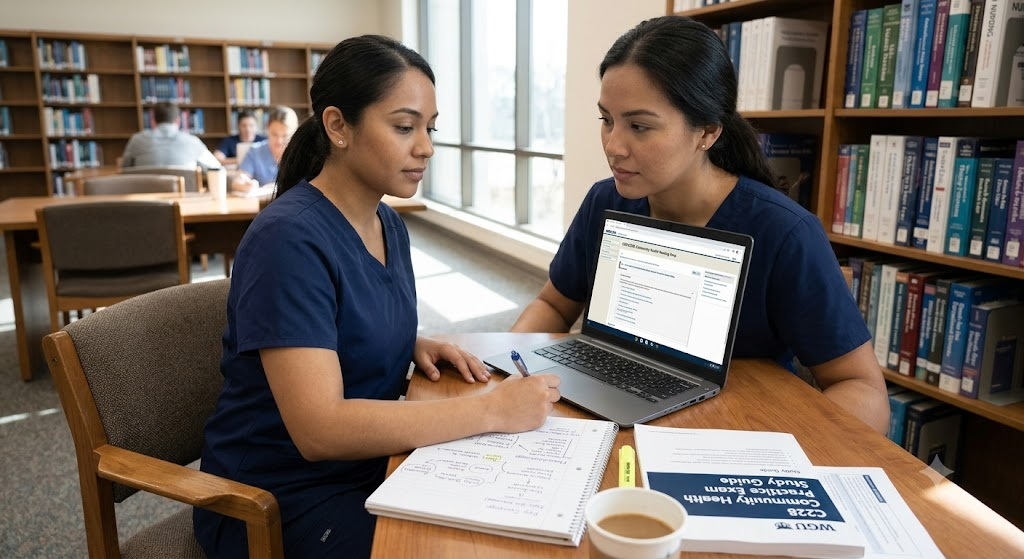
Additional Information
What the Course Entails and Exam Details
The WGU C228 course, "Community Health and Population-Focused Nursing Practice," is a comprehensive exploration of public health principles. It covers critical concepts that every modern nurse must understand. Key areas of study include:
Epidemiology: The study of the distribution and determinants of health-related states in specific populations.
Levels of Prevention: Mastering primary, secondary, and tertiary prevention strategies to reduce the burden of disease.
Community Assessment: Learning methods to identify the unique health needs, assets, and risks of a community.
Vulnerable Populations: Understanding the factors that affect health equity and the tailored care needed for high-risk groups.
Environmental Health: Analyzing how physical, chemical, and biological factors in the environment influence human health.
Disaster Management: Preparing for and responding to large-scale public health emergencies.
Global Health: Gaining perspective on transnational health issues and their determinants.
Culturally Competent Care: Developing strategies to provide effective health services across diverse cultural boundaries.
The core of the final exam, or Objective Assessment (OA), evaluates your competency in these areas through application-based questions.
What to Expect in the Final Exam
The WGU C228 Objective Assessment is a high-stakes, proctored, online examination. It is designed to be a definitive test of your knowledge and ability to apply community health concepts.
Format: The exam consists entirely of multiple-choice questions, which may include single-answer and multiple-response scenarios.
Time Limit: You will typically have a specific time limit, such as 120 minutes (2 hours), to complete the assessment.
Passing Score: To pass the course, you must achieve a score at or above the predetermined "cut score," which represents competency. This cut score can vary but is generally within the 70-75% range. WGU uses a pass/fail model, with the focus on demonstrating proficiency.
Rules: Because it is a proctored exam, you must follow strict rules, including a clean workspace, a working webcam, and no access to outside resources. The proctor will verify your identity and monitor you throughout the entire session to ensure academic integrity.
How to Study and Exam Centers
Preparing for the WGU C228 exam requires a structured and active approach. Here is a proven strategy:
Take the Preassessment First: This is WGU's diagnostic tool. Do not study beforehand. Take it to establish a baseline and immediately identify your areas of strength and weakness. Use the resulting coaching report to create a focused study plan.
Focus on High-Yield Areas: Direct your attention to the levels of prevention (primary, secondary, tertiary), epidemiological calculations, and community assessment methods. These are frequently tested and form the backbone of the course.
Utilize Active Recall: Instead of just reading the course material, use flashcards, teach concepts to someone else (or yourself), and create concept maps to connect different topics.
Practice with Scenario-Based Questions: Community health exams often present complex, real-world situations. Practice applying concepts to new scenarios to develop your critical thinking skills.
Review the 'Nuts and Bolts': Pay close attention to definitions, specific public health models, and official tools used in community assessment.
Exam Centers: WGU is an online university, and as such, the final Objective Assessment for C228 is taken primarily through online proctoring. This means you can take the exam from the comfort of your own home or any location with a stable internet connection and a private, quiet space. You will schedule your exam through the WGU student portal, which connects you to a third-party proctoring service. This provides maximum flexibility for working nurses. While WGU uses this online model, students are occasionally permitted to take exams at authorized physical testing centers in rare circumstances; however, the online, proctored-from-home method is the intended and standard way to complete this final step.
Job Opportunities from the Course
Earning a strong passing grade in WGU C228 and, more importantly, completing your BSN program with a solid foundation in population-focused nursing opens numerous specialized career paths. Your skills in assessment, data analysis, and program planning will make you a prime candidate for roles that focus on systemic health improvement. Potential job opportunities include:
Public Health Nurse: Working for government agencies (county, state) to monitor and improve the health of entire communities through education and policy.
Community Health Nurse: Providing direct care and health education within community settings, such as clinics, non-profits, or mobile units.
School Nurse: Managing the health needs of student populations and implementing school-wide prevention programs.
Occupational Health Nurse: Designing and implementing health and safety programs for employees in various industries.
Home Health Nurse: Delivering care to patients in their homes, with a focus on comprehensive, family-centered assessments.
Health Educator: Developing materials and programs to teach communities about healthy behaviors and disease prevention.
Disease Prevention Specialist: Focusing on managing the spread of communicable diseases and reducing the risk of chronic conditions.
Nurse Case Manager (Community Focus): Coordinating care for individuals within a specific community to ensure they have access to necessary health and social resources.
Disaster Preparedness Coordinator (for a healthcare system or community): Leading initiatives to prepare for and respond to public health emergencies.
Population Health Manager: Analyzing large health datasets to identify trends and design interventions for large patient populations.
Completing this course signals to employers that you are not just a clinician, but a strategic thinker capable of leading large-scale health initiatives.
Frequently Asked Questions
Reviews
5.0
Based on 0 reviews
Leave a Review
No reviews yet. Be the first to review!