
Western Governors University (WGU) PHIL1020 D265 Critical Thinking: Reason and Evidence Practice Exam
$69.00
- Buy to unlock unlimited access to all Quiz questions and Answers in this Quiz.
- After purchase you can print a PDF of the whole quiz at any point. The PDF will contain the questions and the correct answers.
About this Exam
The Western Governors University (WGU) PHIL1020 D265 Critical Thinking: Reason and Evidence course is a comprehensive, competency-based educational program designed to equip students with essential cognitive skills. It focuses on developing the ability to analyze, evaluate, and construct arguments using logic and evidence.
This course is primarily designed for adult learners enrolled in WGU's online degree programs, often serving as a foundational general education requirement across multiple fields, including business, healthcare, and IT. By mastering these critical thinking frameworks, students become more effective problem-solvers, better decision-makers, and more discerning consumers of information in both their academic and professional lives.
Ready to test your knowledge?
Buy Now to Access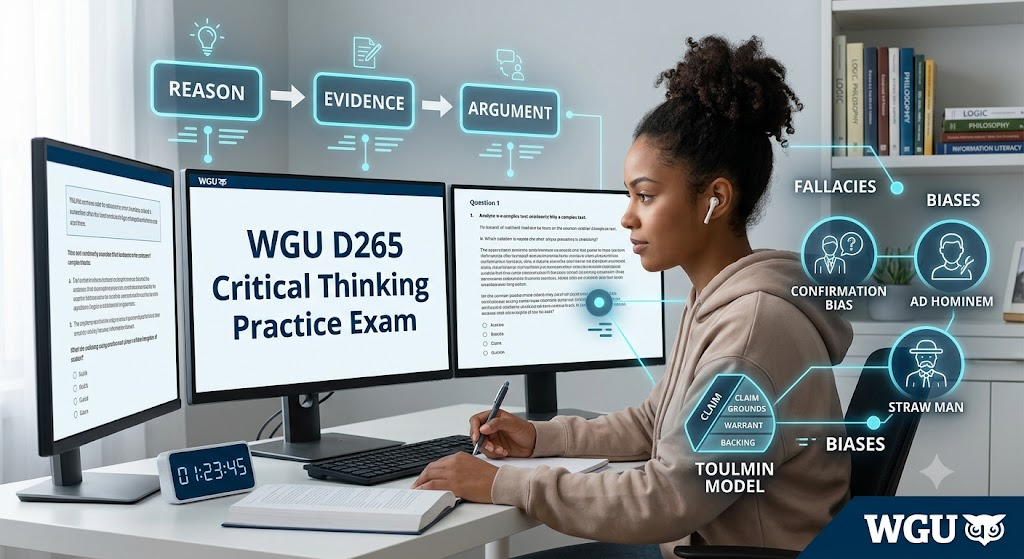
Additional Information
What the Course Entails and Exam Details
This course provides students with a structured approach to analyzing complex information. The curriculum covers a wide spectrum of logical and rhetorical principles, ensuring a well-rounded skill set.
The core syllabus and key skills covered include:
Argument Analysis: Learning to identify and dissect the components of an argument, including premises and conclusions.
The Toulmin Model: A significant part of the D265 course, this section requires students to understand and apply Stephen Toulmin’s structure: Claim, Grounds, Warrant, Backing, Qualifier, and Rebuttal.
Deductive and Inductive Reasoning: Understanding the distinction between arguments that guarantee a conclusion (deductive) and those that support a probable conclusion (inductive).
Logical Fallacies: Identifying common errors in reasoning, such as ad hominem, straw man, false dilemma, and slippery slope.
Cognitive Biases: Recognizing unconscious mental shortcuts that can distort judgment, such as confirmation bias and anchoring.
Evaluating Evidence and Sources: Developing criteria to assess the credibility, relevance, and sufficiency of evidence from diverse sources.
The exam itself, known as the Objective Assessment (OA), is a high-stakes, proctored test that evaluates the student’s mastery of these competencies.
What to Expect in the Final Exam
The final Objective Assessment (OA) for WGU PHIL1020 D265 is a critical milestone. It is a comprehensive exam designed to test your ability to apply concepts to real-world scenarios, rather than just recall definitions.
Exam Format: The test consists primarily of multiple-choice questions. A significant number of questions will present short passages, articles, or scenarios and require you to classify the arguments, identify logical fallacies, or analyze the structure using the Toulmin model.
Time Limit: Students are typically allotted approximately 90 to 120 minutes to complete the exam. Efficient time management is essential due to the nature of passage analysis.
Passing Score: WGU uses a cut score system. Students must meet or exceed a set minimum score, determined by a panel of subject matter experts, to demonstrate competence and pass the course.
Specific Rules: The OA is taken under strict, live online proctoring. Students must have a clear workspace, a working webcam and microphone, and provide government-issued photo identification. Unauthorized materials, including notes, books, and extra monitors, are strictly prohibited. The entire session is recorded.
How to Study and Exam Centers
WGU's flexible model means your study strategy is paramount. Effective preparation must go beyond passive reading to active, practical application.
Actionable Study Strategies:
Take the Pre-Assessment (PA) Early: Use the PA as a diagnostic tool. It mirrors the structure of the OA. A passing score on the PA is a strong indicator of readiness, while a failing score highlights your weak areas.
Focus on the Course Materials: WGU provides extensive digital texts, interactive exercises, and videos. Prioritize mastering the specific "check for understanding" sections.
Master the Catalogs: Create a detailed list or flashcards for logical fallacies and cognitive biases. For each, include the name, definition, and, most importantly, a unique example that you can recall.
Practice Daily Classification: Don't just learn about Toulmin; practice labeling 'claim,' 'warrant,' and 'grounds' in fresh arguments every day. Speed and accuracy in passage analysis are critical.
Utilize Cohorts and Mentors: WGU often provides faculty-led review sessions (cohorts). Attending these can clarify complex topics. Your course mentor is also a valuable resource for guidance.
Exam Centers: WGU is an online university, and as such, all final Objective Assessments, including the D265 OA, are taken online from the student’s location. The exam is administered through WGU's online portal, which connects you to a third-party proctoring service (such as Examity or ProctorU/Guardian). There are no physical testing centers to visit.
Job Opportunities from the Course
A strong foundation in critical thinking is one of the most transferable and sought-after skills in the modern economy. This course equips students with the ability to navigate complexity, making them valuable in nearly any role that requires analysis and decision-making.
The skills gained from this course directly enhance performance in job titles and career paths such as:
IT Systems Analyst: Critical thinking is essential for diagnosing complex technical issues, troubleshooting software bugs, and optimizing network performance.
Business Intelligence Analyst: Interpreting data, identifying trends, and making logical inferences are core to this role, all of which rely on sound reasoning.
Human Resources Generalist: Evaluating evidence and understanding cognitive biases are vital for fair hiring practices, conflict resolution, and employee relations.
Project Manager: Anticipating risks, analyzing arguments for proposed changes, and making data-driven decisions are key project management functions.
Financial Auditor: Systematically evaluating financial statements and identifying potential errors or fraud requires a high degree of logical scrutiny.
Consultant (Management or Strategy): Breaking down client problems, gathering relevant evidence, and constructing persuasive, logical arguments for solutions are foundational consulting skills.
Healthcare Administrator: Making ethical decisions regarding policy, evaluating new procedures, and analyzing performance data to improve patient care.
Frequently Asked Questions
Reviews
5.0
Based on 0 reviews
Leave a Review
No reviews yet. Be the first to review!