
Western Governors University (WGU) SOCG1010 C273 Introduction to Sociology Practice Exam
$69.00
- Buy to unlock unlimited access to all Quiz questions and Answers in this Quiz.
- After purchase you can print a PDF of the whole quiz at any point. The PDF will contain the questions and the correct answers.
About this Exam
The Western Governors University (WGU) SOCG1010 course, known by its assessment code C273, is a fundamental Introduction to Sociology class. This course is designed to provide students with a comprehensive introduction to the field, exploring how society and social interaction shape individual and group human behavior. It is for students across a wide array of degree programs at WGU—including business, healthcare, education, information technology, and social science—who need to fulfill a general education or foundational requirement in the social sciences. The course challenges students to look at the world through a "sociological imagination," understanding the connection between personal experience and broader social structures.
Ready to test your knowledge?
Buy Now to Access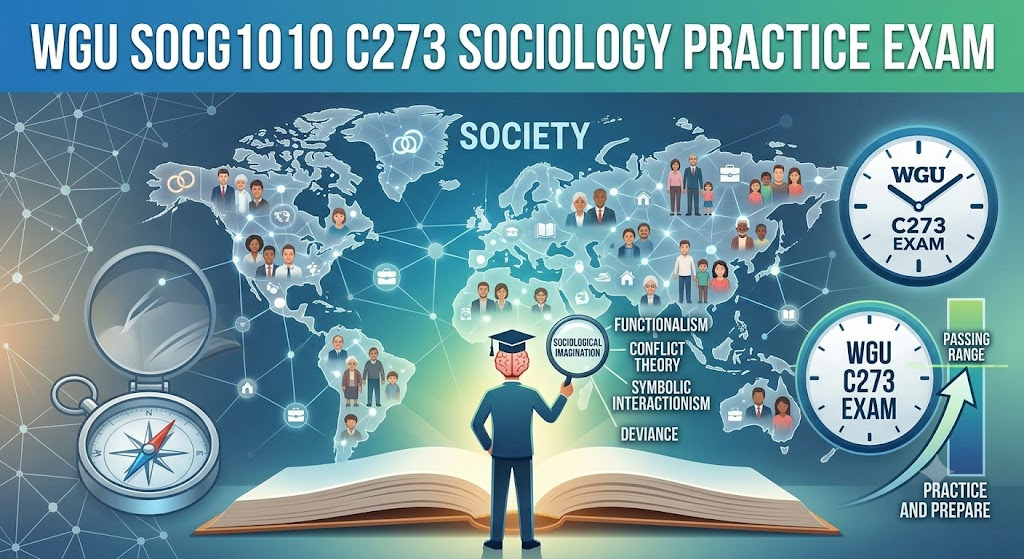
Additional Information
What the Course Entails and Exam Details
This course provides a robust foundation in sociological concepts, theories, and research methods. Students will learn to analyze a variety of topics and institutions through distinct sociological lenses. The core curriculum covers the following key areas:
The Sociological Perspective: Understanding the origins of the discipline and the "sociological imagination."
Theoretical Perspectives: A deep dive into the three major paradigms: structural functionalism, conflict theory (including feminist theory), and symbolic interactionism.
Founders of Sociology: Learning the core ideas and contributions of key figures such as Auguste Comte, Émile Durkheim, Karl Marx, and Max Weber.
Culture: Examining the components of culture, cultural diversity, and social change.
Socialization: Understanding how individuals develop their social identities through interaction throughout their lives.
Deviance and Social Control: Exploring the definitions, theories, and institutional responses to social deviations.
Social Stratification: Analyzing systems of inequality based on social class, race, ethnicity, gender, age, and global location.
Social Institutions: Examining the functions and forms of essential social units such as the family, education, religion, and the economy.
What to Expect in the Final Exam
The full C273 assessment, which this practice exam prepares you for, is a proctored, high-stakes "Objective Assessment" (OA). At WGU, the practice exam is typically referred to as the "Pre-Assessment" or PA. Both the PA and OA generally consist of:
Format: Multiple-choice questions.
Number of Questions: You can typically expect between 70 and 75 questions in the actual final exam.
Time Limit: Students are generally given around two hours (120 minutes) to complete the assessment.
Passing Score: WGU uses "cut scores" for all its assessments. You must achieve a precise minimum percentage to demonstrate competency and pass. This percentage varies slightly based on the specific version of the exam, but it is typically in the range of 65% to 70%.
Rules: For the official final exam, you will be online with a live proctor who will verify your identity, inspect your testing area, and monitor you throughout the duration of the test. No external resources, such as books, notes, or mobile devices, are permitted.
How to Study and Exam Centers
WGU is an online university, and as such, all high-stakes exams are administered remotely.
Actionable Study Strategies
Take the Pre-Assessment First: This is your best diagnostic tool. The PA will show you exactly how you are performing against the cut score and provide a detailed "Coaching Report" that breaks down your competence by specific unit. Use this report to target your studies where you need them most.
Master the Theoretical Perspectives: Ensure you can not only define functionalism, conflict theory, and symbolic interactionism, but also apply each one to a variety of social situations (e.g., how each theory would view a job loss or a religious institution).
Know the Key Theorists: Be ready to connect major concepts, such as "bureaucracy," "anomie," or "historical materialism," to the thinkers who defined them, including Weber, Durkheim, and Marx.
Don't Skimp on Difficult Units: Course instructors often advise students to pay close attention to the units on "Deviance and Social Control" and "Social Stratification" (especially race, class, and gender inequality), as these tend to have higher-stakes questions that require deeper application of knowledge.
Use Active Learning: Create your own flashcards, write out detailed summaries of each unit, and teach a concept to an imaginary student. Simply reading the material is not enough; you must practice applying it.
Where and How to Take the Exam
The official final WGU SOCG1010 C273 exam is proctored online. There are no physical testing centers you need to visit. You will take the exam from a computer at your home, office, or a quiet, private location of your choice.
Schedule the Exam: You must request authorization to test through your WGU course dashboard and then schedule a time slot with the university's approved online proctoring service (such as Examity).
Hardware and Environment: You will need a reliable computer, a webcam, a microphone, and high-speed internet. Before your exam time, you must perform a system check to ensure your equipment is compatible. You must also have a clean, clear, and private room, free of interruptions.
Job Opportunities from the Course
Completion of the WGU SOCG1010 C273 course provides essential foundational knowledge that is highly valued in numerous professional fields. While it is a singular course within a larger degree program, the skills you develop—understanding social systems, group dynamics, inequality, and human behavior—directly translate to a broad range of career paths. Here are specific job titles and fields where a strong background in sociology is highly applicable and beneficial:
Human Resources Coordinator / Specialist (Understanding group behavior and organizational culture)
Social Services Case Manager / Assistant (Navigating social systems to help individuals)
Community Outreach Specialist (Engaging with diverse populations and understanding local needs)
Recruiting Assistant / Coordinator (Identifying talent and analyzing group fit)
Public Relations Specialist / Assistant (Analyzing public perception and managing communication)
Market Research Assistant / Analyst (Understanding consumer trends and demographic behavior)
Non-profit Program Coordinator (Managing community-focused initiatives and identifying social gaps)
Legislation Aide / Assistant (Analyzing social problems and assisting with policy research)
Frequently Asked Questions
Reviews
5.0
Based on 0 reviews
Leave a Review
No reviews yet. Be the first to review!