
Wilderness & Remote First Aid Certification Practice Test
$69.00
- Buy to unlock unlimited access to all Quiz questions and Answers in this Quiz.
- After purchase you can print a PDF of the whole quiz at any point. The PDF will contain the questions and the correct answers.
About this Exam
The Wilderness & Remote First Aid (WRFA) certification is a crucial credential for anyone who works, plays, or spends significant time in environments where medical care is delayed by more than an hour.
Unlike standard urban first aid courses, WRFA training focuses on making critical decisions with limited resources and improvising care when professional help is far away.
This comprehensive certification is designed for outdoor enthusiasts, hike leaders, camp counselors, guides, research teams, and remote workers.
It provides the knowledge, skills, and confidence required to respond effectively to emergencies when immediate professional medical response is not an option, often involving multi-day patient care scenarios.
Ready to test your knowledge?
Buy Now to Access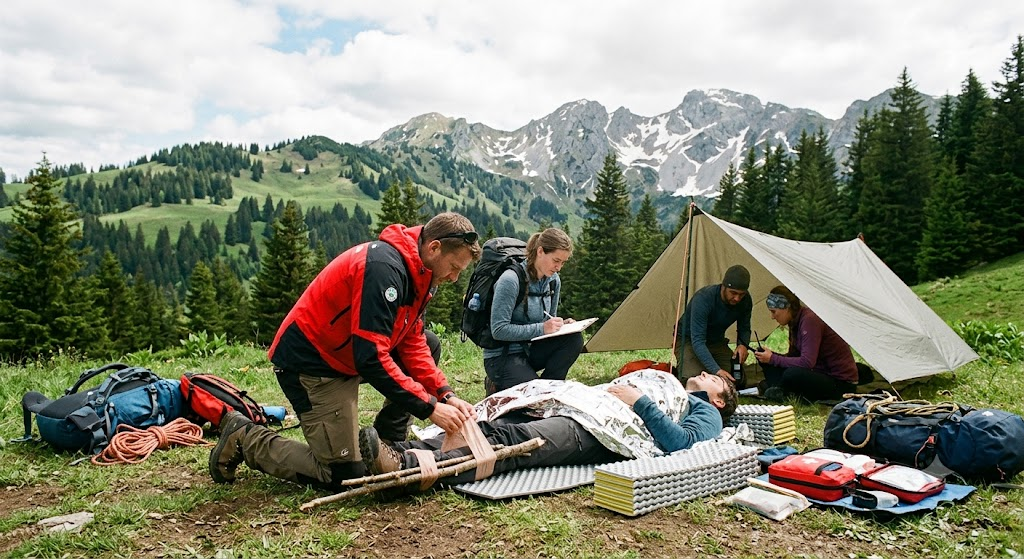
Additional Information
What the Course Entails and Exam Details
The WRFA course is demanding, blending theory with hands-on practice.
A standard WRFA curriculum typically covers:
Primary Survey and Patient Assessment: A rapid, methodical approach to identifying and managing life-threatening conditions in a wilderness setting.
Wound Management: Cleansing, dressing, and treating various wounds (abrasions, lacerations, burns) in the field to prevent infection.
Musculoskeletal Injuries: Splinting techniques for fractures, dislocations, sprains, and strains using available materials.
Environmental Emergencies: Recognizing, treating, and preventing hypothermia, heatstroke, altitude sickness, and lightning strike injuries.
Bites and Stings: Management of snakebites, insect stings, and other wildlife encounters.
Medical Emergencies: Managing conditions like diabetes, allergies, and seizures with limited protocols and equipment.
Improvised Litters and Evacuation: Techniques for packaging and transporting an injured person over difficult terrain.
The structure usually involves classroom lectures, case study reviews, and extensive outdoor skill practice and mock scenarios.
What to Expect in the Final Exam
The WRFA final assessment typically has two components to prove your competency in high-stress, remote situations.
Component 1: The Written Examination
This part assesses your theoretical knowledge through a multiple-choice exam, often 25–50 questions.
You must demonstrate understanding of physiology, assessment protocols, and appropriate treatments for different conditions.
Component 2: The Practical Skills Assessment (Scenarios)
This is the core of WRFA certification. Candidates must perform a complete primary and secondary assessment on a "patient" (often a classmate) within an outdoor scenario.
You will be evaluated on your ability to prioritize life threats, apply appropriate treatments (like a traction splint or a complicated wound dress), keep the patient warm, and develop a comprehensive evacuation plan.
Evaluation is performance-based; instructors assess if you meet all critical skills listed on a check-off sheet without compromising patient safety.
Passing Score: Most agencies require at least 80% on the written exam and a "Proficient" mark on all practical scenarios.
Time Limits: Practical assessments are timed (often under 15 minutes for the initial assessment and treatment).
Specific Rules: You may be expected to provide clear "radio" communication for a helicopter evacuation or detail long-term monitoring for a patient for 12+ hours.
How to Study and Exam Centers
The best way to prepare for WRFA is by reinforcing your assessment algorithms.
Actionable Study Strategies:
Prioritize the Patient Assessment Triangle: Memorize and practice the primary survey (ABCDE). If you can't assess, you can't treat.
Practice High-Risk Skills repeatedly: Master splinting, bleeding control, and clearing an airway on various body types and environments.
Review Protocols for Long-Term Care: Focus on hydration, infection control over days, and evacuation decision-making trees.
Practice in Adverse Conditions: Replicate stress by practicing assessments outside when it's wet, cold, or dark to build mental resilience.
Testing and Exam Centers:
WRFA certification cannot be completed entirely online because the practical skills component is essential.
Training is delivered by authorized providers like the American Red Cross, NOLS Wilderness Medicine, or Solo Wilderness Medical School.
Students must attend in-person courses, which are held at designated training sites or partner institutions (such as universities, outfitters, or search and rescue bases).
To find a course and register for the certification exam, use the locator tools provided by these recognized certifying bodies on their respective websites.
Job Opportunities from the Course
Obtaining a Wilderness & Remote First Aid certification is highly valuable and often a mandatory requirement for various career paths that operate outside the 911 service area.
This certification unlocks opportunities in fields such as:
Outdoor Guiding (e.g., Backpacking, Whitewater Rafting, Climbing)
Search and Rescue (SAR) Team Member
Camp Counselor and Director
Wildland Firefighter
Park Ranger
Outdoor Educator and Instructor
Ski Patrol (depending on regional requirements)
Remote Research Assistant and Scientist
Adventure Travel Coordinator
Frequently Asked Questions
Reviews
5.0
Based on 0 reviews
Leave a Review
No reviews yet. Be the first to review!