
Wildland Firefighter Training (S-130) Practice Test
$69.00
- Buy to unlock unlimited access to all Quiz questions and Answers in this Quiz.
- After purchase you can print a PDF of the whole quiz at any point. The PDF will contain the questions and the correct answers.
About this Exam
The Wildland Firefighter Training (S-130) is the foundational course designed to equip new firefighters with the core skills and safety knowledge required to respond to and manage wildland fires. This nationally-recognized certification is the stepping stone for anyone aspiring to become a certified Wildland Firefighter Type 2 (FFT2) within the National Wildfire Coordinating Group (NWCG) framework. The training is suitable for individuals with little to no previous fire service experience and is typically undertaken by state, federal, local, and private firefighting agencies, as well as prescribed burn participants. Successful completion of S-130, along with its corequisite courses (S-190 Introduction to Wildland Fire Behavior and L-180 Human Factors in the Wildland Fire Service), is essential to earn the prestigious "Red Card" (Incident Qualification Card) required for operational roles on a fireline.
Ready to test your knowledge?
Buy Now to Access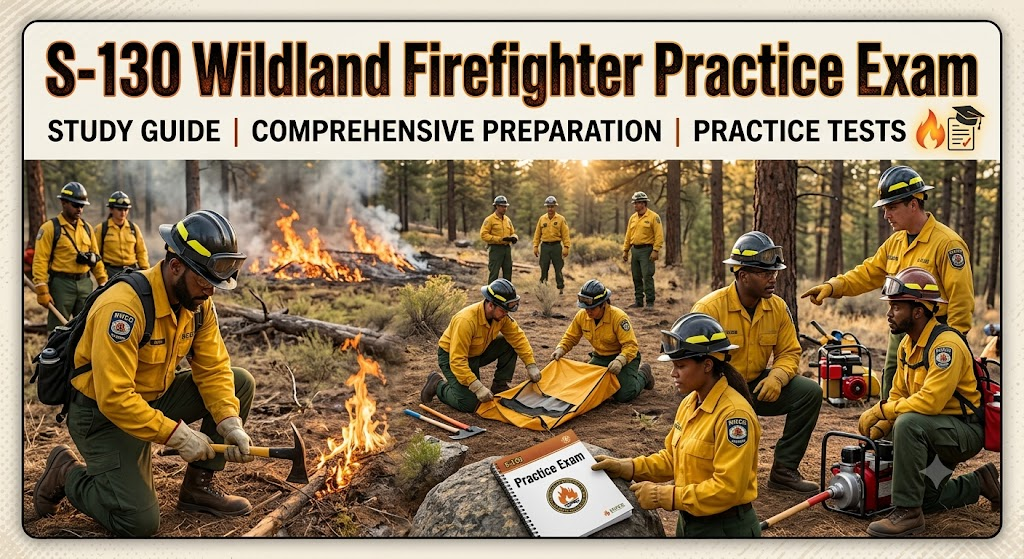
Additional Information
What the Course Entails and Exam Details
This intensive course covers a blend of critical classroom knowledge and vital hands-on skills through both lecture and mandatory field exercises. Core topics and skills you will master include:
Wildland Fire Safety: Mastering LCES (Lookouts, Communications, Escape Routes, Safety Zones), understanding the 10 Standard Firefighting Orders, and recognizing the 18 Watchout Situations.
Terminology: Learning the language of wildland firefighting to ensure clear communication.
Wildland Fire Behavior: (Often reinforced in the companion S-190 course) – understanding how fuel, weather, and topography influence fire spread.
Suppression Techniques: Fireline construction (hand lines, wet lines), mop-up operations, and water use.
Tools and Equipment: Safe and effective operation of various hand tools, pumps, and water handling equipment.
Firing Devices: Introduction to different types of devices used for ignition.
Communications: Proper radio use and communication protocols.
Fire Shelters: Critical deployment and use of a fire shelter.
Risk Management and Decision Making: Applying leadership principles and making sound tactical decisions on the fireline.
The culminating assessment is not typically a single national standardized exam like for some professional certifications. Instead, it involves two key components:
Written Examination: A comprehensive test, often combined with the S-190 material, evaluating your understanding of wildland firefighting principles, safety rules, terminology, and tactics.
Practical Skills Assessment: A mandatory, in-person field day evaluation where instructors assess your ability to properly apply the skills you've learned. This includes demonstrating proficiency in fireline construction, tool use, and fire shelter deployment. A passing score, usually around 70%, on the written exam, combined with successful practical evaluation, is required. Candidates also typically need to pass the physical Work Capacity Test ("Pack Test") for full FFT2 certification.
What to Expect in the Final Assessment
Your final assessment for S-130 is designed to test both your theoretical understanding and your practical readiness for fireline duties.
Written Assessment:
Format: Typically multiple-choice, true/false, or matching questions.
Content: Expect questions covering all major course topics, emphasizing safety rules (10 and 18), LCES, terminology, fireline construction, and communications.
Passing Score: Often requires a minimum score of 70% to pass the academic portion.
Time Limits: Are typically determined by the course host/agency and may vary but are usually sufficient for thoughtful responses.
Rules: Standard test-taking rules apply, with an emphasis on individual work. No external resources or discussion are allowed.
Practical Skills Evaluation:
Format: A structured series of practical exercises and problem-solving scenarios in a simulated or controlled fire environment.
Content: You will be required to demonstrate proficiency in various core skills, including:
Properly deploying a fire shelter within specified safety standards.
Constructing a specified length and type of fireline using appropriate tools and techniques.
Safe handling and maintenance of hand tools and pumps.
Clear communication of information and implementation of LCES.
Participation in small team scenarios demonstrating tactical decision-making and teamwork.
Assessment: Instructors will use a standardized checklist or rubric to evaluate your performance for safety, technique, and compliance with standards.
Rules: Safety is paramount; strict adherence to all safety protocols and instructor commands is mandatory. Performance must be individual, and successful completion often hinges on correct execution under observation.
How to Study and Assessment Methods
Preparing effectively is key to succeeding in your S-130 assessment and field evaluation. A practice test, like the one you are preparing for, is an invaluable tool for reinforcing knowledge.
Study Strategies:
Review Course Materials: Thoroughly study the student workbook, instructor handouts, and the crucial Incident Response Pocket Guide (IRPG), which is a key resource for wildland firefighters.
Master Key Concepts: Focus heavily on LCES, the 10 Standard Firefighting Orders, and the 18 Watchout Situations. Memorize them and understand their practical application.
Learn Terminology: Make flashcards or a glossary for wildland firefighting terms. Clear communication is critical.
Practice with Practice Tests: Utilize S-130 practice tests and online quizzes frequently. This not only reinforces knowledge but also helps you become familiar with the type and format of questions you'll encounter on the written exam.
Prepare for Field Day: If possible, practice hand tool techniques and fire shelter deployment before the required field exercise (after receiving initial instruction). Visualize yourself safely and efficiently executing these tasks. Ensure your physical fitness meets the arduous nature of the training and thePack Test requirements.
Participate Actively: Engage fully in all classroom and field activities, ask questions, and seek feedback from instructors. Practical experience is highly valued.
Assessment Methods and Centers:
Online Portals & Learning Management Systems: The classroom portion of S-130 is increasingly offered through online learning portals (e.g., NWCG's training system, state forestry platforms) and completed asynchronously. The written test might also be delivered and proctored online for some agencies or integrated within the course delivery.
Authorized Training Providers: Various entities offer NWCG-compliant S-130 courses, including:
Federal agencies (e.g., US Forest Service, National Park Service, Bureau of Land Management) for their employees and seasonal hires.
State forestry/wildfire agencies.
Local fire departments with wildland responsibilities.
State fire training academies and authorized training institutions.
Interagency fire academies.
Specific Testing/Evaluation Locations: The in-person field day and associated practical assessments are held at designated training grounds, academies, or specific physical locations determined by the hosting agency or training organization. These will be specified upon enrollment in a particular course. You must find an authorized provider to take the full S-130 course and assessment. Look for course offerings that include both classroom (or online) and the mandatory field exercises.
Job Opportunities from the Course
A successful S-130 certification opens doors to exciting and challenging career paths. Here are specific job titles and directions unlocked by this foundational training:
Wildland Firefighter Type 2 (FFT2): The primary entry-level position for crew members and general fireline duties.
Crew Member: Working on hand crews or engine crews in various suppression and prevention capacities.
Engine Crewmember: Utilizing a fire engine for wildland fire suppression and prescribed burns.
Forestry Technician/Aid (Fire): Common job title for wildfire-related roles within federal and state natural resource agencies.
Prescribed Burn Crew Member: Participating in planned, beneficial fires.
Helitack Crew Member: Working as part of a helicopter-based initial attack and support team.
Initial Attack Crew: Rapid response teams typically dispatched to small fires.
Firefighter (with wildland responsibilities): Structure fire positions in areas prone to wildland fires often require this additional training.
Wildfire Prevention Specialist (Entry-level): Focusing on public education, fuel management, and mitigation.
Seasonal Firefighter: Numerous opportunities, especially in federal agencies during peak fire seasons.
Career opportunities with federal agencies like the US Forest Service, National Park Service, BLM, US Fish and Wildlife Service, state forestry departments, and private contracted wildfire companies. Continuing education can lead to roles like Firefighter Type 1, Crew Boss, Engine Boss, and various specialist or leadership positions.
Remember, the S-130 is not just about passing a test; it's about gaining the vital skills and commitment to safety that could save your life and the lives of your crewmates on the fireline. Approach your studies and practice with dedication, and look forward to the rewarding challenges that await you in the field of wildland firefighting!
Frequently Asked Questions
Reviews
5.0
Based on 0 reviews
Leave a Review
No reviews yet. Be the first to review!