
Wildland TB 190 – Brush Tools and Handline Construction Practice Test
$69.00
- Buy to unlock unlimited access to all Quiz questions and Answers in this Quiz.
- After purchase you can print a PDF of the whole quiz at any point. The PDF will contain the questions and the correct answers.
About this Exam
The Wildland TB 190 – Brush Tools and Handline Construction certification is a critical credential for aspiring wildland firefighters. This specialized course is designed to equip entry-level personnel, or those looking to refresh their practical skills, with the essential technical knowledge and hands-on proficiency required to safely operate hand tools and construct effective firelines in complex wildland environments.
A fundamental component for qualifying as a Wildland Firefighter Type 2 (FFT2), this certification focuses on the physical and technical demands of direct and indirect fire suppression. It ensures that every firefighter on the line can execute basic tactics, maintain their equipment, and, most importantly, work safely within a crew structure. It is typically a mandatory prerequisite for any fieldwork on state or federal wildland incidents.
Ready to test your knowledge?
Buy Now to Access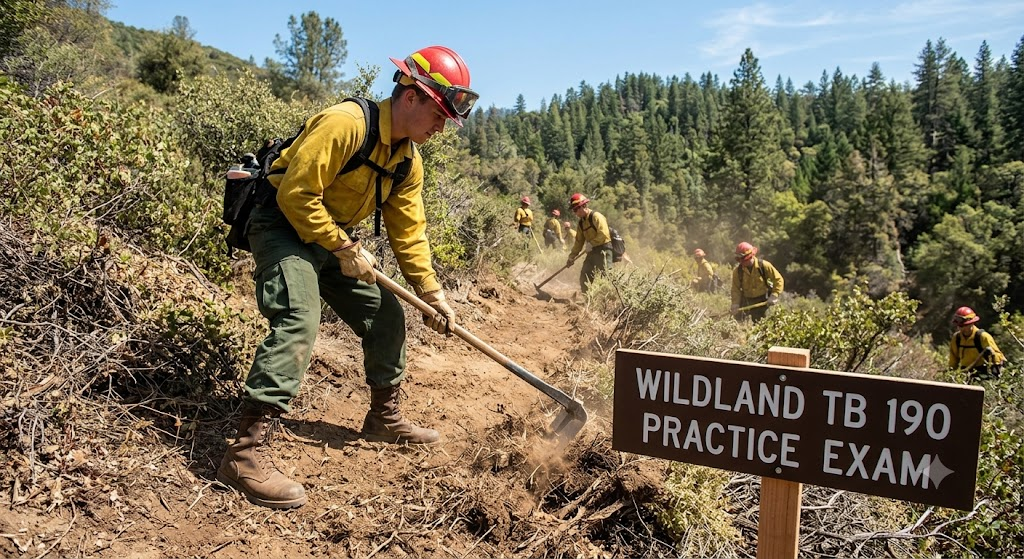
Additional Information
What the Course Entails and Exam Details
This comprehensive course provides in-depth instruction across several core areas. The primary syllabus covers:
Tool Identification and Classification: Correct identification of common wildland hand tools, including cutting tools (Pulaski, axe, brush hook), scraping tools (McLeod, shovel, fire rake, combination tool), and specialized equipment.
Safety Protocols and Procedures: Rigorous training on proper carrying methods (balance point, downhill side), passing techniques (handle first, signaling), maintaining safe spacing (typically 10 feet), and identifying unsafe tool conditions.
Tool Maintenance and Field Repair: Demonstration of field sharpening, handle replacement, and procedures for tagging tools out of service.
Handline Construction Methodology: Detailed instruction on the purpose, location, and construction of different types of fireline, including:
Direct Line: Construction immediately adjacent to the fire's edge.
Parallel Line: Constructed a short distance from the fire, allowing for burnout.
Indirect Line: Located far from the fire’s edge, utilizing natural barriers.
Progressive Line: Continuous construction by a crew, rather than assigned sections.
Dynamic Line: A adaptable line that changes with fire behavior.
What to Expect in the Final Exam
The final certification for Wildland TB 190 is overwhelmingly a practical, hands-on evaluation, often following a multiple-choice written test (or "Knowledge Check"). You should prepare for a multi-station field exam.
Written/Theory Section: Expect a written test containing approximately 25-50 questions covering tool identification, safety rules, and line construction theory. A passing score is typically 70% to 80%.
Practical Field Evaluation: This is the core of the certification. You will be required to perform several tasks under the direct supervision of an evaluator. This includes:
Tool Maintenance: Demonstrate the proper technique for field-sharpening a specific tool (e.g., McLeod or Pulaski) and identify tool defects.
Safety and Movement: Show how to safely carry, pass, and store a set of tools while navigating diverse terrain.
Handline Construction: You will be assigned a section of line to construct, usually within a team or as an individual. Evaluators will judge the line based on:
Width: Must meet the specified standard for the fuel type.
Depth: Must be dug to bare mineral soil, removing all organic matter ("duff").
Placement: Must be located according to instruction and natural features.
Time Limit: Practical tasks are timed, simulating the urgency of real fire incidents.
Crew Spacing: Maintain appropriate distance from other firefighters.
How to Study and Exam Centers
Effective preparation is essential for success in this demanding practical exam. Actionable study methods include:
Master the Manuals: Review the National Wildfire Coordinating Group (NWCG) S-130 Unit 8 ("Tools and Equipment") and S-190 material, especially the "Incident Response Pocket Guide" (IRPG, PMS 461).
Visual Learning: Watch approved training videos demonstrating correct tool usage and line construction techniques.
Physical Conditioning: Handline construction is grueling. Incorporate physical training that builds core, upper body, and grip strength.
Practical Application (Critical): Nothing replaces hands-on practice. If possible, volunteer for local brush-clearing projects, join a volunteer fire department, or participate in authorized pre-exam practical workshops where you can dig actual line under guidance.
Where to Take the Exam
The Wildland TB 190 exam is not typically administered at generalized testing centers (like Pearson VUE). Instead, you will take it through authorized agencies. Common locations include:
Local and State Fire Departments: Many departments host their own wildland training.
State Forestry or Natural Resource Agencies: Organizations like the California Department of Forestry and Fire Protection (CAL FIRE) or the Ohio DNR offer certifications.
Federal Agencies: Training centers run by the US Forest Service (USFS) or Bureau of Land Management (BLM).
Community Colleges: Institutions with established Fire Science or Natural Areas Management programs.
Specialized Wildland Training Academies.
Job Opportunities from the Course
Successfully earning the Wildland TB 190 certification is a key step that opens the door to numerous career paths within the wildland firefighting and natural resource sectors. Specific job titles this credential unlocks include:
Wildland Firefighter (Entry-Level / Type 2)
Forestry Technician
Handcrew Member
Engine Crew Member
Fuels Technician
Prescribed Fire Crew Member
Wildland Fire Module Member
Conservation Corps Member (Wildland Fire Focus)
Frequently Asked Questions
Reviews
5.0
Based on 0 reviews
Leave a Review
No reviews yet. Be the first to review!